



The distance between the orthocentre and circumcentre of a triangle with vertices \[(1,0),\left( \dfrac{-1}{2},\dfrac{\sqrt{3}}{2} \right),\left( \dfrac{-1}{2},\dfrac{-\sqrt{3}}{2} \right)\] is
A) \[\dfrac{1}{2}\]
B) \[\dfrac{\sqrt{3}}{2}\]
C) \[\dfrac{1}{3}\]
D) \[0\]
Answer
 Verified
646.2k+ views
Hint: If the lengths of all three sides of a triangle are equal, then the triangle is equilateral. For such triangles, the centroid, orthocentre, and the circumcentre coincide with each other.
Complete step-by-step answer:
Consider the given vertices to be \[P(1,0),Q\left( \dfrac{-1}{2},\dfrac{\sqrt{3}}{2} \right)\] and \[R\left( \dfrac{-1}{2},\dfrac{-\sqrt{3}}{2} \right)\] .
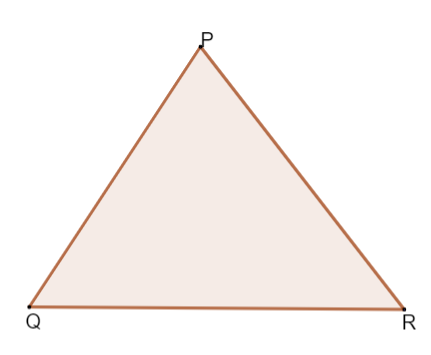
First, we will find the length of the sides of the triangle.
We know, the distance between two points \[\left( {{a}_{1}},{{b}_{1}} \right)\] and \[\left( {{a}_{2}},{{b}_{2}} \right)\] is given as
\[\sqrt{{{\left( {{a}_{1}}-{{a}_{2}} \right)}^{2}}+{{\left( {{b}_{1}}-{{b}_{2}} \right)}^{2}}}\]
So, the length of the side \[PQ\] is given as \[PQ=\sqrt{{{\left( 1-\left( \dfrac{-1}{2} \right) \right)}^{2}}+{{\left( 0-\dfrac{\sqrt{3}}{2} \right)}^{2}}}\] .
\[\begin{align}
& =\sqrt{{{\left( \dfrac{3}{2} \right)}^{2}}+\dfrac{3}{4}} \\
& =\sqrt{\dfrac{9}{4}+\dfrac{3}{4}}=\sqrt{\dfrac{12}{4}} \\
& =\sqrt{3} \\
\end{align}\]
And, the length of the side \[QR\] is given as \[QR=\sqrt{{{\left( \dfrac{-1}{2}+\dfrac{1}{2} \right)}^{2}}+{{\left( \dfrac{\sqrt{3}}{2}-\left( -\dfrac{\sqrt{3}}{2} \right) \right)}^{2}}}\] .
\[\begin{align}
& =\sqrt{0+3} \\
& =\sqrt{3} \\
\end{align}\]
And, the length of the side \[PR\] is given as \[PR=\sqrt{{{\left( 1-\left( \dfrac{-1}{2} \right) \right)}^{2}}+{{\left( 0-\left( -\dfrac{\sqrt{3}}{2} \right) \right)}^{2}}}\] .
\[\begin{align}
& =\sqrt{{{\left( \dfrac{3}{2} \right)}^{2}}+\dfrac{3}{4}} \\
& =\sqrt{\dfrac{9}{4}+\dfrac{3}{4}}=\sqrt{\dfrac{12}{4}}=\sqrt{3} \\
\end{align}\]
Clearly, we can see \[PQ=QR=PR\] , i.e. the length of the sides of the triangle are equal. Hence, the triangle is equilateral.
Now, we know, in an equilateral triangle, the centroid, the circumcentre, and the orthocentre coincide.
Hence, the distance between the circumcentre and the orthocentre is equal to \[0\] units.
Note: We know coordinates \[\left( x,y \right)\] can be expressed in polar form as \[x=r\cos \theta \And y=r\sin \theta \] where \[r=\sqrt{{{x}^{2}}+{{y}^{2}}}\] and \[\theta \] is the angle made by the line joining \[\left( x,y \right)\] and the origin \[O\left( 0,0 \right)\] with the \[x\] -axis.
So, \[P\text{ }\left( 1,0 \right)\] can be written as \[P\left( \cos 0,\sin 0 \right)\] .
\[Q\left( \dfrac{-1}{2},\dfrac{\sqrt{3}}{2} \right)\] can be written as \[Q\left( \cos \dfrac{2\pi }{3},\sin \dfrac{2\pi }{3} \right)\] .
\[R\left( \dfrac{-1}{2},\dfrac{-\sqrt{3}}{2} \right)\] can be written as \[R\left( \cos \dfrac{4\pi }{3},\sin \dfrac{4\pi }{3} \right)\] .
So, clearly \[OP\] is inclined with the \[x\] -axis at \[{{0}^{\circ }}\] .
\[OQ\] is inclined with \[x\] -axis at \[{{120}^{\circ }}\] and \[OR\] is inclined with \[x\] -axis at \[{{240}^{\circ }}\] (or \[-{{120}^{\circ }}\]).

So, \[PR\] is inclined with \[PQ\] at \[{{60}^{\circ }}\], and with \[QR\]at \[{{60}^{\circ }}\].
So, \[\Delta PQR\] is equilateral.
Now, we know, in an equilateral triangle, the centroid, the circumcentre, and the orthocentre coincide.
Hence, the circumcentre and the orthocentre will coincide and the distance between the circumcentre and the orthocentre is equal to \[0\] units.
Complete step-by-step answer:
Consider the given vertices to be \[P(1,0),Q\left( \dfrac{-1}{2},\dfrac{\sqrt{3}}{2} \right)\] and \[R\left( \dfrac{-1}{2},\dfrac{-\sqrt{3}}{2} \right)\] .
First, we will find the length of the sides of the triangle.
We know, the distance between two points \[\left( {{a}_{1}},{{b}_{1}} \right)\] and \[\left( {{a}_{2}},{{b}_{2}} \right)\] is given as
\[\sqrt{{{\left( {{a}_{1}}-{{a}_{2}} \right)}^{2}}+{{\left( {{b}_{1}}-{{b}_{2}} \right)}^{2}}}\]
So, the length of the side \[PQ\] is given as \[PQ=\sqrt{{{\left( 1-\left( \dfrac{-1}{2} \right) \right)}^{2}}+{{\left( 0-\dfrac{\sqrt{3}}{2} \right)}^{2}}}\] .
\[\begin{align}
& =\sqrt{{{\left( \dfrac{3}{2} \right)}^{2}}+\dfrac{3}{4}} \\
& =\sqrt{\dfrac{9}{4}+\dfrac{3}{4}}=\sqrt{\dfrac{12}{4}} \\
& =\sqrt{3} \\
\end{align}\]
And, the length of the side \[QR\] is given as \[QR=\sqrt{{{\left( \dfrac{-1}{2}+\dfrac{1}{2} \right)}^{2}}+{{\left( \dfrac{\sqrt{3}}{2}-\left( -\dfrac{\sqrt{3}}{2} \right) \right)}^{2}}}\] .
\[\begin{align}
& =\sqrt{0+3} \\
& =\sqrt{3} \\
\end{align}\]
And, the length of the side \[PR\] is given as \[PR=\sqrt{{{\left( 1-\left( \dfrac{-1}{2} \right) \right)}^{2}}+{{\left( 0-\left( -\dfrac{\sqrt{3}}{2} \right) \right)}^{2}}}\] .
\[\begin{align}
& =\sqrt{{{\left( \dfrac{3}{2} \right)}^{2}}+\dfrac{3}{4}} \\
& =\sqrt{\dfrac{9}{4}+\dfrac{3}{4}}=\sqrt{\dfrac{12}{4}}=\sqrt{3} \\
\end{align}\]
Clearly, we can see \[PQ=QR=PR\] , i.e. the length of the sides of the triangle are equal. Hence, the triangle is equilateral.
Now, we know, in an equilateral triangle, the centroid, the circumcentre, and the orthocentre coincide.
Hence, the distance between the circumcentre and the orthocentre is equal to \[0\] units.
Note: We know coordinates \[\left( x,y \right)\] can be expressed in polar form as \[x=r\cos \theta \And y=r\sin \theta \] where \[r=\sqrt{{{x}^{2}}+{{y}^{2}}}\] and \[\theta \] is the angle made by the line joining \[\left( x,y \right)\] and the origin \[O\left( 0,0 \right)\] with the \[x\] -axis.
So, \[P\text{ }\left( 1,0 \right)\] can be written as \[P\left( \cos 0,\sin 0 \right)\] .
\[Q\left( \dfrac{-1}{2},\dfrac{\sqrt{3}}{2} \right)\] can be written as \[Q\left( \cos \dfrac{2\pi }{3},\sin \dfrac{2\pi }{3} \right)\] .
\[R\left( \dfrac{-1}{2},\dfrac{-\sqrt{3}}{2} \right)\] can be written as \[R\left( \cos \dfrac{4\pi }{3},\sin \dfrac{4\pi }{3} \right)\] .
So, clearly \[OP\] is inclined with the \[x\] -axis at \[{{0}^{\circ }}\] .
\[OQ\] is inclined with \[x\] -axis at \[{{120}^{\circ }}\] and \[OR\] is inclined with \[x\] -axis at \[{{240}^{\circ }}\] (or \[-{{120}^{\circ }}\]).
So, \[PR\] is inclined with \[PQ\] at \[{{60}^{\circ }}\], and with \[QR\]at \[{{60}^{\circ }}\].
So, \[\Delta PQR\] is equilateral.
Now, we know, in an equilateral triangle, the centroid, the circumcentre, and the orthocentre coincide.
Hence, the circumcentre and the orthocentre will coincide and the distance between the circumcentre and the orthocentre is equal to \[0\] units.
Recently Updated Pages
Master Class 12 Economics: Engaging Questions & Answers for Success

Master Class 12 English: Engaging Questions & Answers for Success
Master Class 12 Social Science: Engaging Questions & Answers for Success
Master Class 12 Maths: Engaging Questions & Answers for Success
Master Class 12 Physics: Engaging Questions & Answers for Success
Master Class 11 Social Science: Engaging Questions & Answers for Success
Trending doubts
One Metric ton is equal to kg A 10000 B 1000 C 100 class 11 physics CBSE
Difference Between Prokaryotic Cells and Eukaryotic Cells
Two of the body parts which do not appear in MRI are class 11 biology CBSE
1 ton equals to A 100 kg B 1000 kg C 10 kg D 10000 class 11 physics CBSE
Draw a diagram of nephron and explain its structur class 11 biology CBSE
10 examples of friction in our daily life