




The distance between the circumcentre and orthocentre of a triangle \[ABC\] is
(a) \[R\sqrt{1-8\cos A\cos B\cos C}\]
(b) \[2R\sqrt{1-4\cos A\cos B\cos C}\]
(c) \[R\sqrt{1-8\sin A\sin B\sin C}\]
(d) \[2R\sqrt{1-4\sin A\sin B\sin C}\]
Answer
 Verified
625.2k+ views
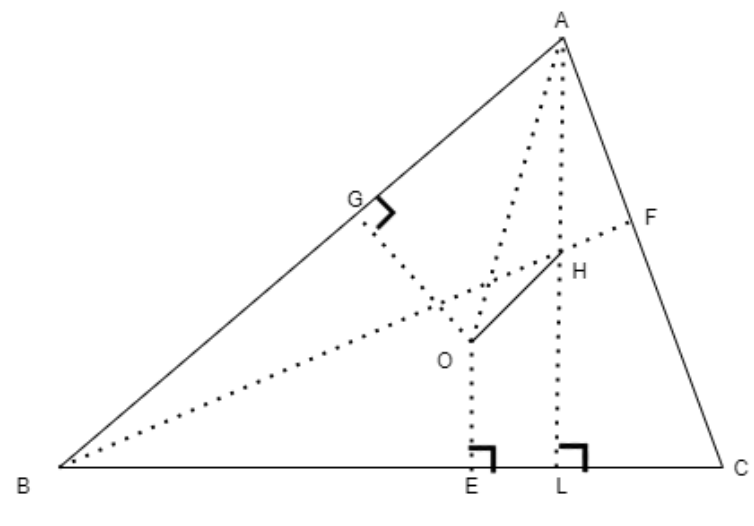
Hint: We solve this problem by using the properties of triangles and some simple geometry. For a triangle let us assume that the orthocentre and the circumcentre as ‘H’ and ‘O’ respectively. The orthocentre and circumcentre are as shown in the figure.
Complete step-by-step solution:
We use the cosine rule of a triangle to solve this problem. The cosine rule of the following triangle is given as
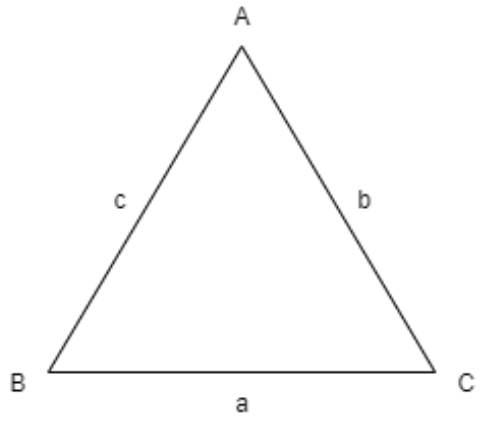
\[\cos A=\dfrac{{{b}^{2}}+{{c}^{2}}-{{a}^{2}}}{2bc}\] Similarly for the other angles.
Let us assume that the circumcentre and orthocentre as ‘O’ and ‘H’ respectively.
Let us consider the triangle \[\Delta OAG\]
Here, by using the result that is sum of all angles in a triangle is \[{{180}^{\circ }}\] we can take the angle \[\angle OAG\] as
\[\begin{align}
& \Rightarrow \angle AOG+\angle OAG+{{90}^{\circ }}={{180}^{\circ }} \\
& \Rightarrow \angle OAG={{90}^{\circ }}-\angle AOG.......equation(i) \\
\end{align}\]
From the definition of orthocentre we know that the angle formed by a vertex and a side passing through that vertex is equal to angle at opposite vertex of that side that is
\[\Rightarrow \angle AOG=\angle C\]
By substituting the above angle in equation (i) we get
\[\Rightarrow \angle OAG={{90}^{\circ }}-\angle C\]
Now, let us consider the triangle \[\Delta ALC\]
Here, we can take the angle \[\angle LAC\] as
\[\Rightarrow \angle LAC={{90}^{\circ }}-\angle C\]
Here, we can see that the points ‘L’ and ‘H’ are on the same line. So, we can take
\[\Rightarrow \angle HAC={{90}^{0}}-\angle C\]
Now let us consider the triangle \[\Delta OAH\] we can take the angle \[\angle OAH\] as
\[\Rightarrow \angle OAH=\angle A-\left( \angle OAG+\angle HAC \right)\]
By substituting the required angles in above equation we get
\[\begin{align}
& \Rightarrow \angle OAH=\angle A-\left( {{180}^{\circ }}-2\angle C \right) \\
& \Rightarrow \angle OAH=\angle A+2\angle C-{{180}^{0}}........equation(ii) \\
\end{align}\]
We know that the sum of angles of a triangle is equal to \[{{180}^{0}}\] that is
\[\Rightarrow \angle A+\angle B+\angle C={{180}^{\circ }}\]
Now, by substituting the above formula to equation (ii) we get
\[\begin{align}
& \Rightarrow \angle OAH=\angle A+2\angle C-\left( \angle A+\angle B+\angle C \right) \\
& \Rightarrow \angle OAH=\angle C-\angle B \\
\end{align}\]
Let us assume that the circum radius of the triangle as \['R'\].
Now, we know that, form the definition of circumradius we have
\[\Rightarrow OA=R\]
We know that the distance between orthocentre and a vertex is equal to \['2R'\] times the cosine of the angle at that vertex that is
\[\Rightarrow HA=2R\cos A\]
Now let us consider the triangle \[\Delta OAH\]
We know that the cosine rule of a triangle is given a
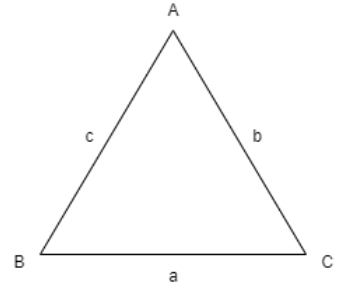
\[\cos A=\dfrac{{{b}^{2}}+{{c}^{2}}-{{a}^{2}}}{2bc}\] Similarly for the other angles.
By using the cosine rule to triangle \[\Delta OAH\] we get
\[\cos \left( \angle OAH \right)=\dfrac{O{{A}^{2}}+H{{A}^{2}}-O{{H}^{2}}}{2.OA.AH}\]
Now, by substituting the required values in the above equation we get
\[\Rightarrow \cos \left( C-B \right)=\dfrac{{{R}^{2}}+{{\left( 2R\cos A \right)}^{2}}-O{{H}^{2}}}{2R\left( 2R\cos A \right)}\]
By cross multiplying we get
\[\begin{align}
& \Rightarrow 4{{R}^{2}}\cos A\cos \left( C-B \right)={{R}^{2}}+4{{R}^{2}}{{\cos }^{2}}A-O{{H}^{2}} \\
& \Rightarrow O{{H}^{2}}={{R}^{2}}+4{{R}^{2}}\cos A\left( \cos A-\cos \left( C-B \right) \right)........equation(iv) \\
\end{align}\]
We know that the sum of angles of a triangle is equal to \[{{180}^{0}}\] that is
\[\begin{align}
& \Rightarrow \angle A+\angle B+\angle C={{180}^{0}} \\
& \Rightarrow \angle B+\angle C={{180}^{0}}-\angle A \\
& \Rightarrow \cos \left( B+C \right)=-\cos A \\
\end{align}\]
By substituting the above formula in equation (iv) we get
\[\Rightarrow O{{H}^{2}}={{R}^{2}}-4{{R}^{2}}\cos A\left( \cos \left( B+C \right)+\cos \left( B-C \right) \right)\]
We know that the formula of sum of composite angles as
\[\cos \left( A+B \right)+\cos \left( A-B \right)=2\cos A\cos B\]
By using this formula in above equation we get
\[\begin{align}
& \Rightarrow O{{H}^{2}}={{R}^{2}}-4{{R}^{2}}\cos A\left( 2\cos B\cos C \right) \\
& \Rightarrow O{{H}^{2}}={{R}^{2}}\left( 1-8\cos A\cos B\cos C \right) \\
& \Rightarrow OH=R\sqrt{1-8\cos A\cos B\cos C} \\
\end{align}\]
Therefore, we can say that the distance between the orthocentre and circumcentre is given as \[R\sqrt{1-8\cos A\cos B\cos C}\]
So, option (a) is the correct answer.
Note: Students may make mistakes in remembering the formulas we used in this problem. There are a lot of standard results we used in this question. The list of formulas we used in this question are given as
(i) cosine rule
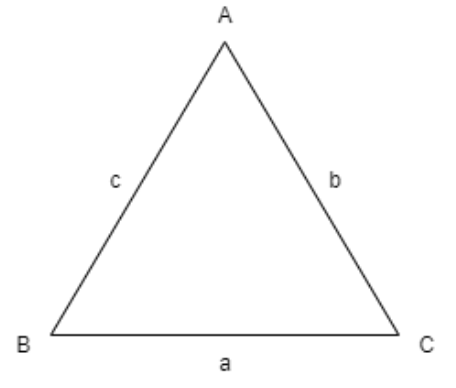
\[\cos A=\dfrac{{{b}^{2}}+{{c}^{2}}-{{a}^{2}}}{2bc}\]
(ii) The sum of angles of a triangle is equal to \[{{180}^{0}}\] that is
\[\Rightarrow \angle A+\angle B+\angle C={{180}^{0}}\]
(iii) Sum of composite angles as
\[\cos \left( A+B \right)+\cos \left( A-B \right)=2\cos A\cos B\]
Remembering these formulas is important in this problem.
Complete step-by-step solution:
We use the cosine rule of a triangle to solve this problem. The cosine rule of the following triangle is given as
\[\cos A=\dfrac{{{b}^{2}}+{{c}^{2}}-{{a}^{2}}}{2bc}\] Similarly for the other angles.
Let us assume that the circumcentre and orthocentre as ‘O’ and ‘H’ respectively.
Let us consider the triangle \[\Delta OAG\]
Here, by using the result that is sum of all angles in a triangle is \[{{180}^{\circ }}\] we can take the angle \[\angle OAG\] as
\[\begin{align}
& \Rightarrow \angle AOG+\angle OAG+{{90}^{\circ }}={{180}^{\circ }} \\
& \Rightarrow \angle OAG={{90}^{\circ }}-\angle AOG.......equation(i) \\
\end{align}\]
From the definition of orthocentre we know that the angle formed by a vertex and a side passing through that vertex is equal to angle at opposite vertex of that side that is
\[\Rightarrow \angle AOG=\angle C\]
By substituting the above angle in equation (i) we get
\[\Rightarrow \angle OAG={{90}^{\circ }}-\angle C\]
Now, let us consider the triangle \[\Delta ALC\]
Here, we can take the angle \[\angle LAC\] as
\[\Rightarrow \angle LAC={{90}^{\circ }}-\angle C\]
Here, we can see that the points ‘L’ and ‘H’ are on the same line. So, we can take
\[\Rightarrow \angle HAC={{90}^{0}}-\angle C\]
Now let us consider the triangle \[\Delta OAH\] we can take the angle \[\angle OAH\] as
\[\Rightarrow \angle OAH=\angle A-\left( \angle OAG+\angle HAC \right)\]
By substituting the required angles in above equation we get
\[\begin{align}
& \Rightarrow \angle OAH=\angle A-\left( {{180}^{\circ }}-2\angle C \right) \\
& \Rightarrow \angle OAH=\angle A+2\angle C-{{180}^{0}}........equation(ii) \\
\end{align}\]
We know that the sum of angles of a triangle is equal to \[{{180}^{0}}\] that is
\[\Rightarrow \angle A+\angle B+\angle C={{180}^{\circ }}\]
Now, by substituting the above formula to equation (ii) we get
\[\begin{align}
& \Rightarrow \angle OAH=\angle A+2\angle C-\left( \angle A+\angle B+\angle C \right) \\
& \Rightarrow \angle OAH=\angle C-\angle B \\
\end{align}\]
Let us assume that the circum radius of the triangle as \['R'\].
Now, we know that, form the definition of circumradius we have
\[\Rightarrow OA=R\]
We know that the distance between orthocentre and a vertex is equal to \['2R'\] times the cosine of the angle at that vertex that is
\[\Rightarrow HA=2R\cos A\]
Now let us consider the triangle \[\Delta OAH\]
We know that the cosine rule of a triangle is given a
\[\cos A=\dfrac{{{b}^{2}}+{{c}^{2}}-{{a}^{2}}}{2bc}\] Similarly for the other angles.
By using the cosine rule to triangle \[\Delta OAH\] we get
\[\cos \left( \angle OAH \right)=\dfrac{O{{A}^{2}}+H{{A}^{2}}-O{{H}^{2}}}{2.OA.AH}\]
Now, by substituting the required values in the above equation we get
\[\Rightarrow \cos \left( C-B \right)=\dfrac{{{R}^{2}}+{{\left( 2R\cos A \right)}^{2}}-O{{H}^{2}}}{2R\left( 2R\cos A \right)}\]
By cross multiplying we get
\[\begin{align}
& \Rightarrow 4{{R}^{2}}\cos A\cos \left( C-B \right)={{R}^{2}}+4{{R}^{2}}{{\cos }^{2}}A-O{{H}^{2}} \\
& \Rightarrow O{{H}^{2}}={{R}^{2}}+4{{R}^{2}}\cos A\left( \cos A-\cos \left( C-B \right) \right)........equation(iv) \\
\end{align}\]
We know that the sum of angles of a triangle is equal to \[{{180}^{0}}\] that is
\[\begin{align}
& \Rightarrow \angle A+\angle B+\angle C={{180}^{0}} \\
& \Rightarrow \angle B+\angle C={{180}^{0}}-\angle A \\
& \Rightarrow \cos \left( B+C \right)=-\cos A \\
\end{align}\]
By substituting the above formula in equation (iv) we get
\[\Rightarrow O{{H}^{2}}={{R}^{2}}-4{{R}^{2}}\cos A\left( \cos \left( B+C \right)+\cos \left( B-C \right) \right)\]
We know that the formula of sum of composite angles as
\[\cos \left( A+B \right)+\cos \left( A-B \right)=2\cos A\cos B\]
By using this formula in above equation we get
\[\begin{align}
& \Rightarrow O{{H}^{2}}={{R}^{2}}-4{{R}^{2}}\cos A\left( 2\cos B\cos C \right) \\
& \Rightarrow O{{H}^{2}}={{R}^{2}}\left( 1-8\cos A\cos B\cos C \right) \\
& \Rightarrow OH=R\sqrt{1-8\cos A\cos B\cos C} \\
\end{align}\]
Therefore, we can say that the distance between the orthocentre and circumcentre is given as \[R\sqrt{1-8\cos A\cos B\cos C}\]
So, option (a) is the correct answer.
Note: Students may make mistakes in remembering the formulas we used in this problem. There are a lot of standard results we used in this question. The list of formulas we used in this question are given as
(i) cosine rule
\[\cos A=\dfrac{{{b}^{2}}+{{c}^{2}}-{{a}^{2}}}{2bc}\]
(ii) The sum of angles of a triangle is equal to \[{{180}^{0}}\] that is
\[\Rightarrow \angle A+\angle B+\angle C={{180}^{0}}\]
(iii) Sum of composite angles as
\[\cos \left( A+B \right)+\cos \left( A-B \right)=2\cos A\cos B\]
Remembering these formulas is important in this problem.
Recently Updated Pages
Master Class 12 Economics: Engaging Questions & Answers for Success

Master Class 12 Biology: Engaging Questions & Answers for Success
Master Class 11 English: Engaging Questions & Answers for Success
Master Class 11 Physics: Engaging Questions & Answers for Success
Master Class 11 Computer Science: Engaging Questions & Answers for Success
Master Class 11 Chemistry: Engaging Questions & Answers for Success
Trending doubts
What is the Total Duration of Football Match?
Explain the Treaty of Vienna of 1815 class 10 social science CBSE
In football, which nation is called "La Roja"?
Why is there a time difference of about 5 hours between class 10 social science CBSE
10 examples of evaporation in daily life with explanations
What is the full form of POSCO class 10 social science CBSE