




The distance between rails of a railway line is 1 m How much should the outer rail be raised relative to the inner one so that the train may cross over turn of 400m with a speed of 20m/s without friction? $g = 10m/{s^2}$
Answer
 Verified
571.8k+ views
Hint: This question can be answered by using newton’s second law. According to Newton's second law for a particular system rate of change of momentum will be equal to the external force acting on the system. Here external force will be responsible for the resulting acceleration of the system
Formula used:
${F_{ext}} = ma$
Complete step by step solution:
According to Newton's second law the unbalanced external force will be responsible for the acceleration of the system. By seeing the diagram below we can interpret important information.
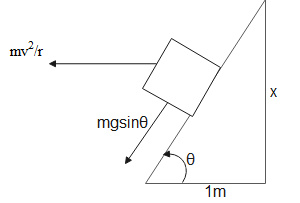
There will be weight of the blocks acting in the downward direction. If we resolve the weight of the blocks into components, we will get one component along the plane and another component perpendicular to the plane. We have the equation ${F_{ext}} = ma$
Along the plane the weight component will be $mg\sin \theta $
When an object is rotating in a circle its direction of velocity keeps on changing. When velocity changes there will be an acceleration and this contributes for the force. Now the force which is responsible for the change in direction in case of circular motion is called a centripetal force.
Centripetal force for mass ‘m’ is given by $\dfrac{{m{v^2}}}{r}$
Component of centripetal force along the plane is $\dfrac{{m{v^2}}}{r}\cos \theta $
We will equate component of weight along the plane with the component of centripetal force along the plane because its weight component will be responsible for centripetal force component.
$\eqalign{
& \dfrac{{m{v^2}}}{r}\cos \theta = mg\sin \theta \cr
& \therefore \tan \theta = \dfrac{{{v^2}}}{{rg}} \cr} $
For the same triangle we have
$\eqalign{
& \dfrac{x}{1} = \tan \theta \cr
& \Rightarrow \dfrac{x}{1} = \dfrac{{{v^2}}}{{rg}} \cr
& \Rightarrow \dfrac{x}{1} = \dfrac{{{{\left( {20} \right)}^2}}}{{400 \times 10}} \cr
& \Rightarrow \dfrac{x}{1} = \dfrac{1}{{10}}m = \dfrac{1}{{10}} \times 100cm \cr
& \therefore x = 10cm \cr} $
So the rails should be raised 10 centimeter so that the train can move at a given speed without friction.
Note:
If there is friction between the slope and train, then we will get a different angle. The angle theta to which elevation is created is called banking angle and it is created so that the required centripetal force will be given by the weight of the body i.e components of weight of the body.
Formula used:
${F_{ext}} = ma$
Complete step by step solution:
According to Newton's second law the unbalanced external force will be responsible for the acceleration of the system. By seeing the diagram below we can interpret important information.
There will be weight of the blocks acting in the downward direction. If we resolve the weight of the blocks into components, we will get one component along the plane and another component perpendicular to the plane. We have the equation ${F_{ext}} = ma$
Along the plane the weight component will be $mg\sin \theta $
When an object is rotating in a circle its direction of velocity keeps on changing. When velocity changes there will be an acceleration and this contributes for the force. Now the force which is responsible for the change in direction in case of circular motion is called a centripetal force.
Centripetal force for mass ‘m’ is given by $\dfrac{{m{v^2}}}{r}$
Component of centripetal force along the plane is $\dfrac{{m{v^2}}}{r}\cos \theta $
We will equate component of weight along the plane with the component of centripetal force along the plane because its weight component will be responsible for centripetal force component.
$\eqalign{
& \dfrac{{m{v^2}}}{r}\cos \theta = mg\sin \theta \cr
& \therefore \tan \theta = \dfrac{{{v^2}}}{{rg}} \cr} $
For the same triangle we have
$\eqalign{
& \dfrac{x}{1} = \tan \theta \cr
& \Rightarrow \dfrac{x}{1} = \dfrac{{{v^2}}}{{rg}} \cr
& \Rightarrow \dfrac{x}{1} = \dfrac{{{{\left( {20} \right)}^2}}}{{400 \times 10}} \cr
& \Rightarrow \dfrac{x}{1} = \dfrac{1}{{10}}m = \dfrac{1}{{10}} \times 100cm \cr
& \therefore x = 10cm \cr} $
So the rails should be raised 10 centimeter so that the train can move at a given speed without friction.
Note:
If there is friction between the slope and train, then we will get a different angle. The angle theta to which elevation is created is called banking angle and it is created so that the required centripetal force will be given by the weight of the body i.e components of weight of the body.
Recently Updated Pages
Master Class 11 Computer Science: Engaging Questions & Answers for Success

Master Class 11 Business Studies: Engaging Questions & Answers for Success
Master Class 11 Economics: Engaging Questions & Answers for Success
Master Class 11 English: Engaging Questions & Answers for Success
Master Class 11 Maths: Engaging Questions & Answers for Success
Master Class 11 Biology: Engaging Questions & Answers for Success
Trending doubts
One Metric ton is equal to kg A 10000 B 1000 C 100 class 11 physics CBSE
There are 720 permutations of the digits 1 2 3 4 5 class 11 maths CBSE
Discuss the various forms of bacteria class 11 biology CBSE
Draw a diagram of a plant cell and label at least eight class 11 biology CBSE
State the laws of reflection of light
Explain zero factorial class 11 maths CBSE