




The displacement time graph of 2 particles A and B are straight lines making angles of respectively $30^\circ $ and $60^\circ $ with the time axis. If the velocity of A is ${v_A}$ and that of B is ${v_B}$, then the value of $\dfrac{{{v_A}}}{{{v_B}}}$ is
(A) $\dfrac{1}{2}$
(B) $\dfrac{1}{{\sqrt 3 }}$
(C) $\sqrt 3 $
(D) $\dfrac{1}{3}$
Answer
 Verified
621.9k+ views
Hint: The slope of displacement-time graph represents the velocity.
Slope is given by $ = \dfrac{{{x_2} - {x_1}}}{{{t_2} - {t_1}}}$
$ = \dfrac{{dx}}{{dt}} = v(velocity)$
Slope is $\tan \theta = $ velocity
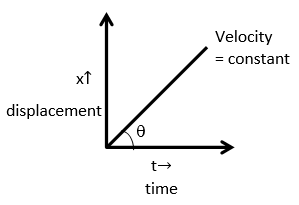
Complete step by step solution:
Velocity of any particle is defined as the ratio of displacement and time and the instantaneous velocity is defined as
$v = \dfrac{{dx}}{{dt}}$
which is also defined as the slope of the x-t curve.
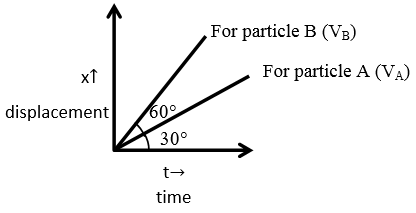
i.e., slope $ = \dfrac{{dx}}{{dt}} = v$ …..(1)
The slope of any curve is defined as
$\tan \theta = $ slope …..(2)
So, from equation (1) & (2)
$v = \tan \theta $
For particle A - ${v_A} = \tan {\theta _A}$
${\theta _A} = 30^\circ $
So, ${v_A} = \tan 30^\circ = \dfrac{1}{{\sqrt 3 }}$ …..(3)
For particle B - ${v_B} = \tan {\theta _B}$
${\theta _B} = 60^\circ $
${v_B} = \tan 60^\circ = \sqrt 3 $ …..(4)
So, from equation (1)/(2)
$\dfrac{{{v_A}}}{{{v_B}}} = \dfrac{1}{{\sqrt 3 }} \times \dfrac{1}{{\sqrt 3 }} = \dfrac{1}{3}$
Hence $\dfrac{{{v_A}}}{{{v_B}}} = \dfrac{1}{3}$
So, option D is correct answer.
Note: Slope of x-t curve represents velocity $v = \dfrac{{dx}}{{dt}}$
Slope of v-t curve represents acceleration $a = \dfrac{{dv}}{{dt}}$
Area under v-t curve represents $\int {vdt = } $displacement
Slope is given by $ = \dfrac{{{x_2} - {x_1}}}{{{t_2} - {t_1}}}$
$ = \dfrac{{dx}}{{dt}} = v(velocity)$
Slope is $\tan \theta = $ velocity
Complete step by step solution:
Velocity of any particle is defined as the ratio of displacement and time and the instantaneous velocity is defined as
$v = \dfrac{{dx}}{{dt}}$
which is also defined as the slope of the x-t curve.
i.e., slope $ = \dfrac{{dx}}{{dt}} = v$ …..(1)
The slope of any curve is defined as
$\tan \theta = $ slope …..(2)
So, from equation (1) & (2)
$v = \tan \theta $
For particle A - ${v_A} = \tan {\theta _A}$
${\theta _A} = 30^\circ $
So, ${v_A} = \tan 30^\circ = \dfrac{1}{{\sqrt 3 }}$ …..(3)
For particle B - ${v_B} = \tan {\theta _B}$
${\theta _B} = 60^\circ $
${v_B} = \tan 60^\circ = \sqrt 3 $ …..(4)
So, from equation (1)/(2)
$\dfrac{{{v_A}}}{{{v_B}}} = \dfrac{1}{{\sqrt 3 }} \times \dfrac{1}{{\sqrt 3 }} = \dfrac{1}{3}$
Hence $\dfrac{{{v_A}}}{{{v_B}}} = \dfrac{1}{3}$
So, option D is correct answer.
Note: Slope of x-t curve represents velocity $v = \dfrac{{dx}}{{dt}}$
Slope of v-t curve represents acceleration $a = \dfrac{{dv}}{{dt}}$
Area under v-t curve represents $\int {vdt = } $displacement
Recently Updated Pages
Master Class 11 English: Engaging Questions & Answers for Success

Master Class 11 Social Science: Engaging Questions & Answers for Success
Master Class 11 Maths: Engaging Questions & Answers for Success
Master Class 11 Chemistry: Engaging Questions & Answers for Success
Master Class 11 Biology: Engaging Questions & Answers for Success
Master Class 11 Physics: Engaging Questions & Answers for Success
Trending doubts
One Metric ton is equal to kg A 10000 B 1000 C 100 class 11 physics CBSE
Difference Between Prokaryotic Cells and Eukaryotic Cells
Find the value of the expression given below sin 30circ class 11 maths CBSE
1 ton equals to A 100 kg B 1000 kg C 10 kg D 10000 class 11 physics CBSE
Two of the body parts which do not appear in MRI are class 11 biology CBSE
Draw a diagram of nephron and explain its structur class 11 biology CBSE