




The displacement of an object attached to a spring and executing simple harmonic motion is given by \[x=2\pi \times {{10}^{-2}}\cos \pi t\text{ meters}\]. The time at which the maximum speed first occur is:
A). 0.5 s
B). 0.75 s
C). 0.125 s
D). 0.25 s
Answer
 Verified
597k+ views
Hint: Simple harmonic motion is a sinusoidal motion executed by an object. Here we have attached this object with a spring. So, it will execute the linear simple harmonic motion. From the displacement equation, we can find out the velocity of the motion.
Formula used: \[v=\dfrac{dx}{dt}\], where v is the velocity and x is the displacement.
Complete step by step answer:
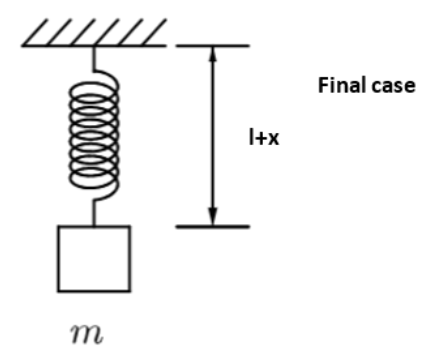
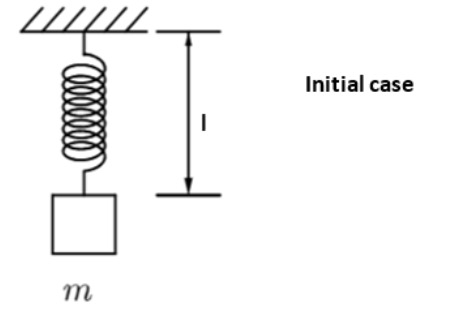
In this question, the displacement of an object attached to the spring is given.
\[x=2\pi \times {{10}^{-2}}\cos \pi t\text{ meters}\]
From this, we can find out the velocity, since the velocity is the rate of change of displacement.
\[v=\dfrac{dx}{dt}\]
\[v=\dfrac{d(2\pi \times {{10}^{-2}}\cos \pi t)}{dt}\]
\[v= -2\pi \times {{10}^{-2}}\pi \sin \pi t\]
\[|v|=2\pi \times {{10}^{-2}}\pi \sin \pi t\]
Here we have to find the time at which the first maximum speed occurs that’s why we consider only magnitude. Since it is a simple harmonic motion, it will occur in repeated motions. We have to find the time for the first maximum speed.
Since it is a sine-based equation, the maxima and minima depend upon that.
The maximum value of the sine is 1. So we can equate \[\sin \pi t\] to 1.
\[\sin \pi t=1\]
This is only possible if \[\sin \pi t=\sin \dfrac{\pi }{2}\]
\[\dfrac{\pi }{2}=\pi t\], or \[t=\dfrac{1}{2}\]
The time required for the first maximum speed is 0.5 seconds. Therefore, the correct answer is option A.
Additional information:
Simple harmonic motion can be defined as the repeating motion with a sinusoidal function of time.
\[x(t)=A\cos (\omega t+\phi )\]
Amplitude is the maximum displacement occurring during the propagation in either direction. The simple harmonic motion will obey Hooke’s law.
\[F=-kx\], where k is the spring constant and x is the displacement.
The period of the simple harmonic motion is the time required to complete one oscillation by an oscillator. So after every period, the motion will get repeated.
Note: During the simple harmonic motion, the velocity will be zero at extreme positions. While the velocity will be maximum at equilibrium positions. Do not think that, \[\sin \pi t=0\] since \[\sin \pi =0\]. The simple harmonic functions are dependent on time. So that, the time (t) has a great impact on that function.
Formula used: \[v=\dfrac{dx}{dt}\], where v is the velocity and x is the displacement.
Complete step by step answer:
In this question, the displacement of an object attached to the spring is given.
\[x=2\pi \times {{10}^{-2}}\cos \pi t\text{ meters}\]
From this, we can find out the velocity, since the velocity is the rate of change of displacement.
\[v=\dfrac{dx}{dt}\]
\[v=\dfrac{d(2\pi \times {{10}^{-2}}\cos \pi t)}{dt}\]
\[v= -2\pi \times {{10}^{-2}}\pi \sin \pi t\]
\[|v|=2\pi \times {{10}^{-2}}\pi \sin \pi t\]
Here we have to find the time at which the first maximum speed occurs that’s why we consider only magnitude. Since it is a simple harmonic motion, it will occur in repeated motions. We have to find the time for the first maximum speed.
Since it is a sine-based equation, the maxima and minima depend upon that.
The maximum value of the sine is 1. So we can equate \[\sin \pi t\] to 1.
\[\sin \pi t=1\]
This is only possible if \[\sin \pi t=\sin \dfrac{\pi }{2}\]
\[\dfrac{\pi }{2}=\pi t\], or \[t=\dfrac{1}{2}\]
The time required for the first maximum speed is 0.5 seconds. Therefore, the correct answer is option A.
Additional information:
Simple harmonic motion can be defined as the repeating motion with a sinusoidal function of time.
\[x(t)=A\cos (\omega t+\phi )\]
Amplitude is the maximum displacement occurring during the propagation in either direction. The simple harmonic motion will obey Hooke’s law.
\[F=-kx\], where k is the spring constant and x is the displacement.
The period of the simple harmonic motion is the time required to complete one oscillation by an oscillator. So after every period, the motion will get repeated.
Note: During the simple harmonic motion, the velocity will be zero at extreme positions. While the velocity will be maximum at equilibrium positions. Do not think that, \[\sin \pi t=0\] since \[\sin \pi =0\]. The simple harmonic functions are dependent on time. So that, the time (t) has a great impact on that function.
Recently Updated Pages
Master Class 11 Computer Science: Engaging Questions & Answers for Success

Master Class 11 Business Studies: Engaging Questions & Answers for Success
Master Class 11 Economics: Engaging Questions & Answers for Success
Master Class 11 English: Engaging Questions & Answers for Success
Master Class 11 Maths: Engaging Questions & Answers for Success
Master Class 11 Biology: Engaging Questions & Answers for Success
Trending doubts
There are 720 permutations of the digits 1 2 3 4 5 class 11 maths CBSE
Discuss the various forms of bacteria class 11 biology CBSE
Explain zero factorial class 11 maths CBSE
What organs are located on the left side of your body class 11 biology CBSE
Draw a diagram of nephron and explain its structur class 11 biology CBSE
How do I convert ms to kmh Give an example class 11 physics CBSE