




The direction of angular momentum vector is given by
A). Right hand rule
B). Left hand rule
C). Dot product rule
D). Vector additive rule
Answer
 Verified
589.5k+ views
Hint: Angular momentum is perpendicular to the distance and the linear momentum, because it is a cross product. Angular momentum is a vector quantity.
Here’s the expression
$\overrightarrow L = \overrightarrow r \times \overrightarrow p $
Complete step by step solution:
First of all the angular momentum,
We consider a particle of mass m is located at the vector position $\overrightarrow r $ moving with linear momentum $\overrightarrow p $
Now,
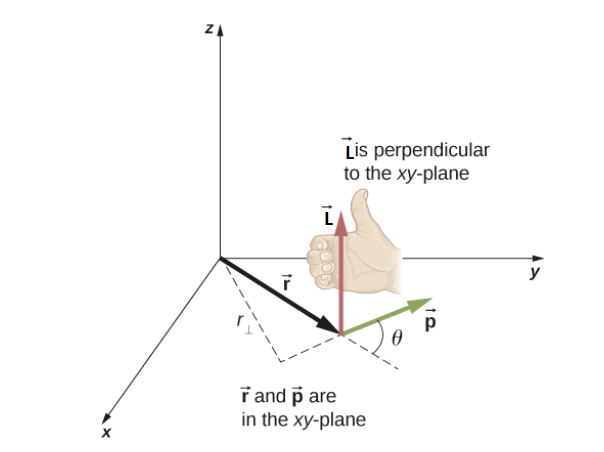
Now, we curl the fingers of our right hand, so the curl in the direction of a point object moves in the direction of angular momentum.
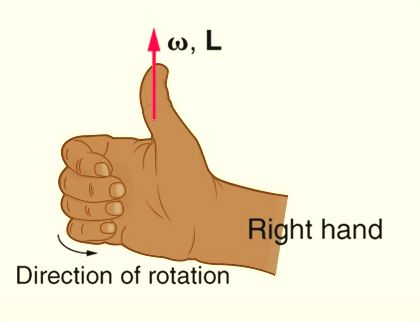
> Curl your fingers in the direction of rotation, your thumb points the direction of the angular momentum.
> In simple terms, the direction of the angular momentum is defined by the direction in which the thumb of the right hand points when you curl your fingers in the direction of rotation.
> Direction of the angular momentum is upward as well as downward.
> When the arm is rotating downward, then the right-hand rule gives the angular momentum and the direction is positive in the z-axis. When the arm is rotating downward, the right-hand rule gives the direction of the angular momentum and the direction is negative in z-direction.
> In positive z-direction it is outward and in negative z-direction it is inward.
Note: The direction can be resolute using the right hand rule, according to this rule, the fingers on your hand curl towards the direction of rotation or force exerted, and your thumb points towards the direction of angular momentum.
Here’s the expression
$\overrightarrow L = \overrightarrow r \times \overrightarrow p $
Complete step by step solution:
First of all the angular momentum,
We consider a particle of mass m is located at the vector position $\overrightarrow r $ moving with linear momentum $\overrightarrow p $
Now,
Now, we curl the fingers of our right hand, so the curl in the direction of a point object moves in the direction of angular momentum.
> Curl your fingers in the direction of rotation, your thumb points the direction of the angular momentum.
> In simple terms, the direction of the angular momentum is defined by the direction in which the thumb of the right hand points when you curl your fingers in the direction of rotation.
> Direction of the angular momentum is upward as well as downward.
> When the arm is rotating downward, then the right-hand rule gives the angular momentum and the direction is positive in the z-axis. When the arm is rotating downward, the right-hand rule gives the direction of the angular momentum and the direction is negative in z-direction.
> In positive z-direction it is outward and in negative z-direction it is inward.
Note: The direction can be resolute using the right hand rule, according to this rule, the fingers on your hand curl towards the direction of rotation or force exerted, and your thumb points towards the direction of angular momentum.
Recently Updated Pages
Master Class 11 English: Engaging Questions & Answers for Success

Master Class 11 Physics: Engaging Questions & Answers for Success
Master Class 11 Computer Science: Engaging Questions & Answers for Success
Master Class 11 Chemistry: Engaging Questions & Answers for Success
Master Class 11 Social Science: Engaging Questions & Answers for Success
Master Class 11 Accountancy: Engaging Questions & Answers for Success
Trending doubts
Difference Between Prokaryotic Cells and Eukaryotic Cells
Two of the body parts which do not appear in MRI are class 11 biology CBSE
One Metric ton is equal to kg A 10000 B 1000 C 100 class 11 physics CBSE
10 examples of friction in our daily life
Draw a diagram of nephron and explain its structur class 11 biology CBSE
Draw a diagram of a plant cell and label at least eight class 11 biology CBSE