




The difference between the radii of the smaller circle and the bigger circle is 7 cm and the difference between the areas of the two circles is 1078 sq cm. What is the radius of the smaller circle in cm?
(a) 28
(b) 21
(c) 17.5
(d) 35
Answer
 Verified
644.4k+ views
Hint: We will assume the radius of the smaller circle as r and the radius of the bigger circle as r+7 because the difference between their radius is 7. Also the difference between their areas is mentioned and for calculating the areas we will use the formula \[\pi {{r}^{2}}\].
Complete step-by-step answer:
It is mentioned in the question that the difference between the radii of the smaller circle and the bigger circle is 7 cm. So let the radius of the smaller circle be r and hence the radius of the bigger circle will be r+7. So the figure is,
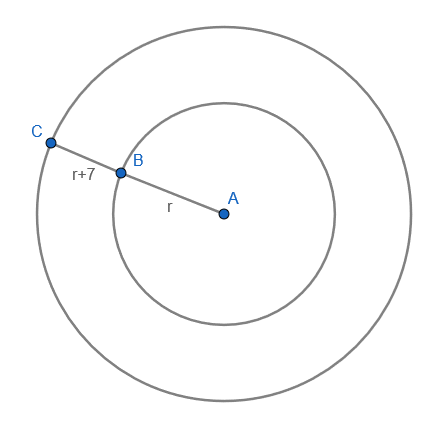
Now, area of the smaller circle \[=\pi {{r}^{2}}......(1)\]
Area of the bigger circle \[=\pi {{(r+7)}^{2}}......(2)\]
Now it is also mentioned in the question that the difference between the areas of the bigger circle and smaller circle is 1078 sq. cm. So using this information we subtract equation (2) and equation (1) and then we equate it to 1078. Doing this we get,
\[\Rightarrow \pi {{(r+7)}^{2}}-\pi {{r}^{2}}=1078........(3)\]
Now first taking common terms out and then expanding the squares in equation (3) we get,
\[\Rightarrow \pi \left[ {{r}^{2}}+49+14r-{{r}^{2}} \right]=1078........(4)\]
Now cancelling similar terms in equation (4) we get,
\[\Rightarrow \pi \left[ 49+14r \right]=1078........(5)\]
Now rearranging and simplifying equation (5) we get,
\[\Rightarrow 49+14r=\dfrac{1078\times 7}{22}........(6)\]
Now solving for r in equation (6) we get,
\[\begin{align}
& \Rightarrow 49+14r=343 \\
& \Rightarrow 14r=294 \\
& \Rightarrow r=\dfrac{294}{14}=21 \\
\end{align}\]
So the radius of the smaller circle is 21 cm. Hence the correct answer is option (b).
Note: Remembering the formula of the area \[\pi {{r}^{2}}\] is the key here. Also when we draw the figure from the given details in the question things become very much clear. We in a hurry can make a mistake in solving equation (3) as we may expand \[{{(r+7)}^{2}}\] incorrectly and hence we need to be careful while doing this calculation.
Complete step-by-step answer:
It is mentioned in the question that the difference between the radii of the smaller circle and the bigger circle is 7 cm. So let the radius of the smaller circle be r and hence the radius of the bigger circle will be r+7. So the figure is,
Now, area of the smaller circle \[=\pi {{r}^{2}}......(1)\]
Area of the bigger circle \[=\pi {{(r+7)}^{2}}......(2)\]
Now it is also mentioned in the question that the difference between the areas of the bigger circle and smaller circle is 1078 sq. cm. So using this information we subtract equation (2) and equation (1) and then we equate it to 1078. Doing this we get,
\[\Rightarrow \pi {{(r+7)}^{2}}-\pi {{r}^{2}}=1078........(3)\]
Now first taking common terms out and then expanding the squares in equation (3) we get,
\[\Rightarrow \pi \left[ {{r}^{2}}+49+14r-{{r}^{2}} \right]=1078........(4)\]
Now cancelling similar terms in equation (4) we get,
\[\Rightarrow \pi \left[ 49+14r \right]=1078........(5)\]
Now rearranging and simplifying equation (5) we get,
\[\Rightarrow 49+14r=\dfrac{1078\times 7}{22}........(6)\]
Now solving for r in equation (6) we get,
\[\begin{align}
& \Rightarrow 49+14r=343 \\
& \Rightarrow 14r=294 \\
& \Rightarrow r=\dfrac{294}{14}=21 \\
\end{align}\]
So the radius of the smaller circle is 21 cm. Hence the correct answer is option (b).
Note: Remembering the formula of the area \[\pi {{r}^{2}}\] is the key here. Also when we draw the figure from the given details in the question things become very much clear. We in a hurry can make a mistake in solving equation (3) as we may expand \[{{(r+7)}^{2}}\] incorrectly and hence we need to be careful while doing this calculation.
Recently Updated Pages
Master Class 11 English: Engaging Questions & Answers for Success

Master Class 11 Social Science: Engaging Questions & Answers for Success
Master Class 11 Maths: Engaging Questions & Answers for Success
Master Class 11 Chemistry: Engaging Questions & Answers for Success
Master Class 11 Biology: Engaging Questions & Answers for Success
Master Class 11 Physics: Engaging Questions & Answers for Success
Trending doubts
Explain the Treaty of Vienna of 1815 class 10 social science CBSE
Why is it 530 pm in india when it is 1200 afternoon class 10 social science CBSE
What is the full form of CNG A Complete Natural Gas class 10 social science CBSE
In cricket, what is a "Yorker" designed to do?
What is the full form of POSCO class 10 social science CBSE
Define Potential, Developed, Stock and Reserved resources