




The difference between the diagonals of a rhombus is 4cm and the area of the rhombus is\[96c{{m}^{2}}\]. Then find the difference between the length of the smaller diagonal and the length of the side of the rhombus. Choose the correct option:
A. 2 cm
B 3 cm
C. 4 cm
D. 6 cm
Answer
 Verified
638.7k+ views
Hint: The diagonals of the rhombus intersect at right angles and also bisects each other. Also, the area of the rhombus is given as \[\dfrac{{{d}_{1}}\times {{d}_{2}}}{2}\]. All the sides of the rhombus are equal.
Complete step by step solution:
In the given question, we have to find the difference between the length of the smaller diagonal and the length of the side of the rhombus. It is given that the difference between the diagonals of a rhombus is 4cm and the area of the rhombus is \[96c{{m}^{2}}\].
So, let the rhombus is as follows:
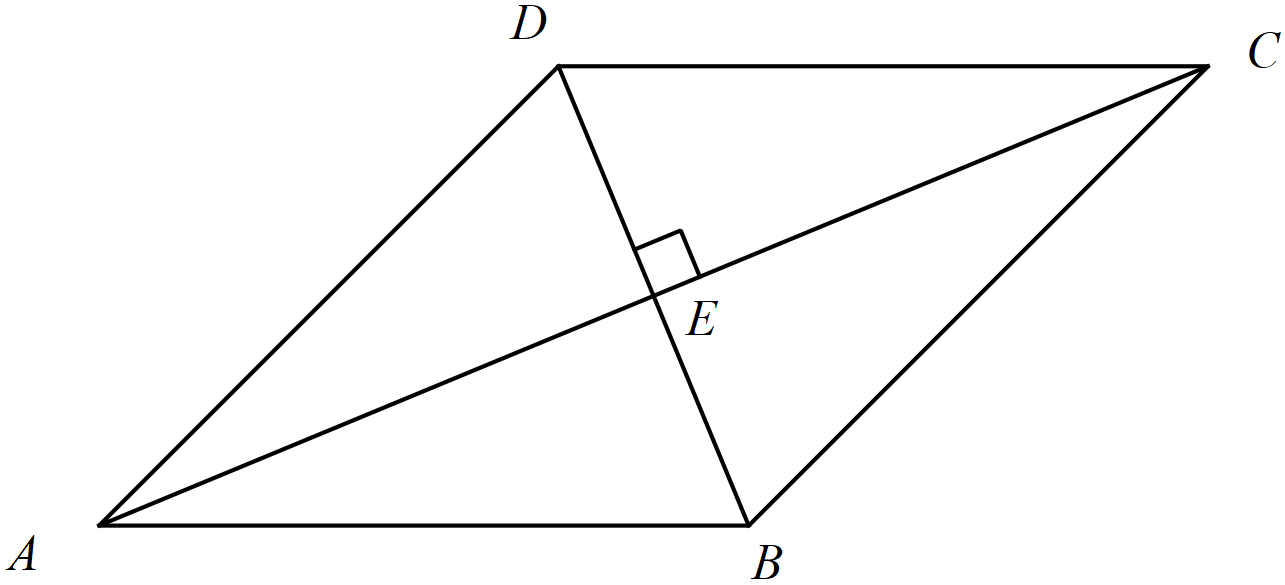
Now, we know that the diagonals of the rhombus intersect at right angles and also bisects each other. So, AC = 2EC and BD= 2ED .
Now, the area of the rhombus is given as \[\dfrac{2EC\times 2ED}{2}=2EC\times ED\]
Now, it is given that the area is \[96c{{m}^{2}}\], so we have:
\[\begin{align}
& \Rightarrow 2EC\times ED=96\, \\
& \Rightarrow EC\times ED=48\,\,\,\,\,\,\,\,\,\,\,\,\,\,(1)\, \\
\end{align}\]
Also, it is given that the difference between the diagonals of a rhombus is 4cm. So, we have:
\[\begin{align}
& \Rightarrow AC-BD=4 \\
& \Rightarrow 2EC-2ED=4 \\
& \Rightarrow EC-ED=2\, \\
& \Rightarrow EC=2+ED\,\,\,\,\,\,\,\,\,\,\,\,\,(2) \\
\end{align}\]
Now from equation (1) and (2), we get:
\[\begin{align}
& \Rightarrow (EC)\times (ED)=48\,\, \\
& \Rightarrow (2+(ED))\times (ED)=48 \\
& \Rightarrow 2(ED)+{{(ED)}^{2}}=48 \\
& \Rightarrow {{(ED)}^{2}}+2(ED)-48=0 \\
\end{align}\]
Now, to solve the given quadratic equation, we will use the formula \[x=\dfrac{-b\pm \sqrt{{{b}^{2}}-4ac}}{2a}\], when the quadratic equation is of the form \[a{{x}^{2}}+bx+c=0\]
Now the equation is solved as follows:
\[\begin{align}
& \Rightarrow {{(ED)}^{2}}+2(ED)-48=0 \\
& \Rightarrow (ED)=\dfrac{-2\pm \sqrt{{{2}^{2}}-4\cdot \;1\left( -48 \right)}}{2\cdot \;1} \\
& \Rightarrow (ED)=-1\pm 7 \\
& \Rightarrow (ED)=-8,\,\,6 \\
\end{align}\]
Ignoring the negative value, we have the length of one diagonal as
\[\begin{align}
& \Rightarrow (ED)=6\,cm \\
& \Rightarrow BD=2(ED) \\
& \Rightarrow BD=12\,\,cm \\
\end{align}\]
Next, the length of the other diagonal will be calculated as follows:
\[\begin{align}
& \Rightarrow (EC)=2+(ED) \\
& \Rightarrow (EC)=2+(6) \\
& \Rightarrow (EC)=8\,\,cm \\
& \Rightarrow AC=2(EC) \\
& \Rightarrow AC=2(8) \\
& \Rightarrow AC=16\,\,\,cm \\
\end{align}\]
Now, since the two diagonals are perpendicular to each other we have to apply the Pythagoras theorem in the triangle CED to get the side length of the rhombus.
So, as per the Pythagoras theorem, we have:
\[\begin{align}
& \Rightarrow {{(CD)}^{2}}={{(EC)}^{2}}+{{(ED)}^{2}} \\
& \Rightarrow {{(CD)}^{2}}={{(EC)}^{2}}+{{(ED)}^{2}} \\
& \Rightarrow {{(CD)}^{2}}={{(8)}^{2}}+{{(6)}^{2}} \\
& \Rightarrow {{(CD)}^{2}}=100 \\
& \Rightarrow (CD)=10\,\,cm \\
\end{align}\]
Here the side length of the rhombus is 10 cm. Now, we have to find the difference between the length of the smaller diagonal (BD) and the length of the side (CD) of the rhombus. So, this is given as:
\[\begin{align}
& \Rightarrow (BD)-(CD)=12-10 \\
& \Rightarrow (BD)-(CD)=2\,\,cm \\
\end{align}\]
So, the correct answer is option A) 2cm.
Note: It is important to note that the lengths of two diagonals of a rhombus are different and are not equal. Also, the area of the rhombus is not the product of two diagonals length but half of the product of the two diagonals length. There can be calculation mistakes while solving the equation\[(ED)=\dfrac{-2\pm \sqrt{{{2}^{2}}-4\cdot \ 1\left( -48 \right)}}{2\cdot \ 1}\], which should be avoided.
Complete step by step solution:
In the given question, we have to find the difference between the length of the smaller diagonal and the length of the side of the rhombus. It is given that the difference between the diagonals of a rhombus is 4cm and the area of the rhombus is \[96c{{m}^{2}}\].
So, let the rhombus is as follows:
Now, we know that the diagonals of the rhombus intersect at right angles and also bisects each other. So, AC = 2EC and BD= 2ED .
Now, the area of the rhombus is given as \[\dfrac{2EC\times 2ED}{2}=2EC\times ED\]
Now, it is given that the area is \[96c{{m}^{2}}\], so we have:
\[\begin{align}
& \Rightarrow 2EC\times ED=96\, \\
& \Rightarrow EC\times ED=48\,\,\,\,\,\,\,\,\,\,\,\,\,\,(1)\, \\
\end{align}\]
Also, it is given that the difference between the diagonals of a rhombus is 4cm. So, we have:
\[\begin{align}
& \Rightarrow AC-BD=4 \\
& \Rightarrow 2EC-2ED=4 \\
& \Rightarrow EC-ED=2\, \\
& \Rightarrow EC=2+ED\,\,\,\,\,\,\,\,\,\,\,\,\,(2) \\
\end{align}\]
Now from equation (1) and (2), we get:
\[\begin{align}
& \Rightarrow (EC)\times (ED)=48\,\, \\
& \Rightarrow (2+(ED))\times (ED)=48 \\
& \Rightarrow 2(ED)+{{(ED)}^{2}}=48 \\
& \Rightarrow {{(ED)}^{2}}+2(ED)-48=0 \\
\end{align}\]
Now, to solve the given quadratic equation, we will use the formula \[x=\dfrac{-b\pm \sqrt{{{b}^{2}}-4ac}}{2a}\], when the quadratic equation is of the form \[a{{x}^{2}}+bx+c=0\]
Now the equation is solved as follows:
\[\begin{align}
& \Rightarrow {{(ED)}^{2}}+2(ED)-48=0 \\
& \Rightarrow (ED)=\dfrac{-2\pm \sqrt{{{2}^{2}}-4\cdot \;1\left( -48 \right)}}{2\cdot \;1} \\
& \Rightarrow (ED)=-1\pm 7 \\
& \Rightarrow (ED)=-8,\,\,6 \\
\end{align}\]
Ignoring the negative value, we have the length of one diagonal as
\[\begin{align}
& \Rightarrow (ED)=6\,cm \\
& \Rightarrow BD=2(ED) \\
& \Rightarrow BD=12\,\,cm \\
\end{align}\]
Next, the length of the other diagonal will be calculated as follows:
\[\begin{align}
& \Rightarrow (EC)=2+(ED) \\
& \Rightarrow (EC)=2+(6) \\
& \Rightarrow (EC)=8\,\,cm \\
& \Rightarrow AC=2(EC) \\
& \Rightarrow AC=2(8) \\
& \Rightarrow AC=16\,\,\,cm \\
\end{align}\]
Now, since the two diagonals are perpendicular to each other we have to apply the Pythagoras theorem in the triangle CED to get the side length of the rhombus.
So, as per the Pythagoras theorem, we have:
\[\begin{align}
& \Rightarrow {{(CD)}^{2}}={{(EC)}^{2}}+{{(ED)}^{2}} \\
& \Rightarrow {{(CD)}^{2}}={{(EC)}^{2}}+{{(ED)}^{2}} \\
& \Rightarrow {{(CD)}^{2}}={{(8)}^{2}}+{{(6)}^{2}} \\
& \Rightarrow {{(CD)}^{2}}=100 \\
& \Rightarrow (CD)=10\,\,cm \\
\end{align}\]
Here the side length of the rhombus is 10 cm. Now, we have to find the difference between the length of the smaller diagonal (BD) and the length of the side (CD) of the rhombus. So, this is given as:
\[\begin{align}
& \Rightarrow (BD)-(CD)=12-10 \\
& \Rightarrow (BD)-(CD)=2\,\,cm \\
\end{align}\]
So, the correct answer is option A) 2cm.
Note: It is important to note that the lengths of two diagonals of a rhombus are different and are not equal. Also, the area of the rhombus is not the product of two diagonals length but half of the product of the two diagonals length. There can be calculation mistakes while solving the equation\[(ED)=\dfrac{-2\pm \sqrt{{{2}^{2}}-4\cdot \ 1\left( -48 \right)}}{2\cdot \ 1}\], which should be avoided.
Recently Updated Pages
Master Class 11 English: Engaging Questions & Answers for Success

Master Class 11 Social Science: Engaging Questions & Answers for Success
Master Class 11 Maths: Engaging Questions & Answers for Success
Master Class 11 Biology: Engaging Questions & Answers for Success
Master Class 11 Physics: Engaging Questions & Answers for Success
Master Class 11 Chemistry: Engaging Questions & Answers for Success
Trending doubts
Explain the Treaty of Vienna of 1815 class 10 social science CBSE
What is the Total Duration of Football Match?
First Cotton Mill of India
In which year voting age was reduced from 21 to 18?
10 examples of evaporation in daily life with explanations
What planets have no moons Which one has only one moon class 10 physics CBSE