



The diameter of a garden roller is 1.4 m and it is 2 m long. How much area will it cover in one revolution?
(a) \[6.8\,{{m}^{2}}\]
(b) \[8.8\,{{m}^{2}}\]
(c) \[3.8\,{{m}^{2}}\]
(d) \[5.8\,{{m}^{2}}\]
Answer
 Verified
595.5k+ views
Hint: The garden roller is in the shape of a right circular cylinder. To find the area that the garden roller covers in one revolution, we need to find the lateral area of the garden roller. The lateral area of the garden roller is equal to the area of its curved surface.
Complete step-by-step answer:
We will first draw the diagram from the details mentioned in the question.
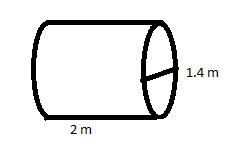
The formula for finding the lateral area of a right circular cylinder is: \[\text{L=}2\pi rh......(1)\] where L is the lateral surface area of the cylinder, r is the radius of the cylinder and h is the cylinder’s height.
Since the garden roller is positioned horizontal as it rolls along the ground, then the length of the roller is actually its height.
Now in the question diameter is mentioned and we need to find a radius which is half of diameter.
Diameter of the garden roller \[=d=1.4\,m\]
Radius of the garden roller \[=r=\dfrac{d}{2}=\dfrac{1.4}{2}=0.7\,m\]
Height of the garden roller \[=h=2\,m\]
Now putting value of r and h in equation (1) to get the lateral area of the garden roller we get,
\[\text{L=}2\times \dfrac{22}{7}\times 0.7\times 2=8.8\,{{m}^{2}}......(2)\]
\[\text{A}=\text{n }\!\!\times\!\!\text{ L}.....(3)\] where A is the area covered by the roller, n is the number of revolutions and L is the lateral area of the roller.
In the question the given number of revolutions is 1 that is \[\text{n}=1\]. Now substituting this value of n and the value of L from equation (2) in equation (3) we get,
\[\text{A}=1\text{ }\!\!\times\!\!\text{ 8}\text{.8=8}\text{.8 }{{m}^{2}}\]
Hence the area covered by the garden roller in one revolution is \[\text{8}\text{.8 }{{m}^{2}}\]. So the correct answer is option (b).
Note: The key here is to understand that the garden roller is nothing but a cylinder. Knowing the formula of lateral area is important and radius is always half of the diameter. We in a hurry may substitute diameter which is 1.4 m in place of radius which is 0.7 m. We need to be careful with the units too because if a unit is missing some marks would be deducted by the examiner.
Complete step-by-step answer:
We will first draw the diagram from the details mentioned in the question.
The formula for finding the lateral area of a right circular cylinder is: \[\text{L=}2\pi rh......(1)\] where L is the lateral surface area of the cylinder, r is the radius of the cylinder and h is the cylinder’s height.
Since the garden roller is positioned horizontal as it rolls along the ground, then the length of the roller is actually its height.
Now in the question diameter is mentioned and we need to find a radius which is half of diameter.
Diameter of the garden roller \[=d=1.4\,m\]
Radius of the garden roller \[=r=\dfrac{d}{2}=\dfrac{1.4}{2}=0.7\,m\]
Height of the garden roller \[=h=2\,m\]
Now putting value of r and h in equation (1) to get the lateral area of the garden roller we get,
\[\text{L=}2\times \dfrac{22}{7}\times 0.7\times 2=8.8\,{{m}^{2}}......(2)\]
\[\text{A}=\text{n }\!\!\times\!\!\text{ L}.....(3)\] where A is the area covered by the roller, n is the number of revolutions and L is the lateral area of the roller.
In the question the given number of revolutions is 1 that is \[\text{n}=1\]. Now substituting this value of n and the value of L from equation (2) in equation (3) we get,
\[\text{A}=1\text{ }\!\!\times\!\!\text{ 8}\text{.8=8}\text{.8 }{{m}^{2}}\]
Hence the area covered by the garden roller in one revolution is \[\text{8}\text{.8 }{{m}^{2}}\]. So the correct answer is option (b).
Note: The key here is to understand that the garden roller is nothing but a cylinder. Knowing the formula of lateral area is important and radius is always half of the diameter. We in a hurry may substitute diameter which is 1.4 m in place of radius which is 0.7 m. We need to be careful with the units too because if a unit is missing some marks would be deducted by the examiner.
Recently Updated Pages
Master Class 9 General Knowledge: Engaging Questions & Answers for Success

Master Class 9 Social Science: Engaging Questions & Answers for Success
Master Class 9 English: Engaging Questions & Answers for Success
Master Class 9 Maths: Engaging Questions & Answers for Success
Master Class 9 Science: Engaging Questions & Answers for Success
Class 9 Question and Answer - Your Ultimate Solutions Guide
Trending doubts
Find the mode and median of the data 13 16 12 14 1-class-9-maths-CBSE
What were the main changes brought about by the Bolsheviks class 9 social science CBSE
What is the theme or message of the poem The road not class 9 english CBSE
What are the major achievements of the UNO class 9 social science CBSE
Explain the importance of pH in everyday life class 9 chemistry CBSE
Differentiate between parenchyma collenchyma and sclerenchyma class 9 biology CBSE