



The diameter of a bus wheel is 140cm. The speed of the bus is 66Km/hr. What is the number of revolutions of the wheel per minute?
$ \left( A \right) $ 200
$ \left( B \right) $ 250
$ \left( C \right) $ 300
$ \left( D \right) $ 350
Answer
 Verified
633.6k+ views
Hint:In this particular question use the concept that radius of the circle is half of the diameter of the circle and circumference of the circle is given as $ \left( {2\pi r} \right) $ , where r is the radius of the circle, then use the property that the revolutions that the bus made per minute is the ratio of the total distance travel by the bus in 1 min to the circumference of the wheel so use this concept to reach the solution of the question.
Complete step-by-step answer:
Given data:
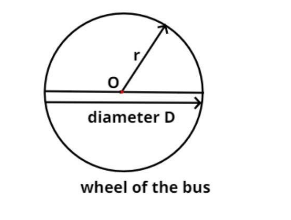
The diameter (D) of the bus wheel = 140 cm, as shown in the above figure.
The speed of the bus = 66 Km/hr.
Let diameter be D.
Therefore, D = 140 cm.
As we all know that the wheel is circular in shape so the radius of the wheel is half of the diameter of the wheel so we have,
$ \Rightarrow r = \dfrac{D}{2} = \dfrac{{140}}{2} = 70 $ cm
Where, r = radius of the wheel, as shown in the above figure.
Now as we know that the circumference (C) of the wheel is given as $ \left( {2\pi r} \right) $
Therefore, $ C = 2 \times \dfrac{{22}}{7} \times 70 = 440 $ cm, $ \left[ {\because \pi = \dfrac{{22}}{7}} \right] $
As 100 cm = 1m
So 440 cm = 4.4 m
So the circumference of the wheel = 4.4m
Now as we know that 1 km = 1000m and 1 hr. = 3600 seconds.
So 66km/hr. = $ 66 \times \dfrac{{1000}}{{3600}} = \dfrac{{110}}{6} $ m/s.
Now we have to find out the number of revolutions of the wheel per minute.
As the bus travels (110/6) m in 1 sec.
As in 1 min = 60 sec.
So the bus travels ( $ \dfrac{{110}}{6} \times 60 = 1100 $ ) meter per minute.
So the number of revolutions that the bus made is the ratio of the total distance travel by the bus in 1 min to the circumference of the wheel.
So the number of revolutions that the bus made is = $ \dfrac{{1100}}{{4.4}} = 250 $
So the bus made 250 revolutions in 1 minute.
So this is the required answer.
Hence option (B) is the correct answer.
Note:The trick point here was the conversion of the units of km/hr. into m/s and then to m/minute as the number of revolutions of the wheels are asked per minute and the diameter is given in cm so it’s better to convert it into meters. Basic conversions like 1km are equal to 1000 meters, 1 hour is equal to 60 minutes and 1 minute is equal to 60 seconds, which helps solving problems of these kinds.
Complete step-by-step answer:
Given data:
The diameter (D) of the bus wheel = 140 cm, as shown in the above figure.
The speed of the bus = 66 Km/hr.
Let diameter be D.
Therefore, D = 140 cm.
As we all know that the wheel is circular in shape so the radius of the wheel is half of the diameter of the wheel so we have,
$ \Rightarrow r = \dfrac{D}{2} = \dfrac{{140}}{2} = 70 $ cm
Where, r = radius of the wheel, as shown in the above figure.
Now as we know that the circumference (C) of the wheel is given as $ \left( {2\pi r} \right) $
Therefore, $ C = 2 \times \dfrac{{22}}{7} \times 70 = 440 $ cm, $ \left[ {\because \pi = \dfrac{{22}}{7}} \right] $
As 100 cm = 1m
So 440 cm = 4.4 m
So the circumference of the wheel = 4.4m
Now as we know that 1 km = 1000m and 1 hr. = 3600 seconds.
So 66km/hr. = $ 66 \times \dfrac{{1000}}{{3600}} = \dfrac{{110}}{6} $ m/s.
Now we have to find out the number of revolutions of the wheel per minute.
As the bus travels (110/6) m in 1 sec.
As in 1 min = 60 sec.
So the bus travels ( $ \dfrac{{110}}{6} \times 60 = 1100 $ ) meter per minute.
So the number of revolutions that the bus made is the ratio of the total distance travel by the bus in 1 min to the circumference of the wheel.
So the number of revolutions that the bus made is = $ \dfrac{{1100}}{{4.4}} = 250 $
So the bus made 250 revolutions in 1 minute.
So this is the required answer.
Hence option (B) is the correct answer.
Note:The trick point here was the conversion of the units of km/hr. into m/s and then to m/minute as the number of revolutions of the wheels are asked per minute and the diameter is given in cm so it’s better to convert it into meters. Basic conversions like 1km are equal to 1000 meters, 1 hour is equal to 60 minutes and 1 minute is equal to 60 seconds, which helps solving problems of these kinds.
Recently Updated Pages
Master Class 12 Economics: Engaging Questions & Answers for Success

Master Class 12 English: Engaging Questions & Answers for Success
Master Class 12 Social Science: Engaging Questions & Answers for Success
Master Class 12 Maths: Engaging Questions & Answers for Success
Master Class 12 Physics: Engaging Questions & Answers for Success
Master Class 9 General Knowledge: Engaging Questions & Answers for Success
Trending doubts
Find the sum of series 1 + 2 + 3 + 4 + 5 + + 100 class 9 maths CBSE
Difference Between Plant Cell and Animal Cell
Fill the blanks with the suitable prepositions 1 The class 9 english CBSE
What is pollution? How many types of pollution? Define it
Name 10 Living and Non living things class 9 biology CBSE
What is the full form of pH?