




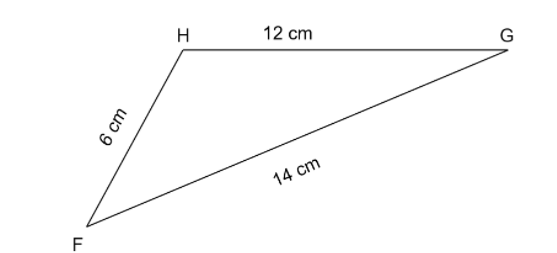
The diagram shows triangle \[FGH\] , with \[FG = 14{\text{ }}cm\] , \[GH = 12{\text{ }}cm\] and \[FH = 6{\text{ }}cm\] . Calculate the size of angle \[HFG\].
Answer
 Verified
552k+ views
Hint: We have to find the value of the angle \[HFG\] . We solve this question using the concept of cosine law of trigonometry and using the values of trigonometric functions . We can find the values of angles of the triangle by applying cosine law . And thereafter finding the value of angle \[HFG\] by putting the values in the formula of cosine law .
Complete step-by-step answer:
All the trigonometric functions are classified into two categories or types as either sine function or cosine function . All the functions which lie in the category of sine functions are sin , cosec and tan functions on the other hand the functions which lie in the category of cosine functions are cos , sec and cot functions . The trigonometric functions are classified into these two categories on the basis of their property which is stated as : when the value of angle is substituted by the negative value of the angle then we get the negative value for the functions in the sine family and a positive value for the functions in the cosine family .
Given :
\[FG = 14{\text{ }}cm\] , \[GH = 12{\text{ }}cm\] and \[FH = 6{\text{ }}cm\]
Let the angles be stated as \[angle{\text{ }}F = angle{\text{ }}HFG\] , \[angle{\text{ }}H = angle{\text{ }}FHG\] and \[angle{\text{ }}G = angle{\text{ }}HGF\] .
We know ,
Formula of cosine law is given as :
\[\cos C = \dfrac{{{a^2} + {b^2} - {c^2}}}{{2ab}}\]
Now , after putting the values we will get the value for \[angle{\text{ }}C\]
Putting the values for the formula , we get
\[\cos F = \dfrac{{{{(FH)}^2} + {{(FG)}^2} - {{(HG)}^2}}}{{2 \times FH \times FG}}\]
Putting the values in the formula , we get
After solving we get ,
\[\cos F = \dfrac{{{6^2} + {{14}^2} - {{12}^2}}}{{2 \times 6 \times 14}}\]
On further simplifying , we get
\[\cos F = \dfrac{{36 + 196 - 144}}{{2 \times 6 \times 14}}\]
We get ,
\[\cos F = \dfrac{{88}}{{168}}\]
After further simplifying , we get
\[\cos F = \dfrac{{11}}{{21}}\]
Taking \[{\cos ^{ - 1}}\] both sides , we get
As , \[{\cos ^{ - 1}}[\cos x] = x\]
Then ,
\[F = {\cos ^{ - 1}}\left[ {\dfrac{{11}}{{21}}} \right]\]
Thus the value of angle \[HFG\] is \[F = {\cos ^{ - 1}}\left[ {\dfrac{{11}}{{21}}} \right]\] .
So, the correct answer is “\[F = {\cos ^{ - 1}}\left[ {\dfrac{{11}}{{21}}} \right]\]”.
Note: The formula of triangle law of sine is given as :
\[\dfrac{a}{{\sin A}} = \dfrac{b}{{\sin B}} = \dfrac{c}{{\sin C}}\]
The formula of triangle law of cosine is given as :
\[\cos A = \dfrac{{{b^2} + {c^2} - {a^2}}}{{2bc}}\]
Where \[A\] , \[B\] , \[C\] are the angles of the triangle \[ABC\] and \[a\] , \[b\] , \[c\] are the sides of the triangle \[ABC\].
These formulas must be remembered. Calculations must be verified to be sure of the answer.
Complete step-by-step answer:
All the trigonometric functions are classified into two categories or types as either sine function or cosine function . All the functions which lie in the category of sine functions are sin , cosec and tan functions on the other hand the functions which lie in the category of cosine functions are cos , sec and cot functions . The trigonometric functions are classified into these two categories on the basis of their property which is stated as : when the value of angle is substituted by the negative value of the angle then we get the negative value for the functions in the sine family and a positive value for the functions in the cosine family .
Given :
\[FG = 14{\text{ }}cm\] , \[GH = 12{\text{ }}cm\] and \[FH = 6{\text{ }}cm\]
Let the angles be stated as \[angle{\text{ }}F = angle{\text{ }}HFG\] , \[angle{\text{ }}H = angle{\text{ }}FHG\] and \[angle{\text{ }}G = angle{\text{ }}HGF\] .
We know ,
Formula of cosine law is given as :
\[\cos C = \dfrac{{{a^2} + {b^2} - {c^2}}}{{2ab}}\]
Now , after putting the values we will get the value for \[angle{\text{ }}C\]
Putting the values for the formula , we get
\[\cos F = \dfrac{{{{(FH)}^2} + {{(FG)}^2} - {{(HG)}^2}}}{{2 \times FH \times FG}}\]
Putting the values in the formula , we get
After solving we get ,
\[\cos F = \dfrac{{{6^2} + {{14}^2} - {{12}^2}}}{{2 \times 6 \times 14}}\]
On further simplifying , we get
\[\cos F = \dfrac{{36 + 196 - 144}}{{2 \times 6 \times 14}}\]
We get ,
\[\cos F = \dfrac{{88}}{{168}}\]
After further simplifying , we get
\[\cos F = \dfrac{{11}}{{21}}\]
Taking \[{\cos ^{ - 1}}\] both sides , we get
As , \[{\cos ^{ - 1}}[\cos x] = x\]
Then ,
\[F = {\cos ^{ - 1}}\left[ {\dfrac{{11}}{{21}}} \right]\]
Thus the value of angle \[HFG\] is \[F = {\cos ^{ - 1}}\left[ {\dfrac{{11}}{{21}}} \right]\] .
So, the correct answer is “\[F = {\cos ^{ - 1}}\left[ {\dfrac{{11}}{{21}}} \right]\]”.
Note: The formula of triangle law of sine is given as :
\[\dfrac{a}{{\sin A}} = \dfrac{b}{{\sin B}} = \dfrac{c}{{\sin C}}\]
The formula of triangle law of cosine is given as :
\[\cos A = \dfrac{{{b^2} + {c^2} - {a^2}}}{{2bc}}\]
Where \[A\] , \[B\] , \[C\] are the angles of the triangle \[ABC\] and \[a\] , \[b\] , \[c\] are the sides of the triangle \[ABC\].
These formulas must be remembered. Calculations must be verified to be sure of the answer.
Recently Updated Pages
Master Class 11 English: Engaging Questions & Answers for Success

Master Class 11 Physics: Engaging Questions & Answers for Success
Master Class 11 Computer Science: Engaging Questions & Answers for Success
Master Class 11 Chemistry: Engaging Questions & Answers for Success
Master Class 11 Social Science: Engaging Questions & Answers for Success
Master Class 11 Accountancy: Engaging Questions & Answers for Success
Trending doubts
Difference Between Prokaryotic Cells and Eukaryotic Cells
Two of the body parts which do not appear in MRI are class 11 biology CBSE
One Metric ton is equal to kg A 10000 B 1000 C 100 class 11 physics CBSE
10 examples of friction in our daily life
Draw a diagram of nephron and explain its structur class 11 biology CBSE
Draw a diagram of a plant cell and label at least eight class 11 biology CBSE