




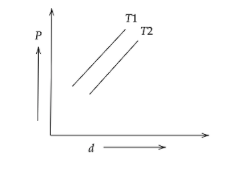
The diagram shows the graph of pressure vs density for given mass of an ideal gas at two temperatures ${T_1}$ and ${T_2}$
A) ${T_1} > {T_2}$
B) ${T_1} = {T_2}$
C) ${T_1} < {T_2}$
D) Any of the three are possible
Answer
 Verified
593.1k+ views
Hint:The internal energy of the gas is measured by multiplying the total number of gas molecules with the average kinetic energy of each molecule. This means that the density is inversely proportional to temperature. To address this statement, the basic laws are used for unit volume.
Useful formula:
Ideal Gas Law in term of density
$PM = dRT$
Where,
$d$ - density of gas
$P$ - Pressure
$R$- Gas Constant
$T$-Temperature
$M$- Molar Mass
Complete step by step process:
Given by,
An ideal gas at two temperatures ${T_1}$ and ${T_2}$
As we know the ideal gas formula,
$PM = dRT$
The above diagram,
The slope of the straight line ${T_1}$ is greater than that of ${T_2}$.
pressure of a given gas is inversely proportional to its volume provided the temperature remains constant
$PV = nRT$
Therefore,
$P = wRT/MV$
Rearranging the above equation,
$P = dRT/M$
The $rms$ speed of the gas is given by $3{P_p}$.
It means gas $rms$ of ${T_1}$ molecules are higher than ${T_2}$ molecules.
Therefore, $P\alpha d - T$
So, ${T_1} > {T_2}$.
Hence, option A is the correct answer.
Note: The number of molecules in a gas is very high and the average separation between them is greater than the size of the gas molecules. The molecules of different gases are different. The measurement of heat is temperature. The molecules of different gases are different. Density is the indicator of how tightly an object is packaged or the ratio of the object's mass to its length.
Useful formula:
Ideal Gas Law in term of density
$PM = dRT$
Where,
$d$ - density of gas
$P$ - Pressure
$R$- Gas Constant
$T$-Temperature
$M$- Molar Mass
Complete step by step process:
Given by,
An ideal gas at two temperatures ${T_1}$ and ${T_2}$
As we know the ideal gas formula,
$PM = dRT$
The above diagram,
The slope of the straight line ${T_1}$ is greater than that of ${T_2}$.
pressure of a given gas is inversely proportional to its volume provided the temperature remains constant
$PV = nRT$
Therefore,
$P = wRT/MV$
Rearranging the above equation,
$P = dRT/M$
The $rms$ speed of the gas is given by $3{P_p}$.
It means gas $rms$ of ${T_1}$ molecules are higher than ${T_2}$ molecules.
Therefore, $P\alpha d - T$
So, ${T_1} > {T_2}$.
Hence, option A is the correct answer.
Note: The number of molecules in a gas is very high and the average separation between them is greater than the size of the gas molecules. The molecules of different gases are different. The measurement of heat is temperature. The molecules of different gases are different. Density is the indicator of how tightly an object is packaged or the ratio of the object's mass to its length.
Recently Updated Pages
Master Class 11 Social Science: Engaging Questions & Answers for Success

Master Class 11 Physics: Engaging Questions & Answers for Success
Master Class 11 Maths: Engaging Questions & Answers for Success
Master Class 11 Economics: Engaging Questions & Answers for Success
Master Class 11 Computer Science: Engaging Questions & Answers for Success
Master Class 11 Chemistry: Engaging Questions & Answers for Success
Trending doubts
One Metric ton is equal to kg A 10000 B 1000 C 100 class 11 physics CBSE
How many bones are in the spine class 11 biology CBSE
1 Quintal is equal to a 110 kg b 10 kg c 100kg d 1000 class 11 physics CBSE
There are 720 permutations of the digits 1 2 3 4 5 class 11 maths CBSE
State and prove Bernoullis theorem class 11 physics CBSE
Difference Between Prokaryotic Cells and Eukaryotic Cells