




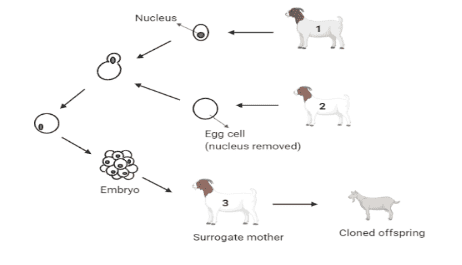
The diagram shows the cloning of an animal. Which of the following options will be most closely related to the mitochondrial DNA of the cloned animal?
A. Nuclear DNA of animal 1
B. Nuclear DNA of animal 2
C. Mitochondrial DNA of animal 1
D. Mitochondrial DNA of animal 2
E. Mitochondrial DNA of animal 3
Answer
 Verified
606.3k+ views
Hint:The process shown in the diagram is the somatic cell nuclear transfer technique. It is the method of producing a viable embryo from an egg cell and body cell. In the given diagram it is explained that the nucleus of one animal is taken in which the egg cell from another animal is implanted to produce clones.
Complete Answer:
1. Cloning is the process of producing one or more individual animals that are identical genetically to another animal.
2. In the above process, an ovum is taken out from the first mother animal and its nucleus is removed. Then this empty ovum is fused with another nucleus taken from the second mother animal. After the fusion, the egg starts to divide to form an embryo. The embryo produced through cloning is implanted into the uterus of the third animal. The offspring produced is the clone of the second animal.
3. According to the diagram given, it is clear that from mother 1 the nucleus is taken out. The egg cell is taken out from the mother 2 which contributes to the cytoplasm of the zygote. Since the nucleus is removed from the egg cell the 2 mother animals will contribute mitochondrial DNA and cytoplasm to the progeny produced. The 3 animals, which act as a surrogate mother (serves to carry the embryo till the time of birth) do not transfer any DNA to the progeny.
So, the correct option to the above question is option (D) i.e. Mitochondrial DNA of animal 2.
Note: Mitochondrial DNA goes through cytoplasmic inheritance and nuclear genes follow Mendelian inheritance. The 2 mothers whose egg cells were taken will contribute to Mitochondrial DNA and cytoplasm. The 3 animals are surrogate mothers which do not contribute any DNA to the progeny.
Complete Answer:
1. Cloning is the process of producing one or more individual animals that are identical genetically to another animal.
2. In the above process, an ovum is taken out from the first mother animal and its nucleus is removed. Then this empty ovum is fused with another nucleus taken from the second mother animal. After the fusion, the egg starts to divide to form an embryo. The embryo produced through cloning is implanted into the uterus of the third animal. The offspring produced is the clone of the second animal.
3. According to the diagram given, it is clear that from mother 1 the nucleus is taken out. The egg cell is taken out from the mother 2 which contributes to the cytoplasm of the zygote. Since the nucleus is removed from the egg cell the 2 mother animals will contribute mitochondrial DNA and cytoplasm to the progeny produced. The 3 animals, which act as a surrogate mother (serves to carry the embryo till the time of birth) do not transfer any DNA to the progeny.
So, the correct option to the above question is option (D) i.e. Mitochondrial DNA of animal 2.
Note: Mitochondrial DNA goes through cytoplasmic inheritance and nuclear genes follow Mendelian inheritance. The 2 mothers whose egg cells were taken will contribute to Mitochondrial DNA and cytoplasm. The 3 animals are surrogate mothers which do not contribute any DNA to the progeny.
Recently Updated Pages
Master Class 12 Business Studies: Engaging Questions & Answers for Success

Master Class 12 Chemistry: Engaging Questions & Answers for Success
Master Class 12 Biology: Engaging Questions & Answers for Success
Class 12 Question and Answer - Your Ultimate Solutions Guide
Master Class 11 English: Engaging Questions & Answers for Success
Master Class 11 Social Science: Engaging Questions & Answers for Success
Trending doubts
Which are the Top 10 Largest Countries of the World?
Draw a labelled sketch of the human eye class 12 physics CBSE
The end of compass needle which points towards north class 12 physics CBSE
Differentiate between homogeneous and heterogeneous class 12 chemistry CBSE
Why is the cell called the structural and functional class 12 biology CBSE
When was the first election held in India a 194748 class 12 sst CBSE