




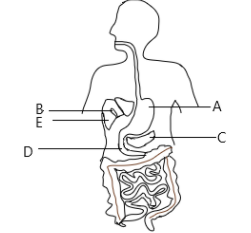
The diagram shows part of the alimentary canal:
When food is present in __(i)__ the two structures ___(ii)__ and ___(iii)___ usually contain bile?
A. ḭ → D, ii → D, iii →B
B. ḭ → A, ii → B, iii →E
C. ḭ → A, ii → B, iii →D
D. ḭ → D, ii → B, iii →E
Answer
 Verified
610.8k+ views
Hint: The food reaches the duodenum part of the small intestine and the pancreatic juice, bile and, eventually, the enzymes in the succus entericus work to complete the absorption of carbohydrates, proteins and fats.
Complete answer:
The alimentary canal begins with an anterior opening - the mouth, and it opens out posteriorly through the anus.
The mechanism of digestion starts with the mouth and the ingestion of food. The teeth play a significant role in chewing or actively breaking down food into tiny particles. Enzymes found in saliva are now beginning to chemically break down food. The oesophagus is a long tube connecting the mouth to the stomach. Using peristalsis, or wave-like smooth muscle contractions, the muscles of the oesophagus force the food to the stomach. Gastric juices, like stomach enzymes, act on the particles of the food and facilitate the process of digestion. Further digestion of food begins in the small intestine, where enzymes generated by the liver, the small intestine, and the pancreas facilitate the process of digestion. The secretions discharged to the small intestine are bile, pancreatic juices, and intestinal juice. The bile and pancreatic juice are released through the hepatopancreatic duct.
The labelling of the given figure is:
A - Stomach
B - Gall Bladder
C - Pancreas
D - Duodenum
E - Liver
Thus, the correct answer is option D i.e., i → D, ii → B, iii →E.
Note:The bile that is released to the duodenum includes bile pigments, bile salts, cholesterol and phospholipids, but no enzymes. Bile helps to emulsify fats, i.e to break down fats, and stimulates lipases.
Complete answer:
The alimentary canal begins with an anterior opening - the mouth, and it opens out posteriorly through the anus.
The mechanism of digestion starts with the mouth and the ingestion of food. The teeth play a significant role in chewing or actively breaking down food into tiny particles. Enzymes found in saliva are now beginning to chemically break down food. The oesophagus is a long tube connecting the mouth to the stomach. Using peristalsis, or wave-like smooth muscle contractions, the muscles of the oesophagus force the food to the stomach. Gastric juices, like stomach enzymes, act on the particles of the food and facilitate the process of digestion. Further digestion of food begins in the small intestine, where enzymes generated by the liver, the small intestine, and the pancreas facilitate the process of digestion. The secretions discharged to the small intestine are bile, pancreatic juices, and intestinal juice. The bile and pancreatic juice are released through the hepatopancreatic duct.
The labelling of the given figure is:
A - Stomach
B - Gall Bladder
C - Pancreas
D - Duodenum
E - Liver
Thus, the correct answer is option D i.e., i → D, ii → B, iii →E.
Note:The bile that is released to the duodenum includes bile pigments, bile salts, cholesterol and phospholipids, but no enzymes. Bile helps to emulsify fats, i.e to break down fats, and stimulates lipases.
Recently Updated Pages
Master Class 12 Business Studies: Engaging Questions & Answers for Success

Master Class 12 Chemistry: Engaging Questions & Answers for Success
Master Class 12 Biology: Engaging Questions & Answers for Success
Class 12 Question and Answer - Your Ultimate Solutions Guide
Master Class 11 Social Science: Engaging Questions & Answers for Success
Master Class 11 Chemistry: Engaging Questions & Answers for Success
Trending doubts
Which are the Top 10 Largest Countries of the World?
Draw a labelled sketch of the human eye class 12 physics CBSE
Name the crygenes that control cotton bollworm and class 12 biology CBSE
Differentiate between homogeneous and heterogeneous class 12 chemistry CBSE
Ribosomal RNA is actively synthesised in A Nucleoplasm class 12 biology CBSE
How many molecules of ATP and NADPH are required information class 12 biology CBSE