




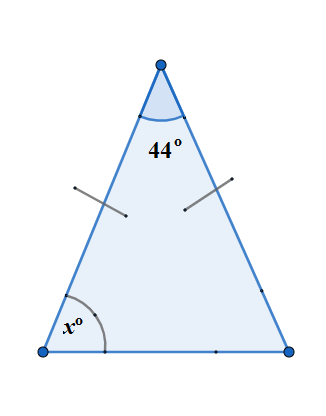
The diagram shows an isosceles triangle. Find the value of $ x $ . \[\]
Answer
 Verified
601.5k+ views
Hint: We use the property in an isosceles triangle that if the lengths of two sides of a triangle are equal then the measures of their opposite angles are equal. We use the property of triangles that the sum of the angles of a triangle is $ {{180}^{\circ }} $ and then solve for $ x $ . \[\]
Complete step by step answer:
We see in the given diagram that we are given an isosceles triangle with angles subtended at the apex as $ {{44}^{\circ }} $ and one other angle as $ {{x}^{\circ }} $ . We denote the apex as A, the vertex at which the unknown angle $ {{x}^{\circ }} $ is subtended as B and the third vertex as C. We have diagram as; \[\]
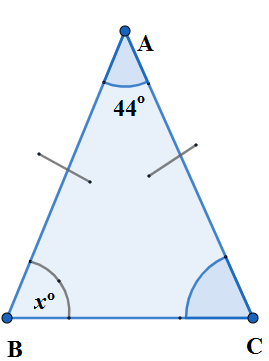
We are give in the figure that the sides AB and AC are equal, $ \angle BAC={{44}^{\circ }} $ and $ \angle ABC={{x}^{\circ }} $ \[\]
We know that if measures of two angles in a triangle are equal then the length of their opposite sides is equal. Its converse is also true which means if the lengths of two sides of a triangle are equal then the measures of their opposite angles are equal. So the angles opposite to AB and AC are going to be equal which are $ \angle ABC=\angle ACB $ . So we have;
\[\angle ACB=\angle ABC={{x}^{\circ }}\]
We know that the sum of the measures of angles in a triangle is $ {{180}^{\circ }} $ . The three angles in the isosceles triangle are $ \angle ABC,\angle ACB,\angle BAC $ . So we have;
\[\angle ABC+\angle ACB+\angle BAC={{180}^{\circ }}\]
We put previously obtained $ \angle ACB=\angle ABC={{x}^{\circ }} $ and given $ \angle BAC={{44}^{\circ }} $ in the above step to have;
\[\begin{align}
& \Rightarrow {{x}^{\circ }}+{{x}^{\circ }}+{{44}^{\circ }}={{180}^{\circ }} \\
& \Rightarrow 2{{x}^{\circ }}+{{44}^{\circ }}={{180}^{\circ }} \\
\end{align}\]
We subtract $ {{44}^{\circ }} $ from both sides to have
\[\Rightarrow 2{{x}^{\circ }}={{136}^{\circ }}\]
We divide both sides by 2 to have ;
\[\Rightarrow x=\dfrac{136}{2}={{68}^{\circ }}\]
Note:
We note that in an isosceles triangle the vertex that equal sides share is called the apex. The altitude, median, angle bisector dropped from the apex to the opposite side is the same. The in-center of the point of intersection angle bisector of the other two angles lies in the bisector of the angle of the angle at apex.
Complete step by step answer:
We see in the given diagram that we are given an isosceles triangle with angles subtended at the apex as $ {{44}^{\circ }} $ and one other angle as $ {{x}^{\circ }} $ . We denote the apex as A, the vertex at which the unknown angle $ {{x}^{\circ }} $ is subtended as B and the third vertex as C. We have diagram as; \[\]
We are give in the figure that the sides AB and AC are equal, $ \angle BAC={{44}^{\circ }} $ and $ \angle ABC={{x}^{\circ }} $ \[\]
We know that if measures of two angles in a triangle are equal then the length of their opposite sides is equal. Its converse is also true which means if the lengths of two sides of a triangle are equal then the measures of their opposite angles are equal. So the angles opposite to AB and AC are going to be equal which are $ \angle ABC=\angle ACB $ . So we have;
\[\angle ACB=\angle ABC={{x}^{\circ }}\]
We know that the sum of the measures of angles in a triangle is $ {{180}^{\circ }} $ . The three angles in the isosceles triangle are $ \angle ABC,\angle ACB,\angle BAC $ . So we have;
\[\angle ABC+\angle ACB+\angle BAC={{180}^{\circ }}\]
We put previously obtained $ \angle ACB=\angle ABC={{x}^{\circ }} $ and given $ \angle BAC={{44}^{\circ }} $ in the above step to have;
\[\begin{align}
& \Rightarrow {{x}^{\circ }}+{{x}^{\circ }}+{{44}^{\circ }}={{180}^{\circ }} \\
& \Rightarrow 2{{x}^{\circ }}+{{44}^{\circ }}={{180}^{\circ }} \\
\end{align}\]
We subtract $ {{44}^{\circ }} $ from both sides to have
\[\Rightarrow 2{{x}^{\circ }}={{136}^{\circ }}\]
We divide both sides by 2 to have ;
\[\Rightarrow x=\dfrac{136}{2}={{68}^{\circ }}\]
Note:
We note that in an isosceles triangle the vertex that equal sides share is called the apex. The altitude, median, angle bisector dropped from the apex to the opposite side is the same. The in-center of the point of intersection angle bisector of the other two angles lies in the bisector of the angle of the angle at apex.
Recently Updated Pages
Master Class 12 Economics: Engaging Questions & Answers for Success

Master Class 12 English: Engaging Questions & Answers for Success
Master Class 12 Social Science: Engaging Questions & Answers for Success
Master Class 12 Maths: Engaging Questions & Answers for Success
Master Class 12 Physics: Engaging Questions & Answers for Success
Master Class 9 General Knowledge: Engaging Questions & Answers for Success
Trending doubts
Explain the Treaty of Vienna of 1815 class 10 social science CBSE
Why is it 530 pm in india when it is 1200 afternoon class 10 social science CBSE
What is the full form of POSCO class 10 social science CBSE
Define Potential, Developed, Stock and Reserved resources
The speaker of the Lok Sabha is elected by the APresident class 10 social science CBSE
Complete the sentence with the most appropriate word class 10 english CBSE