




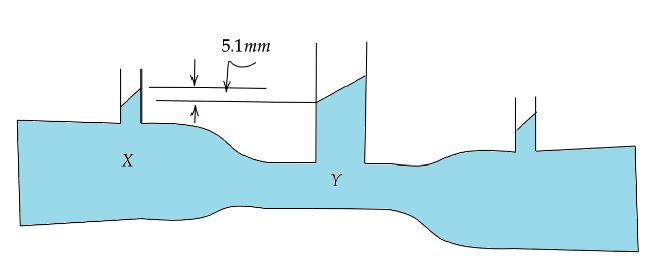
The diagram shows a venturimeter through which water is flowing. The speed of water $X$ is $2\,cm{s^{ - 1}}$. The speed of water at $Y$ ( taking $g = 10\,m{s^2}$ ) is
A. $23\,cm{s^{ - 1}}$
B. $32\,cm{s^{ - 1}}$
C. $101\,cm{s^{ - 1}}$
D. $1024\,cm{s^{ - 1}}$
Answer
 Verified
522.6k+ views
Hint:Here we have to use the formula of the venturimeter. The formula shows the pressure difference between $X$ that is before narrowing of the pipe and $Y$ that is after narrowing of the pipe. After that using the pressure difference formula of fluid we can solve the equation to find the value of speed of water at $Y$.
Complete step by step answer:
As per the problem we have a venturimeter through which water is flowing. The speed of water X is $2\,cm{s^{ - 1}}$. Now we need to calculate the speed of water at Y.
We know venture effect is represented as,
$p_x - p_y = \dfrac{\rho }{2}\left( {v{y^2} - {v_x}^2} \right) \ldots \ldots \left( 1 \right)$
Where, Pressure at position X before the narrowing of the pipe is $px$, Pressure at position Y after the narrowing of the pipe is $p_y$, Density of fluid travelling in the pipe is $\rho $, Velocity of the fluid at position Y is $v_y$ and Velocity of the fluid at position X is $v_x$.
The pressure difference is also represented as,
$p_x - p_y = \Delta h\rho g \ldots \ldots \left( 2 \right)$
Where,
$\Delta h$ is the change in height due to change in before and after narrowing of the pipe.
Now equation equation $\left( 1 \right)$ and $\left( 2 \right)$ we will get,
$\dfrac{\rho }{2}\left( {{v_y}^2 - v_{x^2}} \right) = \Delta h\rho g$
Now cancelling the common terms we will get,
$\dfrac{1}{2}\left( {{v_y}^2 - {v_x}^2} \right) = \Delta hg$
We know,
$\Delta h = 5.1mm = 0.51cm$
$\Rightarrow v_x = 2cm{s^{ - 1}}$
$\Rightarrow g = 10\,m{s^{ - 1}} = 1000\,cm{s^{ - 1}}$
Now putting the given values in the above equation we will get,
$\dfrac{1}{2}\left( {{v_y}^2 - {2^2}} \right) = 0.51 \times 1000$
Now on rearranging and solving further solving we will get,
${v_y}^2 = \left( {510 \times 2} \right) + 2 = 1024$
Hence we can say the speed of water at Y is $32\,cm{s^{ - 1}}$.
Therefore the correct option is $\left( B \right)$.
Note:Here we converted all the units of length in centimeter as our option is given in centimeter. Remember that a venturimeter is a device which is used to measure the rate of flow of fluid flowing through a pipe. The principle of venturimeter is that when a fluid flows through it, it’s acceleration in the convergent section and decelerates in the divergent section which results in drop in static pressure.
Complete step by step answer:
As per the problem we have a venturimeter through which water is flowing. The speed of water X is $2\,cm{s^{ - 1}}$. Now we need to calculate the speed of water at Y.
We know venture effect is represented as,
$p_x - p_y = \dfrac{\rho }{2}\left( {v{y^2} - {v_x}^2} \right) \ldots \ldots \left( 1 \right)$
Where, Pressure at position X before the narrowing of the pipe is $px$, Pressure at position Y after the narrowing of the pipe is $p_y$, Density of fluid travelling in the pipe is $\rho $, Velocity of the fluid at position Y is $v_y$ and Velocity of the fluid at position X is $v_x$.
The pressure difference is also represented as,
$p_x - p_y = \Delta h\rho g \ldots \ldots \left( 2 \right)$
Where,
$\Delta h$ is the change in height due to change in before and after narrowing of the pipe.
Now equation equation $\left( 1 \right)$ and $\left( 2 \right)$ we will get,
$\dfrac{\rho }{2}\left( {{v_y}^2 - v_{x^2}} \right) = \Delta h\rho g$
Now cancelling the common terms we will get,
$\dfrac{1}{2}\left( {{v_y}^2 - {v_x}^2} \right) = \Delta hg$
We know,
$\Delta h = 5.1mm = 0.51cm$
$\Rightarrow v_x = 2cm{s^{ - 1}}$
$\Rightarrow g = 10\,m{s^{ - 1}} = 1000\,cm{s^{ - 1}}$
Now putting the given values in the above equation we will get,
$\dfrac{1}{2}\left( {{v_y}^2 - {2^2}} \right) = 0.51 \times 1000$
Now on rearranging and solving further solving we will get,
${v_y}^2 = \left( {510 \times 2} \right) + 2 = 1024$
Hence we can say the speed of water at Y is $32\,cm{s^{ - 1}}$.
Therefore the correct option is $\left( B \right)$.
Note:Here we converted all the units of length in centimeter as our option is given in centimeter. Remember that a venturimeter is a device which is used to measure the rate of flow of fluid flowing through a pipe. The principle of venturimeter is that when a fluid flows through it, it’s acceleration in the convergent section and decelerates in the divergent section which results in drop in static pressure.
Recently Updated Pages
Master Class 11 Social Science: Engaging Questions & Answers for Success

Master Class 11 Chemistry: Engaging Questions & Answers for Success
Master Class 12 Business Studies: Engaging Questions & Answers for Success
Master Class 12 Chemistry: Engaging Questions & Answers for Success
Master Class 12 Biology: Engaging Questions & Answers for Success
Class 12 Question and Answer - Your Ultimate Solutions Guide
Trending doubts
One Metric ton is equal to kg A 10000 B 1000 C 100 class 11 physics CBSE
Difference Between Prokaryotic Cells and Eukaryotic Cells
Two of the body parts which do not appear in MRI are class 11 biology CBSE
Explain zero factorial class 11 maths CBSE
10 examples of friction in our daily life
Name the Largest and the Smallest Cell in the Human Body ?