




The diagram of Labeo is given. Identify the parts labelled as A, B, C, D, E, F and G.
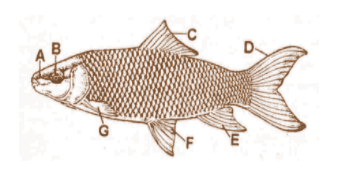
A. A - Nostril B – eye B - Dorsal fin D - Caudal fin E - Anal fin F - Pelvic fin G - Pectorial fin
B. A - Nostril B – eye B- Dorsal fin D - Caudal fin E - Pectorial fin F - Anal fin G - Pelvic fin
C. A - Nostril B – eye B - Dorsal fin D - Anal fin E - Caudal fin F - Pectorial fin G - Pelvic fin
D. A - Nostril B – eye B - Anal fin D - Caudal fin E - Dorsal fin F - Pectorial fin G - Pelvic fin
Answer
 Verified
618k+ views
Hint: Labeo rohita is commonly known as the “Rohu” fish. Bony fishes have paired pectoral and pelvic fins. They also possess dorsal, anal, and caudal fins. Bony fishes also possess an operculum.
Complete answer:
Labeo rohita or “Rohu” is a freshwater bony fish which is found in lakes, ponds, and rivers. The body of the fish is spindle-shaped and laterally flattened. These are usually dark greenish-black in colour. A Labeo has:
(A) It is the nostrils on the snout.
(B) It is a pair of lateral eyes on both sides.
(C) It is the dorsal fin which is located at the back of Labeo.
(D) The caudal fin is the tail fin which is located at the end of the caudal peduncle and it is used for propulsion.
(E) It is an unpaired anal fin that is located on the underside of the fish posterior to the anus.
(F) It is a pair of fins which is positioned on the underside of the body of the fish's pelvic fin.
(G) It is a pair of fins situated one on each side of the fish present just behind the gills are pectoral fins.
Hence, the correct answer is option A.
Additional information: Scientific classification of Labeo rohita is given below:
Note: Labeo is a genus of carps belonging to the family Cyprinidae and the subfamily Labeoninae. They belong to the group of fishes known as Osteichthyes. They are mainly found in freshwater habitats like lakes and rivers usually in the tropics and subtropics of Africa and Asia.
Complete answer:
Labeo rohita or “Rohu” is a freshwater bony fish which is found in lakes, ponds, and rivers. The body of the fish is spindle-shaped and laterally flattened. These are usually dark greenish-black in colour. A Labeo has:
(A) It is the nostrils on the snout.
(B) It is a pair of lateral eyes on both sides.
(C) It is the dorsal fin which is located at the back of Labeo.
(D) The caudal fin is the tail fin which is located at the end of the caudal peduncle and it is used for propulsion.
(E) It is an unpaired anal fin that is located on the underside of the fish posterior to the anus.
(F) It is a pair of fins which is positioned on the underside of the body of the fish's pelvic fin.
(G) It is a pair of fins situated one on each side of the fish present just behind the gills are pectoral fins.
Hence, the correct answer is option A.
Additional information: Scientific classification of Labeo rohita is given below:
| Kingdom | Animalia |
| Phylum | Chordata |
| Class | Actinopterygii |
| Order | Cypriniformes |
| Family | Cyprinidae |
| Subfamily | Labeoninae |
| Genus | Labeo |
Note: Labeo is a genus of carps belonging to the family Cyprinidae and the subfamily Labeoninae. They belong to the group of fishes known as Osteichthyes. They are mainly found in freshwater habitats like lakes and rivers usually in the tropics and subtropics of Africa and Asia.
Recently Updated Pages
Master Class 11 English: Engaging Questions & Answers for Success

Master Class 11 Physics: Engaging Questions & Answers for Success
Master Class 11 Computer Science: Engaging Questions & Answers for Success
Master Class 11 Chemistry: Engaging Questions & Answers for Success
Master Class 11 Social Science: Engaging Questions & Answers for Success
Master Class 11 Accountancy: Engaging Questions & Answers for Success
Trending doubts
Difference Between Prokaryotic Cells and Eukaryotic Cells
Two of the body parts which do not appear in MRI are class 11 biology CBSE
One Metric ton is equal to kg A 10000 B 1000 C 100 class 11 physics CBSE
10 examples of friction in our daily life
Draw a diagram of nephron and explain its structur class 11 biology CBSE
Draw a diagram of a plant cell and label at least eight class 11 biology CBSE