




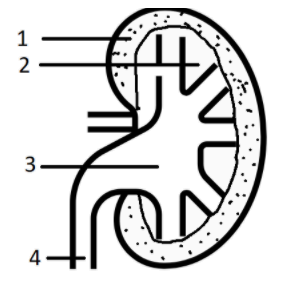
The diagram given shows a section of a human kidney. Study the diagram carefully and answer the questions that follow:
(i) Label the parts numbered 1 to 4.
(ii) Why does part '2' have a striped appearance?
(iii) What is the fluid that passes down part '4'? Name the main nitrogenous waste present in it.
(iv) Mention the structural and functional units of kidneys.
(v) Name the two major steps in the formation of the fluid mentioned in (iii).
Answer
 Verified
572.4k+ views
Hint: The kidney is an important excretory organ in our body. It helps in removing the nitrogenous wastes from the blood and forms urine. The blood undergoes several filtrations under high pressure through the kidney and forms urine. The reabsorption of the useful ions takes place in the kidney tubules and the wastes are eliminated in the form of urine.
Complete answer:
To solve this question, we must know about the structure and function of the kidney.
i). The different parts shown in the kidney are
1. Cortex- It is the outermost portion of the kidney. It contains glomerulus and convoluted tubules. Ultra-filtration takes place here.
2. Medulla- It is the innermost part of the kidney. It regulates the concentration of urine.
3. Pelvis- It acts as a funnel for urine flowing to the ureter.
4. Ureter- It is the tube which carries the urine from kidney to the urinary bladder.
ii). The medulla appears to be stripped in appearance because it contains the renal tubules which are the structural and functional unit of the kidney. These tubules are highly coiled and microscopic in appearance.
iii). The fluid that passes down through the ureter is the urine. The main nitrogenous waste present in it is urea. Urea is formed as a result of breakdown of proteins by the liver.
iv). The structural and functional unit of the kidney is the nephrons. It contains glomerulus, proximal convoluted tubule, distal convoluted tubules, loop of henle.
v). The urine is majorly formed by two important steps- Ultrafiltration which takes place in the glomerulus and reabsorption which takes place in renal tubules (proximal convoluted tubule).
Note:
I) Ultrafiltration- It occurs in glomerulus. The blood under high pressure passes through the capillaries filtering many solutes and water and wastes.
II) Reabsorption is the process of movement of water and other important solutes from the renal tubule to the blood. Water, glucose, proteins and important amino acids are reabsorbed in the renal tubules.
Complete answer:
To solve this question, we must know about the structure and function of the kidney.
i). The different parts shown in the kidney are
1. Cortex- It is the outermost portion of the kidney. It contains glomerulus and convoluted tubules. Ultra-filtration takes place here.
2. Medulla- It is the innermost part of the kidney. It regulates the concentration of urine.
3. Pelvis- It acts as a funnel for urine flowing to the ureter.
4. Ureter- It is the tube which carries the urine from kidney to the urinary bladder.
ii). The medulla appears to be stripped in appearance because it contains the renal tubules which are the structural and functional unit of the kidney. These tubules are highly coiled and microscopic in appearance.
iii). The fluid that passes down through the ureter is the urine. The main nitrogenous waste present in it is urea. Urea is formed as a result of breakdown of proteins by the liver.
iv). The structural and functional unit of the kidney is the nephrons. It contains glomerulus, proximal convoluted tubule, distal convoluted tubules, loop of henle.
v). The urine is majorly formed by two important steps- Ultrafiltration which takes place in the glomerulus and reabsorption which takes place in renal tubules (proximal convoluted tubule).
Note:
I) Ultrafiltration- It occurs in glomerulus. The blood under high pressure passes through the capillaries filtering many solutes and water and wastes.
II) Reabsorption is the process of movement of water and other important solutes from the renal tubule to the blood. Water, glucose, proteins and important amino acids are reabsorbed in the renal tubules.
Recently Updated Pages
Master Class 11 English: Engaging Questions & Answers for Success

Master Class 11 Social Science: Engaging Questions & Answers for Success
Master Class 11 Maths: Engaging Questions & Answers for Success
Master Class 11 Biology: Engaging Questions & Answers for Success
Master Class 11 Physics: Engaging Questions & Answers for Success
Master Class 11 Chemistry: Engaging Questions & Answers for Success
Trending doubts
One Metric ton is equal to kg A 10000 B 1000 C 100 class 11 physics CBSE
Difference Between Prokaryotic Cells and Eukaryotic Cells
Find the value of the expression given below sin 30circ class 11 maths CBSE
Difference between physical and chemical change class 11 chemistry CBSE
Two of the body parts which do not appear in MRI are class 11 biology CBSE
Draw a diagram of a plant cell and label at least eight class 11 biology CBSE