




The diagonals of the quadrilateral are perpendicular to each other. Is such a quadrilateral always a rhombus? Draw a rough figure to justify your answer.
Answer
 Verified
616.5k+ views
Hint: Try thinking about the shape of a kite. Where we have two sticks crossing each other perpendicularly in the middle of the kite. But all the sides are not necessarily equal for any kite.
Complete step-by-step answer:
No, if the diagonals of the quadrilateral are perpendicular to each other then such a quadrilateral is not always a rhombus.
As we know the conditions of rhombus,
1. It should always be a parallelogram.
2. All the sides of the quadrilateral should be equal.
3. The diagonals are perpendicular to each other.
So here given only, “Diagonals of the quadrilateral are perpendicular to each other.”
Hence, we can’t say a given quadrilateral is always rhombus.
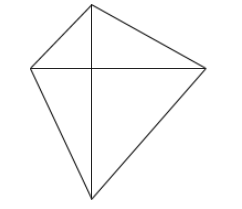
This is a quadrilateral with perpendicular diagonals which is not a rhombus.
Note: In some other cases also, we can think of some shape which has perpendicular diagonals without being a rhombus. Try exploring some other figures. You can also think that square is such a figure that it has perpendicular diagonals and it is not a rhombus. But you need to know that every square is a rhombus, so we can’t consider the case.
Complete step-by-step answer:
No, if the diagonals of the quadrilateral are perpendicular to each other then such a quadrilateral is not always a rhombus.
As we know the conditions of rhombus,
1. It should always be a parallelogram.
2. All the sides of the quadrilateral should be equal.
3. The diagonals are perpendicular to each other.
So here given only, “Diagonals of the quadrilateral are perpendicular to each other.”
Hence, we can’t say a given quadrilateral is always rhombus.
This is a quadrilateral with perpendicular diagonals which is not a rhombus.
Note: In some other cases also, we can think of some shape which has perpendicular diagonals without being a rhombus. Try exploring some other figures. You can also think that square is such a figure that it has perpendicular diagonals and it is not a rhombus. But you need to know that every square is a rhombus, so we can’t consider the case.
Recently Updated Pages
Master Class 12 Business Studies: Engaging Questions & Answers for Success

Master Class 12 Biology: Engaging Questions & Answers for Success
Master Class 12 Chemistry: Engaging Questions & Answers for Success
Class 12 Question and Answer - Your Ultimate Solutions Guide
Master Class 11 Social Science: Engaging Questions & Answers for Success
Master Class 11 English: Engaging Questions & Answers for Success
Trending doubts
What is BLO What is the full form of BLO class 8 social science CBSE
Citizens of India can vote at the age of A 18 years class 8 social science CBSE
Right to vote is a AFundamental Right BFundamental class 8 social science CBSE
10 slogans on organ donation class 8 english CBSE
Name the states through which the Tropic of Cancer class 8 social science CBSE
What are the methods of reducing friction. Explain