




The diagonals of rhombus measure 16cm and 30cm. Find its perimeter.
Answer
 Verified
631.2k+ views
Hint: The diagonals of rhombus bisect each other and perpendicular on each other. By using this statement we can find out the rhombus side. And every side is equal in rhombus by its definition. Once we have all sides then we can figure out its perimeter.
Complete step-by-step answer:
It is given that the diagonal of rhombus are 16cm and 30cm. it will bisect each other and will be perpendicular on each other.
Draw a rhombus ABCD along with its diagonal which cut each other on O.
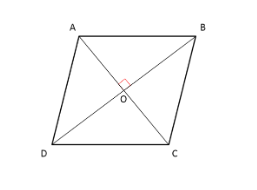
In above figure AC = 30cm and BD = 16cm.
AC and BD are bisecting each other, so AO = 15cm and OD = 8cm.
And \[\angle AOB={{90}^{\circ }}\]
Now, we have a triangle AOB which is a right angled triangle so we can use Pythagoras theorem in order to find side AD (which is a hypotenuse in triangle AOB).
Pythagoras theorem states,
In a right angled triangle, the square of hypotenuse is equal to the sum of square of its base and square of its height.
$ \begin{align}
& A{{D}^{2}}=O{{A}^{2}}+O{{D}^{2}} \\
& A{{D}^{2}}={{15}^{2}}+{{8}^{2}} \\
& A{{D}^{2}}=225+64 \\
& A{{D}^{2}}=289 \\
& AD=17 \\
\end{align} $
Here, we will ignore -17 because the side of the triangle cannot be negative.
All sides are equal in a rhombus. So, the perimeter of rhombus is,
$ 4\times side $
\[\begin{matrix}
Perimeter=4\times side \\
=4\times AD \\
=4\times 17 \\
=68 \\
\end{matrix}\]
The perimeter of rhombus is 68 units.
Note:- Here, we can also find the relation between rhombus’s diagonals and its area in order to find its perimeter. Though Square’s all sides are equal and it has 4 right angles but it is not necessary in rhombus. We can say that the square is a kind of rhombus.
Complete step-by-step answer:
It is given that the diagonal of rhombus are 16cm and 30cm. it will bisect each other and will be perpendicular on each other.
Draw a rhombus ABCD along with its diagonal which cut each other on O.
In above figure AC = 30cm and BD = 16cm.
AC and BD are bisecting each other, so AO = 15cm and OD = 8cm.
And \[\angle AOB={{90}^{\circ }}\]
Now, we have a triangle AOB which is a right angled triangle so we can use Pythagoras theorem in order to find side AD (which is a hypotenuse in triangle AOB).
Pythagoras theorem states,
In a right angled triangle, the square of hypotenuse is equal to the sum of square of its base and square of its height.
$ \begin{align}
& A{{D}^{2}}=O{{A}^{2}}+O{{D}^{2}} \\
& A{{D}^{2}}={{15}^{2}}+{{8}^{2}} \\
& A{{D}^{2}}=225+64 \\
& A{{D}^{2}}=289 \\
& AD=17 \\
\end{align} $
Here, we will ignore -17 because the side of the triangle cannot be negative.
All sides are equal in a rhombus. So, the perimeter of rhombus is,
$ 4\times side $
\[\begin{matrix}
Perimeter=4\times side \\
=4\times AD \\
=4\times 17 \\
=68 \\
\end{matrix}\]
The perimeter of rhombus is 68 units.
Note:- Here, we can also find the relation between rhombus’s diagonals and its area in order to find its perimeter. Though Square’s all sides are equal and it has 4 right angles but it is not necessary in rhombus. We can say that the square is a kind of rhombus.
Recently Updated Pages
Master Class 12 Economics: Engaging Questions & Answers for Success

Master Class 12 English: Engaging Questions & Answers for Success
Master Class 12 Social Science: Engaging Questions & Answers for Success
Master Class 12 Maths: Engaging Questions & Answers for Success
Master Class 12 Physics: Engaging Questions & Answers for Success
Master Class 9 General Knowledge: Engaging Questions & Answers for Success
Trending doubts
Find the sum of series 1 + 2 + 3 + 4 + 5 + + 100 class 9 maths CBSE
Difference Between Plant Cell and Animal Cell
Fill the blanks with the suitable prepositions 1 The class 9 english CBSE
What is pollution? How many types of pollution? Define it
Name 10 Living and Non living things class 9 biology CBSE
What is the full form of pH?