




The diagonals of a rhombus bisect each other at
(a)$60{}^\circ $
(b)$80{}^\circ $
(c)$90{}^\circ $
(d)$120{}^\circ $
Answer
 Verified
657k+ views
Hint: Rhombus is a quadrilateral with four equal sides whose diagonals bisect each other. Take any two adjacent triangles formed by the intersection of the diagonals and try to prove them congruent. Use the property that the measure of a straight angle is $180{}^\circ $, so a linear pair of angles must add up to $180{}^\circ $.
Complete step-by-step answer:
As we know the property of rhombus that all sides of the rhombus are equal to each other and diagonals bisect each other and here we need to determine the angle formed by the diagonals at the intersecting point.
So, let we have a rhombus ABCD which diagram can be given as :-
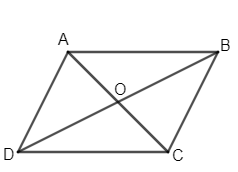
So, the sides AB, BC, CD and AD are equal to each other and diagonals AC and BD bisecting each other i.e. length AO is equal to CO and BO is equal to DO.
So, we have
$AB=BC=CD=AD$ …......................................(i)
$AO=CO$ …......................................(ii)
$BO=DO$ …...................................(iii)
So, from the given diagram, we have to prove angles $\angle AOB,\angle DOA,\angle DOC,\angle COB$ are $90{}^\circ $.
In $\Delta AOB$ and $\Delta BOC$, we have
$AO=CO$ (from equation (ii))
$AB=BC$ (from equation (i))
$BO=BO$ (common in both triangles).
Hence, $\Delta AOB$ and $\Delta BOC$ are congruent to each other by SSS criteria of congruence. So, we get
$\angle AOB=\angle BOC$ (By C.P.C.T.) ………………………………….(iv)
Now, we know that the sum of angles formed by a line on a line is $180{}^\circ $ because of linear pair property.
It means the angles in the diagram below sum as $180{}^\circ $.
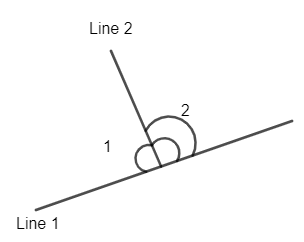
So, $\angle 1+\angle 2=180{}^\circ $ (Linear pair)
Hence, from the rhombus, the sum of angles $\angle AOB$ and $\angle BOC$ is 180 by the above mentioned property. So, we get
$\angle AOB+\angle BOC=180{}^\circ $ ……………………………………………………(v)
Now, from the equation (iv), we have
$\angle AOB=\angle BOC$
So, we can re-write equation (v) as
$\angle AOB+\angle AOB=180{}^\circ $
$2\angle AOB=180{}^\circ $
$\angle AOB=\dfrac{180{}^\circ }{2}=90{}^\circ $
Hence, $\angle AOB=90{}^\circ $ and $\angle BOC=90{}^\circ $ as well from the equation (iv).
Now, we know pairs of vertically opposite angles are always equal formed by intersection of two lines.
It means, we get from the rhombus ABCD as
$\angle AOB=\angle COD$
$\angle BOC=\angle AOD$
Hence, $\angle COD=90{}^\circ $ and $\angle AOD=90{}^\circ $ as well from the above conditions.
So, the diagonals of rhombus bisect each other at $90{}^\circ $.
Hence, option (c) is correct.
Note: One may take any two triangles from the pairs $\left( \Delta AOB,\Delta BOC \right)$, $\left( \Delta BOC,\Delta DOC \right)$, $\left( \Delta AOD,\Delta AOB \right)$, $\left( \Delta DOC,\Delta AOD \right)$ to prove the angle formed by diagonals as $90{}^\circ $. It is not necessary to take the triangles AOB and BOC as done in the solution.
Use the fundamental properties of a rhombus and don’t get confused with the properties of rectangle, parallelogram or square. All have some common properties and some different properties as well. So, be clear with the properties of a rhombus to solve these kinds of problems.
Complete step-by-step answer:
As we know the property of rhombus that all sides of the rhombus are equal to each other and diagonals bisect each other and here we need to determine the angle formed by the diagonals at the intersecting point.
So, let we have a rhombus ABCD which diagram can be given as :-
So, the sides AB, BC, CD and AD are equal to each other and diagonals AC and BD bisecting each other i.e. length AO is equal to CO and BO is equal to DO.
So, we have
$AB=BC=CD=AD$ …......................................(i)
$AO=CO$ …......................................(ii)
$BO=DO$ …...................................(iii)
So, from the given diagram, we have to prove angles $\angle AOB,\angle DOA,\angle DOC,\angle COB$ are $90{}^\circ $.
In $\Delta AOB$ and $\Delta BOC$, we have
$AO=CO$ (from equation (ii))
$AB=BC$ (from equation (i))
$BO=BO$ (common in both triangles).
Hence, $\Delta AOB$ and $\Delta BOC$ are congruent to each other by SSS criteria of congruence. So, we get
$\angle AOB=\angle BOC$ (By C.P.C.T.) ………………………………….(iv)
Now, we know that the sum of angles formed by a line on a line is $180{}^\circ $ because of linear pair property.
It means the angles in the diagram below sum as $180{}^\circ $.
So, $\angle 1+\angle 2=180{}^\circ $ (Linear pair)
Hence, from the rhombus, the sum of angles $\angle AOB$ and $\angle BOC$ is 180 by the above mentioned property. So, we get
$\angle AOB+\angle BOC=180{}^\circ $ ……………………………………………………(v)
Now, from the equation (iv), we have
$\angle AOB=\angle BOC$
So, we can re-write equation (v) as
$\angle AOB+\angle AOB=180{}^\circ $
$2\angle AOB=180{}^\circ $
$\angle AOB=\dfrac{180{}^\circ }{2}=90{}^\circ $
Hence, $\angle AOB=90{}^\circ $ and $\angle BOC=90{}^\circ $ as well from the equation (iv).
Now, we know pairs of vertically opposite angles are always equal formed by intersection of two lines.
It means, we get from the rhombus ABCD as
$\angle AOB=\angle COD$
$\angle BOC=\angle AOD$
Hence, $\angle COD=90{}^\circ $ and $\angle AOD=90{}^\circ $ as well from the above conditions.
So, the diagonals of rhombus bisect each other at $90{}^\circ $.
Hence, option (c) is correct.
Note: One may take any two triangles from the pairs $\left( \Delta AOB,\Delta BOC \right)$, $\left( \Delta BOC,\Delta DOC \right)$, $\left( \Delta AOD,\Delta AOB \right)$, $\left( \Delta DOC,\Delta AOD \right)$ to prove the angle formed by diagonals as $90{}^\circ $. It is not necessary to take the triangles AOB and BOC as done in the solution.
Use the fundamental properties of a rhombus and don’t get confused with the properties of rectangle, parallelogram or square. All have some common properties and some different properties as well. So, be clear with the properties of a rhombus to solve these kinds of problems.
Recently Updated Pages
Master Class 11 English: Engaging Questions & Answers for Success

Master Class 11 Social Science: Engaging Questions & Answers for Success
Master Class 11 Maths: Engaging Questions & Answers for Success
Master Class 11 Biology: Engaging Questions & Answers for Success
Master Class 11 Physics: Engaging Questions & Answers for Success
Master Class 11 Chemistry: Engaging Questions & Answers for Success
Trending doubts
Explain the Treaty of Vienna of 1815 class 10 social science CBSE
First Cotton Mill of India
In which year voting age was reduced from 21 to 18?
What planets have no moons Which one has only one moon class 10 physics CBSE
What is the full form of POSCO class 10 social science CBSE
10 examples of evaporation in daily life with explanations