




The diagonals of a rectangle are perpendicular to each other.
(a). True
(b). False
(c). Only when the rectangle is also a rhombus.
(d). None of these.
Answer
 Verified
649.5k+ views
- Hint: Draw a rectangle, with diagonals. From the figure, find out if the diagonals are perpendicular to each other or not, if they are then the statement is true or else the statement is false.
Complete step-by-step answer: -
Consider the rectangle ABCD drawn below.
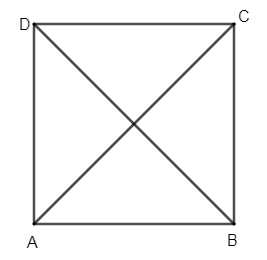
We know that a rectangle has 2 diagonals. From the figure we can see that AC and BD are the diagonals of the rectangle ABCD. From the figure we can understand that each one is a line segment drawn between the opposite corners of the rectangle. The diagonals of the rectangle are equal i.e. AC = BD and they bisect each other. But the diagonals are not perpendicular to each other. We know that if diagonals are perpendicular then they cut at \[{{90}^{\circ }}\]. But in the rectangle the diagonals don’t cut at \[{{90}^{\circ }}\]. Thus the statement given is false.
If in case of square and rhombus, the diagonals are perpendicular to each other. But for rectangles, parallelograms, trapeziums the diagonals are not perpendicular.
\[\therefore \] The diagonals of a rectangle are not perpendicular to each other. The given statement is false.
\[\therefore \] Option (b) is the correct answer.
Note: If you are having doubt about the diagonals if they are perpendicular or not always draw a figure and confirm it. If we draw a rectangle with diagonals, we can see that they are not perpendicular. If we draw a square, their diagonals are always perpendicular.
Complete step-by-step answer: -
Consider the rectangle ABCD drawn below.
We know that a rectangle has 2 diagonals. From the figure we can see that AC and BD are the diagonals of the rectangle ABCD. From the figure we can understand that each one is a line segment drawn between the opposite corners of the rectangle. The diagonals of the rectangle are equal i.e. AC = BD and they bisect each other. But the diagonals are not perpendicular to each other. We know that if diagonals are perpendicular then they cut at \[{{90}^{\circ }}\]. But in the rectangle the diagonals don’t cut at \[{{90}^{\circ }}\]. Thus the statement given is false.
If in case of square and rhombus, the diagonals are perpendicular to each other. But for rectangles, parallelograms, trapeziums the diagonals are not perpendicular.
\[\therefore \] The diagonals of a rectangle are not perpendicular to each other. The given statement is false.
\[\therefore \] Option (b) is the correct answer.
Note: If you are having doubt about the diagonals if they are perpendicular or not always draw a figure and confirm it. If we draw a rectangle with diagonals, we can see that they are not perpendicular. If we draw a square, their diagonals are always perpendicular.
Recently Updated Pages
Master Class 11 English: Engaging Questions & Answers for Success

Master Class 11 Social Science: Engaging Questions & Answers for Success
Master Class 11 Maths: Engaging Questions & Answers for Success
Master Class 11 Chemistry: Engaging Questions & Answers for Success
Master Class 11 Biology: Engaging Questions & Answers for Success
Master Class 11 Physics: Engaging Questions & Answers for Success
Trending doubts
Explain the Treaty of Vienna of 1815 class 10 social science CBSE
Why is it 530 pm in india when it is 1200 afternoon class 10 social science CBSE
What is the full form of CNG A Complete Natural Gas class 10 social science CBSE
In cricket, what is a "Yorker" designed to do?
What is the full form of POSCO class 10 social science CBSE
Define Potential, Developed, Stock and Reserved resources