




The diagonals of a parallelogram $PQRS$ are along the lines $x+3y=4$ and $6x-2y=7$ , Then $PQRS$ must be :
A. Rectangle
B. Square
C. Cyclic quadrilateral
D. Rhombus
Answer
 Verified
651.9k+ views
Hint: Take a slope of given two equations and multiply it. If the product is $-1$ then they are at $90{}^\circ $.
Complete step by step answer:
So here we have a parallelogram $PQRS$ and the equation of diagonals are given.
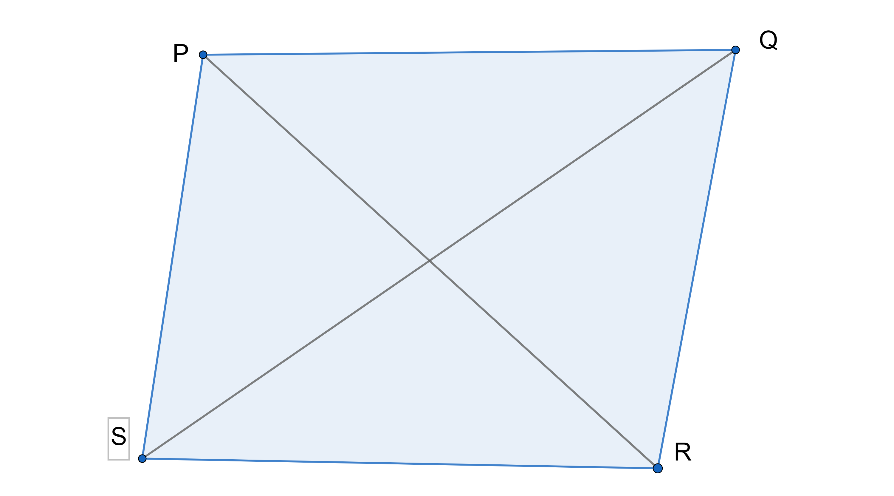
So we can see the parallelogram above $PQRS$ . Where $PR$ and $QS$ are diagonals of parallelogram $PQRS$ .
Let ${{L}_{1}}$ and ${{L}_{2}}$ be the lines such that ${{L}_{1}}$ and ${{L}_{2}}$ is $x+3y=4$ and $6x-2y=7$ respectively.
So now we will take the slope of line ${{L}_{1}}$ that is $x+3y=4$ .
So to find out slope we should convert $x+3y=4$ in the form $y=mx+c$ .
So converting we get $y=-\dfrac{1}{3}x+\dfrac{4}{3}$.
So let slope of line ${{L}_{1}}$ be ${{m}_{1}}$ which is $\dfrac{-1}{3}$.
So ${{m}_{1}}=\dfrac{-1}{3}$
So now we will take the slope of line ${{L}_{2}}$ that is $6x-2y=7$ .
So to find out slope we should convert $6x-2y=7$ in the form $y=mx+c$.
So converting we get $y=3x-\dfrac{7}{2}$.
So let slope of line ${{L}_{2}}$ be ${{m}_{2}}$ which is $3$ .
So ${{m}_{2}}=3$
So we know the property that if two slopes of two different lines are multiplied and we get the final value as $-1$ then the lines are said to be perpendicular.
So let us see for ${{m}_{1}}$ and ${{m}_{2}}$. So multiplying both, we get
${{m}_{1}}\times {{m}_{2}}$$=\dfrac{-1}{3}\times 3=-1$
So we can see that the lines are perpendicular.
So ${{L}_{1}}\bot {{L}_{2}}$ ,
i.e. we can say that
$diagonal PR\bot diagonal QS$
So here we get two options, that is it might be rhombus or it might be square.
Because diagonals of rhombus and square bisect each other at right angles.
Squares are a special case of parallelograms itself
Since it is given that $PQRS$ is a parallelogram.
So we know that the angle between any two sides of a parallelogram and rhombus is not equal to ${{90}^{\circ }}$.
So incase of square the angle between any two sides is ${{90}^{\circ }}$.
Squares are a special case of parallelograms itself.
So the parallelogram can be square or a rhombus.
Option(B) and Option (D) are correct answers.
Note: So just keep in mind that you should know properties of square, rhombus, parallelogram etc.
Sometimes jumbling occurs while converting the equation into $y=mx+c$ form. See the question properly and then solve it. You should be familiar with the properties. As mentioned above” So we know that the angle between any two sides of rhombus is not equal to ${{90}^{\circ }}$ , these properties should be known.
Complete step by step answer:
So here we have a parallelogram $PQRS$ and the equation of diagonals are given.
So we can see the parallelogram above $PQRS$ . Where $PR$ and $QS$ are diagonals of parallelogram $PQRS$ .
Let ${{L}_{1}}$ and ${{L}_{2}}$ be the lines such that ${{L}_{1}}$ and ${{L}_{2}}$ is $x+3y=4$ and $6x-2y=7$ respectively.
So now we will take the slope of line ${{L}_{1}}$ that is $x+3y=4$ .
So to find out slope we should convert $x+3y=4$ in the form $y=mx+c$ .
So converting we get $y=-\dfrac{1}{3}x+\dfrac{4}{3}$.
So let slope of line ${{L}_{1}}$ be ${{m}_{1}}$ which is $\dfrac{-1}{3}$.
So ${{m}_{1}}=\dfrac{-1}{3}$
So now we will take the slope of line ${{L}_{2}}$ that is $6x-2y=7$ .
So to find out slope we should convert $6x-2y=7$ in the form $y=mx+c$.
So converting we get $y=3x-\dfrac{7}{2}$.
So let slope of line ${{L}_{2}}$ be ${{m}_{2}}$ which is $3$ .
So ${{m}_{2}}=3$
So we know the property that if two slopes of two different lines are multiplied and we get the final value as $-1$ then the lines are said to be perpendicular.
So let us see for ${{m}_{1}}$ and ${{m}_{2}}$. So multiplying both, we get
${{m}_{1}}\times {{m}_{2}}$$=\dfrac{-1}{3}\times 3=-1$
So we can see that the lines are perpendicular.
So ${{L}_{1}}\bot {{L}_{2}}$ ,
i.e. we can say that
$diagonal PR\bot diagonal QS$
So here we get two options, that is it might be rhombus or it might be square.
Because diagonals of rhombus and square bisect each other at right angles.
Squares are a special case of parallelograms itself
Since it is given that $PQRS$ is a parallelogram.
So we know that the angle between any two sides of a parallelogram and rhombus is not equal to ${{90}^{\circ }}$.
So incase of square the angle between any two sides is ${{90}^{\circ }}$.
Squares are a special case of parallelograms itself.
So the parallelogram can be square or a rhombus.
Option(B) and Option (D) are correct answers.
Note: So just keep in mind that you should know properties of square, rhombus, parallelogram etc.
Sometimes jumbling occurs while converting the equation into $y=mx+c$ form. See the question properly and then solve it. You should be familiar with the properties. As mentioned above” So we know that the angle between any two sides of rhombus is not equal to ${{90}^{\circ }}$ , these properties should be known.
Recently Updated Pages
Master Class 11 English: Engaging Questions & Answers for Success

Master Class 11 Social Science: Engaging Questions & Answers for Success
Master Class 11 Maths: Engaging Questions & Answers for Success
Master Class 11 Biology: Engaging Questions & Answers for Success
Master Class 11 Physics: Engaging Questions & Answers for Success
Master Class 11 Chemistry: Engaging Questions & Answers for Success
Trending doubts
One Metric ton is equal to kg A 10000 B 1000 C 100 class 11 physics CBSE
Difference Between Prokaryotic Cells and Eukaryotic Cells
Find the value of the expression given below sin 30circ class 11 maths CBSE
Difference between physical and chemical change class 11 chemistry CBSE
Two of the body parts which do not appear in MRI are class 11 biology CBSE
Draw a diagram of a plant cell and label at least eight class 11 biology CBSE