




The Diagonal of a Rhombus measures 16cm and 30cm. find its perimeter?
Answer
 Verified
645k+ views
Hint: In this particular question first draw the pictorial representation of the above problem it will give us a clear picture of what we have to calculate, then use the concept that in a rhombus all sides are equal and the diagonals of the rhombus bisect each other at 90 degrees so use these concepts to reach the solution of the question.
Complete step-by-step answer:
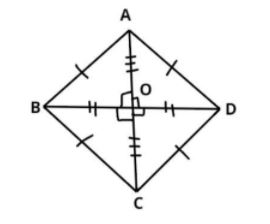
Let us consider the ABCD rhombus as shown in the above figure.
Where AC and BD are the diagonals of the rhombus.
Now as we know that in a rhombus all sides are equal therefore, AB = BC = CD = DA
And we all know that the diagonals of the rhombus bisect each other at 90 degrees.
Therefore, OA = OC = $\dfrac{{AC}}{2}$...................... (1),
And OB = OD = $\dfrac{{BD}}{2}$........... (2)
And $\angle AOD = \angle AOB = \angle BOC = \angle COD = {90^o}$ as shown in the above figure.
Now it is given that the diagonals of the rhombus are 16 cm and 30 cm.
Therefore, AC = 30cm and BD = 16cm.
Now from equation (1) and (2) we have,
OA = OC = $\dfrac{{30}}{2} = 15$cm,
And, OB = OD = $\dfrac{{16}}{2} = 8$cm
So in any triangle apply Pythagoras theorem we have,
As we know that according to the Pythagoras theorem that in a right triangle the sum of the square of the base and perpendicular is equal to the square of the hypotenuse.
$ \Rightarrow {\left( {{\text{base}}} \right)^2} + {\left( {{\text{perpendicular}}} \right)^2} = {\left( {{\text{hypotenuse}}} \right)^{^2}}$................. (1)
So in triangle AOD we have,
Base = OB, perpendicular = OA, and hypotenuse = AB.
Now from equation (1) we have,
$ \Rightarrow {\left( {{\text{OB}}} \right)^2} + {\left( {{\text{OA}}} \right)^2} = {\left( {{\text{AB}}} \right)^{^2}}$
Now substitute the values of OA and OB in the above equation we have,
$ \Rightarrow {\left( {\text{8}} \right)^2} + {\left( {{\text{15}}} \right)^2} = {\left( {{\text{AB}}} \right)^{^2}}$
$ \Rightarrow {\left( {{\text{AB}}} \right)^{^2}} = 64 + 225 = 289 = {\left( {17} \right)^2}$
$ \Rightarrow {\text{AB}} = 17$ cm.
Therefore, AB = BC = CD = DA = 17 cm.
Now as we know that the perimeter of any shape is the sum of all the sides of the shape.
So the perimeter of the rhombus is the sum of all the sides of the rhombus.
So the perimeter of the rhombus = AB + BC + CD + DA
Now substitute the values we have,
So the perimeter of the rhombus = 17 + 17 + 17 + 17 = 68 cm.
So the perimeter of the rhombus is 68cm.
So this is the required answer.
Note: Whenever we face such types of questions the key concept we have to remember is that the perimeter of any shape is the sum of all the sides of the shape, so first find out the length if the sides using Pythagoras theorem as above, then add all these sides to get the required perimeter of the rhombus as above.
Complete step-by-step answer:
Let us consider the ABCD rhombus as shown in the above figure.
Where AC and BD are the diagonals of the rhombus.
Now as we know that in a rhombus all sides are equal therefore, AB = BC = CD = DA
And we all know that the diagonals of the rhombus bisect each other at 90 degrees.
Therefore, OA = OC = $\dfrac{{AC}}{2}$...................... (1),
And OB = OD = $\dfrac{{BD}}{2}$........... (2)
And $\angle AOD = \angle AOB = \angle BOC = \angle COD = {90^o}$ as shown in the above figure.
Now it is given that the diagonals of the rhombus are 16 cm and 30 cm.
Therefore, AC = 30cm and BD = 16cm.
Now from equation (1) and (2) we have,
OA = OC = $\dfrac{{30}}{2} = 15$cm,
And, OB = OD = $\dfrac{{16}}{2} = 8$cm
So in any triangle apply Pythagoras theorem we have,
As we know that according to the Pythagoras theorem that in a right triangle the sum of the square of the base and perpendicular is equal to the square of the hypotenuse.
$ \Rightarrow {\left( {{\text{base}}} \right)^2} + {\left( {{\text{perpendicular}}} \right)^2} = {\left( {{\text{hypotenuse}}} \right)^{^2}}$................. (1)
So in triangle AOD we have,
Base = OB, perpendicular = OA, and hypotenuse = AB.
Now from equation (1) we have,
$ \Rightarrow {\left( {{\text{OB}}} \right)^2} + {\left( {{\text{OA}}} \right)^2} = {\left( {{\text{AB}}} \right)^{^2}}$
Now substitute the values of OA and OB in the above equation we have,
$ \Rightarrow {\left( {\text{8}} \right)^2} + {\left( {{\text{15}}} \right)^2} = {\left( {{\text{AB}}} \right)^{^2}}$
$ \Rightarrow {\left( {{\text{AB}}} \right)^{^2}} = 64 + 225 = 289 = {\left( {17} \right)^2}$
$ \Rightarrow {\text{AB}} = 17$ cm.
Therefore, AB = BC = CD = DA = 17 cm.
Now as we know that the perimeter of any shape is the sum of all the sides of the shape.
So the perimeter of the rhombus is the sum of all the sides of the rhombus.
So the perimeter of the rhombus = AB + BC + CD + DA
Now substitute the values we have,
So the perimeter of the rhombus = 17 + 17 + 17 + 17 = 68 cm.
So the perimeter of the rhombus is 68cm.
So this is the required answer.
Note: Whenever we face such types of questions the key concept we have to remember is that the perimeter of any shape is the sum of all the sides of the shape, so first find out the length if the sides using Pythagoras theorem as above, then add all these sides to get the required perimeter of the rhombus as above.
Recently Updated Pages
Basicity of sulphurous acid and sulphuric acid are

Master Class 12 Economics: Engaging Questions & Answers for Success
Master Class 12 Biology: Engaging Questions & Answers for Success
Master Class 11 English: Engaging Questions & Answers for Success
Master Class 11 Physics: Engaging Questions & Answers for Success
Master Class 11 Computer Science: Engaging Questions & Answers for Success
Trending doubts
What is the Total Duration of Football Match?
In football, which nation is called "La Roja"?
Why is there a time difference of about 5 hours between class 10 social science CBSE
What is the award for the best player at the FIFA World Cup?
Define Potential, Developed, Stock and Reserved resources
Draw the diagram of the sectional view of the human class 10 biology CBSE