




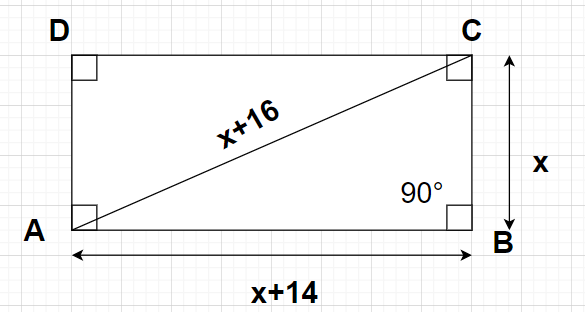
The diagonal of a rectangular field is 16 metres more than the shorter side. If the longer side is 14 metres more than the shortest side, then find the lengths of the sides of the field.
Answer
 Verified
650.4k+ views
Hint:Here, we will proceed by expressing the diagonal and the length of the longer side in terms of the length of the shorter side according to the problem statement and then applying Pythagoras Theorem in order to get the lengths of the sides of the rectangular field.
Complete step-by-step answer:
Let ABCD be a rectangle with AB = CD and BC = AD where sides AB and CD are the longest sides and sides BC and AD are the shortest sides. Here, the diagonals of the rectangle are AC and BD.
Let us suppose the length of the shorter side is x metres.
i.e., Shorter side = BC = AD = x metres
Given, the diagonal of the rectangle ABCD (take any one of the two diagonals) is 16 metres more than the shorter side
i.e., Diagonal = Shorter side + 16
Considering the diagonal AC in the above equation, we have
$ \Rightarrow $AC = (x+16) metres
Also, given that the longest side is 14 metres more than the shorter side
i.e., Longer side = Shorter side + 14
$ \Rightarrow $AB = CD = (x+14) metres
According to the properties of the rectangle, interior angles made at the vertices of a rectangle will always be right angles
So, $\angle {\text{B}} = {90^0}$ and hence, $\vartriangle $ABC is a right angled triangle
By Pythagoras Theorem in any right angled triangle, we have
${\left( {{\text{Hypotenuse}}} \right)^2} = {\left( {{\text{Perpendicular}}} \right)^2} + {\left( {{\text{Base}}} \right)^2}$
By using the above formula in $\vartriangle $ABC, we get
\[
{\left( {{\text{AC}}} \right)^2} = {\left( {{\text{BC}}} \right)^2} + {\left( {{\text{AB}}} \right)^2} \\
\Rightarrow {\left( {x + 16} \right)^2} = {\left( x \right)^2} + {\left( {x + 14} \right)^2} \\
\Rightarrow {x^2} + 256 + 32x = {x^2} + {x^2} + 196 + 28x \\
\Rightarrow {x^2} + 256 + 32x = 2{x^2} + 196 + 28x \\
\Rightarrow 2{x^2} + 196 + 28x - \left( {{x^2} + 256 + 32x} \right) = 0 \\
\Rightarrow 2{x^2} + 196 + 28x - {x^2} - 256 - 32x = 0 \\
\Rightarrow {x^2} - 4x - 60 = 0 \\
\]
By solving the above quadratic equation by splitting the middle terms method, we have
\[
\Rightarrow {x^2} + 6x - 10x - 60 = 0 \\
\Rightarrow x\left( {x + 6} \right) - 10\left( {x + 6} \right) = 0 \\
\Rightarrow \left( {x + 6} \right)\left( {x - 10} \right) = 0 \\
\]
Either \[
x + 6 = 0 \\
\Rightarrow x = - 6 \\
\] or \[
x - 10 = 0 \\
\Rightarrow x = 10 \\
\]
Since, the length of the side of any rectangle can never be negative.
So, x = -6 is neglected
Length of the shorter side = BC = AD = 10 metres
Length of the longer side = AB = CD = x+14 = 10+14 = 24 metres
Therefore, the lengths of the given rectangular field are 24 metres and 10 metres.
Note- In any right angled triangle, the side opposite to the right angle is known as hypotenuse, the side opposite to the considered angle is known as perpendicular and the remaining side is known as base. In this particular problem, in the right angled triangle ABC, AC is the hypotenuse, BC is the perpendicular and AB is the base, from this concept we can solve these types of questions.
Complete step-by-step answer:
Let ABCD be a rectangle with AB = CD and BC = AD where sides AB and CD are the longest sides and sides BC and AD are the shortest sides. Here, the diagonals of the rectangle are AC and BD.
Let us suppose the length of the shorter side is x metres.
i.e., Shorter side = BC = AD = x metres
Given, the diagonal of the rectangle ABCD (take any one of the two diagonals) is 16 metres more than the shorter side
i.e., Diagonal = Shorter side + 16
Considering the diagonal AC in the above equation, we have
$ \Rightarrow $AC = (x+16) metres
Also, given that the longest side is 14 metres more than the shorter side
i.e., Longer side = Shorter side + 14
$ \Rightarrow $AB = CD = (x+14) metres
According to the properties of the rectangle, interior angles made at the vertices of a rectangle will always be right angles
So, $\angle {\text{B}} = {90^0}$ and hence, $\vartriangle $ABC is a right angled triangle
By Pythagoras Theorem in any right angled triangle, we have
${\left( {{\text{Hypotenuse}}} \right)^2} = {\left( {{\text{Perpendicular}}} \right)^2} + {\left( {{\text{Base}}} \right)^2}$
By using the above formula in $\vartriangle $ABC, we get
\[
{\left( {{\text{AC}}} \right)^2} = {\left( {{\text{BC}}} \right)^2} + {\left( {{\text{AB}}} \right)^2} \\
\Rightarrow {\left( {x + 16} \right)^2} = {\left( x \right)^2} + {\left( {x + 14} \right)^2} \\
\Rightarrow {x^2} + 256 + 32x = {x^2} + {x^2} + 196 + 28x \\
\Rightarrow {x^2} + 256 + 32x = 2{x^2} + 196 + 28x \\
\Rightarrow 2{x^2} + 196 + 28x - \left( {{x^2} + 256 + 32x} \right) = 0 \\
\Rightarrow 2{x^2} + 196 + 28x - {x^2} - 256 - 32x = 0 \\
\Rightarrow {x^2} - 4x - 60 = 0 \\
\]
By solving the above quadratic equation by splitting the middle terms method, we have
\[
\Rightarrow {x^2} + 6x - 10x - 60 = 0 \\
\Rightarrow x\left( {x + 6} \right) - 10\left( {x + 6} \right) = 0 \\
\Rightarrow \left( {x + 6} \right)\left( {x - 10} \right) = 0 \\
\]
Either \[
x + 6 = 0 \\
\Rightarrow x = - 6 \\
\] or \[
x - 10 = 0 \\
\Rightarrow x = 10 \\
\]
Since, the length of the side of any rectangle can never be negative.
So, x = -6 is neglected
Length of the shorter side = BC = AD = 10 metres
Length of the longer side = AB = CD = x+14 = 10+14 = 24 metres
Therefore, the lengths of the given rectangular field are 24 metres and 10 metres.
Note- In any right angled triangle, the side opposite to the right angle is known as hypotenuse, the side opposite to the considered angle is known as perpendicular and the remaining side is known as base. In this particular problem, in the right angled triangle ABC, AC is the hypotenuse, BC is the perpendicular and AB is the base, from this concept we can solve these types of questions.
Recently Updated Pages
Master Class 11 English: Engaging Questions & Answers for Success

Master Class 11 Social Science: Engaging Questions & Answers for Success
Master Class 11 Maths: Engaging Questions & Answers for Success
Master Class 11 Biology: Engaging Questions & Answers for Success
Master Class 11 Physics: Engaging Questions & Answers for Success
Master Class 11 Chemistry: Engaging Questions & Answers for Success
Trending doubts
Explain the Treaty of Vienna of 1815 class 10 social science CBSE
What is the full form of CNG A Complete Natural Gas class 10 social science CBSE
In cricket, what is a "Yorker" designed to do?
What is the full form of POSCO class 10 social science CBSE
Define Potential, Developed, Stock and Reserved resources
What were the majoritarian measures taken in Sri Lanka class 10 social science CBSE