




The deflection in a galvanometer falls from $50$ divisions to $20$ divisions, when a $12\Omega $ shunt is applied. The galvanometer resistance is
(A) $18\Omega $
(B) $24\Omega $
(C) $30\Omega $
(D) $36\Omega $
Answer
 Verified
495.3k+ views
Hint: In order to solve this question, we will use the general formula of shunt resistance which is added to the galvanometer, and then using various parameters which are given in the question we will find the actual value of resistance of the given galvanometer.
Formula used:
To calculate the shunt resistance which is added to the galvanometer we use the general formula as,
$S = \dfrac{{{I_g}.{R_g}}}{{(I - {I_g})}}$
where,
S is the shunt resistance which is added to the galvanometer.
${I_g}$ is the current that passes through the galvanometer when shunt resistance is added.
$I$ is the initial current passing through the galvanometer.
${R_g}$ is the actual resistance of the galvanometer.
Complete step by step answer:
If k is the figure of merit of the current of galvanometer then according to the question we have,
${I_g} = 20k$ as the galvanometer drops to $20$ divisions.
$I = 50k$ initial divisions.
$S = 12\Omega $ shunt resistance.
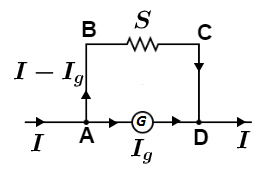
Now, using the formula and putting the values of parameters we get, the magnitude and direction of current across galvanometer G and shunt resistance S is shown in diagram as
$S = \dfrac{{{I_g}.{R_g}}}{{(I - {I_g})}}$
$12 = \dfrac{{(20k){R_g}}}{{(50k - 20k)}}$
on solving we get,
$12 = \dfrac{{20}}{{30}}{R_g}$
or
${R_g} = 18\Omega $
So, the value of actual resistance of the galvanometer is $18\Omega $
Hence, the correct option is (A) $18\Omega $.
Note: It should be remembered that, the figure of merit of any galvanometer is the amount of current required to pass through the galvanometer in order to produce a unit deflection in the galvanometer scale, and its denoted by k, so if n is the number of division and I is the current then current can simply be written as $I = nk.$
Formula used:
To calculate the shunt resistance which is added to the galvanometer we use the general formula as,
$S = \dfrac{{{I_g}.{R_g}}}{{(I - {I_g})}}$
where,
S is the shunt resistance which is added to the galvanometer.
${I_g}$ is the current that passes through the galvanometer when shunt resistance is added.
$I$ is the initial current passing through the galvanometer.
${R_g}$ is the actual resistance of the galvanometer.
Complete step by step answer:
If k is the figure of merit of the current of galvanometer then according to the question we have,
${I_g} = 20k$ as the galvanometer drops to $20$ divisions.
$I = 50k$ initial divisions.
$S = 12\Omega $ shunt resistance.
Now, using the formula and putting the values of parameters we get, the magnitude and direction of current across galvanometer G and shunt resistance S is shown in diagram as
$S = \dfrac{{{I_g}.{R_g}}}{{(I - {I_g})}}$
$12 = \dfrac{{(20k){R_g}}}{{(50k - 20k)}}$
on solving we get,
$12 = \dfrac{{20}}{{30}}{R_g}$
or
${R_g} = 18\Omega $
So, the value of actual resistance of the galvanometer is $18\Omega $
Hence, the correct option is (A) $18\Omega $.
Note: It should be remembered that, the figure of merit of any galvanometer is the amount of current required to pass through the galvanometer in order to produce a unit deflection in the galvanometer scale, and its denoted by k, so if n is the number of division and I is the current then current can simply be written as $I = nk.$
Recently Updated Pages
Master Class 12 Social Science: Engaging Questions & Answers for Success

Master Class 12 Physics: Engaging Questions & Answers for Success
Master Class 12 Maths: Engaging Questions & Answers for Success
Master Class 12 Economics: Engaging Questions & Answers for Success
Master Class 12 Chemistry: Engaging Questions & Answers for Success
Master Class 12 Business Studies: Engaging Questions & Answers for Success
Trending doubts
Which are the Top 10 Largest Countries of the World?
Draw a labelled sketch of the human eye class 12 physics CBSE
Explain the structure of megasporangium class 12 biology CBSE
What are the major means of transport Explain each class 12 social science CBSE
How many chromosomes are found in human ovum a 46 b class 12 biology CBSE
The diagram of the section of a maize grain is given class 12 biology CBSE