



The curved surface area of the cone is $ 550{\text{ c}}{{\text{m}}^2} $ . Its diameter is $ 14{\text{ cm}} $ , find its volume.
Answer
 Verified
571.8k+ views
Hint: The radius of the cone is to be substituted in the formula for curved surface area of the cone $ {A_c} = \pi \times r \times l $ (where, $ r = $ radius of the cone and $ l = $ slant height of the cone) to determine the slant height. Using the Pythagoras theorem the height of the cone is to be determined. Using the formula for volume of the cone, $ V = \dfrac{1}{3}\pi {r^2}h $ (where, $ h = $ height of the cone).
Complete step-by-step answer:
Given information:
The curved surface area of the cone is given as,
$ {A_s} = 550{\text{ c}}{{\text{m}}^2} \cdots \left( 1 \right) $
The diameter of the cone is ,
$ d = 14{\text{ cm}} $
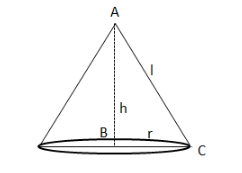
The figure of the cone is shown above.
The radius is calculated from its diameter as,
$
\Rightarrow d = 2r \\
\Rightarrow r = \dfrac{d}{2} \\
\Rightarrow r = \dfrac{{14}}{2} \\
\Rightarrow r = 7{\text{ cm}} \;
$
The mathematical expression for the curved surface area of the cone is given by,
$ {A_c} = \pi \times r \times l \cdots \left( 2 \right) $
Equation (1) and equation (2) , we get
$ \pi \times r \times l = 550 \cdots \left( 3 \right) $
Substitute the value of $ r = 7 $ and $ \pi = \dfrac{{22}}{7} $ in equation (3), we get
$ \dfrac{{22}}{7} \times 7 \times l = 550 \cdots \left( 4 \right) $
Solving equation (4) for slant height, we get
$
\Rightarrow l = \dfrac{{550}}{{22}} \\
\Rightarrow l = 25{\text{ cm}} \;
$
The relation between the slant height radius and the height of right circular cone is given by Pythagoras theorem as
$ {l^2} = {h^2} + {r^2} \cdots \left( 5 \right) $
Substitute the value of $ l = 25 $ and $ r = 7 $ in equation (5), the height can be calculated as
$
\Rightarrow {25^2} = {h^2} + {7^2} \\
\Rightarrow {h^2} = {25^2} - 49 \\
\Rightarrow h = \sqrt {625 - 49} \\
\Rightarrow h = \sqrt {576} \\
\Rightarrow h = 24{\text{ cm}} \;
$
The volume of the cone is calculated using the formula as
$ V = \dfrac{1}{3} \times \pi \times {r^2} \times h \cdots \left( 6 \right) $
Substitute the value of, $ h = 24 $ , $ r = 7 $ and $ \pi = \dfrac{{22}}{7} $ in equation (6) , we get
$
\Rightarrow V = \dfrac{1}{3} \times \dfrac{{22}}{7} \times {7^2} \times 24 \\
\Rightarrow V = 1232{\text{ c}}{{\text{m}}^3} \;
$
Hence, the volume of the cone is $ V = 1232 $ cubic cm.
So, the correct answer is “ $ V = 1232 $ cubic cm”.
Note: The important point is to remember the relation between the slant height, height and the radius of the cone. All the three are related using the Pythagoras theorem as
$ {l^2} = {h^2} + {r^2} $
Where,
$ l = $ slant height
$ h = $ height
$ r = $ radius of the cone.
The value of $ \pi $ should be chosen suitably. For this question it should be chosen as $ \dfrac{{22}}{7} $ .
Complete step-by-step answer:
Given information:
The curved surface area of the cone is given as,
$ {A_s} = 550{\text{ c}}{{\text{m}}^2} \cdots \left( 1 \right) $
The diameter of the cone is ,
$ d = 14{\text{ cm}} $
The figure of the cone is shown above.
The radius is calculated from its diameter as,
$
\Rightarrow d = 2r \\
\Rightarrow r = \dfrac{d}{2} \\
\Rightarrow r = \dfrac{{14}}{2} \\
\Rightarrow r = 7{\text{ cm}} \;
$
The mathematical expression for the curved surface area of the cone is given by,
$ {A_c} = \pi \times r \times l \cdots \left( 2 \right) $
Equation (1) and equation (2) , we get
$ \pi \times r \times l = 550 \cdots \left( 3 \right) $
Substitute the value of $ r = 7 $ and $ \pi = \dfrac{{22}}{7} $ in equation (3), we get
$ \dfrac{{22}}{7} \times 7 \times l = 550 \cdots \left( 4 \right) $
Solving equation (4) for slant height, we get
$
\Rightarrow l = \dfrac{{550}}{{22}} \\
\Rightarrow l = 25{\text{ cm}} \;
$
The relation between the slant height radius and the height of right circular cone is given by Pythagoras theorem as
$ {l^2} = {h^2} + {r^2} \cdots \left( 5 \right) $
Substitute the value of $ l = 25 $ and $ r = 7 $ in equation (5), the height can be calculated as
$
\Rightarrow {25^2} = {h^2} + {7^2} \\
\Rightarrow {h^2} = {25^2} - 49 \\
\Rightarrow h = \sqrt {625 - 49} \\
\Rightarrow h = \sqrt {576} \\
\Rightarrow h = 24{\text{ cm}} \;
$
The volume of the cone is calculated using the formula as
$ V = \dfrac{1}{3} \times \pi \times {r^2} \times h \cdots \left( 6 \right) $
Substitute the value of, $ h = 24 $ , $ r = 7 $ and $ \pi = \dfrac{{22}}{7} $ in equation (6) , we get
$
\Rightarrow V = \dfrac{1}{3} \times \dfrac{{22}}{7} \times {7^2} \times 24 \\
\Rightarrow V = 1232{\text{ c}}{{\text{m}}^3} \;
$
Hence, the volume of the cone is $ V = 1232 $ cubic cm.
So, the correct answer is “ $ V = 1232 $ cubic cm”.
Note: The important point is to remember the relation between the slant height, height and the radius of the cone. All the three are related using the Pythagoras theorem as
$ {l^2} = {h^2} + {r^2} $
Where,
$ l = $ slant height
$ h = $ height
$ r = $ radius of the cone.
The value of $ \pi $ should be chosen suitably. For this question it should be chosen as $ \dfrac{{22}}{7} $ .
Recently Updated Pages
Master Class 9 General Knowledge: Engaging Questions & Answers for Success

Master Class 9 Social Science: Engaging Questions & Answers for Success
Master Class 9 English: Engaging Questions & Answers for Success
Master Class 9 Maths: Engaging Questions & Answers for Success
Master Class 9 Science: Engaging Questions & Answers for Success
Class 9 Question and Answer - Your Ultimate Solutions Guide
Trending doubts
Difference Between Plant Cell and Animal Cell
Fill the blanks with the suitable prepositions 1 The class 9 english CBSE
Who is eligible for RTE class 9 social science CBSE
Which places in India experience sunrise first and class 9 social science CBSE
What is pollution? How many types of pollution? Define it
Name 10 Living and Non living things class 9 biology CBSE