




The curved surface area of a right circular cone with height 24 m and radius 7 m is?
(a) $500\text{ }{{\text{m}}^{2}}$
(b) $550\text{ }{{\text{m}}^{2}}$
(c) $\text{607 }{{\text{m}}^{2}}$
(d) $650\text{ }{{\text{m}}^{2}}$
Answer
 Verified
653.1k+ views
Hint: Calculate the slant height of the right circular cone by using Pythagoras theorem. Then apply the formula for the curved surface area of the cone $=\pi rl$, where $l=$ slant height, $r=$ radius of the cone.
Complete step-by-step answer:
In a right circular cone height is perpendicular to the radius of the cone. Therefore, applying Pythagoras theorem in the right angle triangle formed by height, radius, and slant height, we get, $l=\sqrt{{{r}^{2}}+{{h}^{2}}}$. Here, $l=$ slant height, $r=$ radius of the cone and $h=$ height of cone.
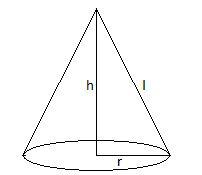
We have been given: \[r=7\text{ m and }h=24\text{ m}\]. Substituting the value of $r\text{ and }h$ in the Pythagorean relation, we get,
\[\begin{align}
& l=\sqrt{{{7}^{2}}+{{24}^{2}}} \\
& =\sqrt{49+576} \\
& =\sqrt{625} \\
& =25 \\
\end{align}\]
Therefore, slant height of the cone $=l=25\text{ m}$.
Now, we know that curved surface area of cone $=\pi rl$. Therefore, substituting the value of\[\pi ,r\ \text{and }l\], we get,
$\begin{align}
& \text{C}\text{.S}\text{.A of cone}=\dfrac{22}{7}\times 7\times 25 \\
& =22\times 25 \\
& =550\text{ }{{\text{m}}^{2}} \\
\end{align}$
Therefore the curved surface area of the cone is $550\text{ }{{\text{m}}^{2}}$.
Hence, option (b) is the correct answer.
Note: Here, one may note that we have used the value of $\pi =\dfrac{22}{7}$. Since, nothing is provided in the question about the value of $\pi $, so we have assumed it $\dfrac{22}{7}$ to make the calculation easy. Also, we have used Pythagoras theorem in the right circular cone. Here, as you can see in the figure that slant height is the hypotenuse of the right angle triangle.
Complete step-by-step answer:
In a right circular cone height is perpendicular to the radius of the cone. Therefore, applying Pythagoras theorem in the right angle triangle formed by height, radius, and slant height, we get, $l=\sqrt{{{r}^{2}}+{{h}^{2}}}$. Here, $l=$ slant height, $r=$ radius of the cone and $h=$ height of cone.
We have been given: \[r=7\text{ m and }h=24\text{ m}\]. Substituting the value of $r\text{ and }h$ in the Pythagorean relation, we get,
\[\begin{align}
& l=\sqrt{{{7}^{2}}+{{24}^{2}}} \\
& =\sqrt{49+576} \\
& =\sqrt{625} \\
& =25 \\
\end{align}\]
Therefore, slant height of the cone $=l=25\text{ m}$.
Now, we know that curved surface area of cone $=\pi rl$. Therefore, substituting the value of\[\pi ,r\ \text{and }l\], we get,
$\begin{align}
& \text{C}\text{.S}\text{.A of cone}=\dfrac{22}{7}\times 7\times 25 \\
& =22\times 25 \\
& =550\text{ }{{\text{m}}^{2}} \\
\end{align}$
Therefore the curved surface area of the cone is $550\text{ }{{\text{m}}^{2}}$.
Hence, option (b) is the correct answer.
Note: Here, one may note that we have used the value of $\pi =\dfrac{22}{7}$. Since, nothing is provided in the question about the value of $\pi $, so we have assumed it $\dfrac{22}{7}$ to make the calculation easy. Also, we have used Pythagoras theorem in the right circular cone. Here, as you can see in the figure that slant height is the hypotenuse of the right angle triangle.
Recently Updated Pages
Master Class 11 English: Engaging Questions & Answers for Success

Master Class 11 Social Science: Engaging Questions & Answers for Success
Master Class 11 Maths: Engaging Questions & Answers for Success
Master Class 11 Biology: Engaging Questions & Answers for Success
Master Class 11 Physics: Engaging Questions & Answers for Success
Master Class 11 Chemistry: Engaging Questions & Answers for Success
Trending doubts
Define Potential, Developed, Stock and Reserved resources
The diagonals of a rhombus are 10cm and 24cm Find the class 10 maths CBSE
One number is chosen from numbers 1 to 200 Find the class 10 maths CBSE
Why is Venus called Earths sister planet class 10 physics CBSE
Draw a circuit diagram showing the cell switch and class 10 physics CBSE
Identify the plural form of the word child from the class 10 english CBSE