




The curved surface area of a frustum cone is $25\pi m{m^2}$. The larger circle area is $12\pi m{m^2}$. The total surface area is $350\pi m{m^2}$. Find the smaller circle area of a cone
A) $313m{m^2}$
B) $323\pi m{m^2}$
C) $333\pi m{m^2}$
D) $313\pi m{m^2}$
Answer
 Verified
620.4k+ views
Hint:
We are given the curved surface area , total surface area and the area of the bigger circle and we can use the formula of area of circle $\pi {r^2}sq.units$, curved surface area of frustum $\pi (r + R)h{\text{ }}sq.units$and obtain the values of ${R^2}{\text{ and }}(R + r)h$ and substitute it in the formula of total surface area of the sphere $\pi [(r + R)h + {r^2} + {R^2}]{\text{ }}sq.units$. And once use the area of the circle formula to get the area of the smaller circle.
Complete step by step solution:
Let's consider a frustum with height h and smaller radius r and bigger radius R
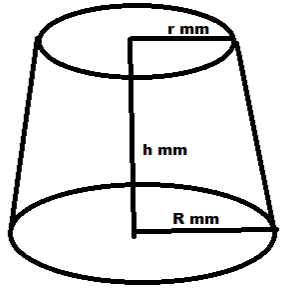
We are given the area of the bigger circle to $12\pi m{m^2}$
We know that the area of circle is given by $\pi {r^2}sq.units$
Therefore
Area of bigger circle $ = \pi {R^2}sq.units$
$
\Rightarrow 12\pi = \pi {R^2} \\
\Rightarrow 12 = {R^2} \\
$
Let this be equation (1)
We are given that the curved surface area of the frustum is $25\pi m{m^2}$
We know that the curved surface area of a frustum is given by $\pi (r + R)h{\text{ }}sq.units$
$
\Rightarrow \pi (r + R)h{\text{ = 25}}\pi \\
\Rightarrow (r + R)h = 25 \\
$
Let this be equation (2)
We are given that the total surface area is $350\pi m{m^2}$
We know that the total surface area of a frustum is given by $\pi [(r + R)h + {r^2} + {R^2}]{\text{ }}sq.units$
$
\Rightarrow \pi [(r + R)h + {r^2} + {R^2}]{\text{ = 350}}\pi \\
\Rightarrow [(r + R)h + {r^2} + {R^2}]{\text{ }} = 350 \\
$
Substitute the values from equation (1) and (2) we get
$
\Rightarrow (25 + {r^2} + 12) = 350 \\
\Rightarrow 37 + {r^2} = 350 \\
\Rightarrow {r^2} = 350 - 37 \\
\Rightarrow {r^2} = 313 \\
$
We know that the area of circle is given by $\pi {r^2}sq.units$
Therefore
Area of smaller circle $ = \pi {r^2}sq.units = 313\pi m{m^2}$
The correct option is D.
Note:
A frustum is
1) the part of a conical solid left after cutting off a top portion with a plane parallel to the base.
2) the part of a solid, as a cone or pyramid, between two usually parallel cutting planes.
We are given the curved surface area , total surface area and the area of the bigger circle and we can use the formula of area of circle $\pi {r^2}sq.units$, curved surface area of frustum $\pi (r + R)h{\text{ }}sq.units$and obtain the values of ${R^2}{\text{ and }}(R + r)h$ and substitute it in the formula of total surface area of the sphere $\pi [(r + R)h + {r^2} + {R^2}]{\text{ }}sq.units$. And once use the area of the circle formula to get the area of the smaller circle.
Complete step by step solution:
Let's consider a frustum with height h and smaller radius r and bigger radius R
We are given the area of the bigger circle to $12\pi m{m^2}$
We know that the area of circle is given by $\pi {r^2}sq.units$
Therefore
Area of bigger circle $ = \pi {R^2}sq.units$
$
\Rightarrow 12\pi = \pi {R^2} \\
\Rightarrow 12 = {R^2} \\
$
Let this be equation (1)
We are given that the curved surface area of the frustum is $25\pi m{m^2}$
We know that the curved surface area of a frustum is given by $\pi (r + R)h{\text{ }}sq.units$
$
\Rightarrow \pi (r + R)h{\text{ = 25}}\pi \\
\Rightarrow (r + R)h = 25 \\
$
Let this be equation (2)
We are given that the total surface area is $350\pi m{m^2}$
We know that the total surface area of a frustum is given by $\pi [(r + R)h + {r^2} + {R^2}]{\text{ }}sq.units$
$
\Rightarrow \pi [(r + R)h + {r^2} + {R^2}]{\text{ = 350}}\pi \\
\Rightarrow [(r + R)h + {r^2} + {R^2}]{\text{ }} = 350 \\
$
Substitute the values from equation (1) and (2) we get
$
\Rightarrow (25 + {r^2} + 12) = 350 \\
\Rightarrow 37 + {r^2} = 350 \\
\Rightarrow {r^2} = 350 - 37 \\
\Rightarrow {r^2} = 313 \\
$
We know that the area of circle is given by $\pi {r^2}sq.units$
Therefore
Area of smaller circle $ = \pi {r^2}sq.units = 313\pi m{m^2}$
The correct option is D.
Note:
A frustum is
1) the part of a conical solid left after cutting off a top portion with a plane parallel to the base.
2) the part of a solid, as a cone or pyramid, between two usually parallel cutting planes.
Recently Updated Pages
Basicity of sulphurous acid and sulphuric acid are

Master Class 10 Computer Science: Engaging Questions & Answers for Success
Master Class 10 Social Science: Engaging Questions & Answers for Success
Master Class 10 Science: Engaging Questions & Answers for Success
Class 10 Question and Answer - Your Ultimate Solutions Guide
Master Class 10 Maths: Engaging Questions & Answers for Success
Trending doubts
What is the Total Duration of Football Match?
Explain the Treaty of Vienna of 1815 class 10 social science CBSE
In football, which nation is called "La Roja"?
Why is there a time difference of about 5 hours between class 10 social science CBSE
10 examples of evaporation in daily life with explanations
What is the full form of POSCO class 10 social science CBSE