




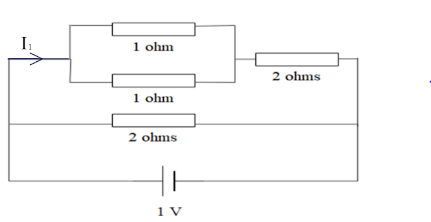
The current I1 (in A) flowing through the 1 Ω resistor in the below circuit is,
(A) $0.25$
(B) $0.2$
(C) $0.5$
(D) $0.4$
Answer
 Verified
585k+ views
Hint
To find out the current flowing through the given resistor, first we need to know about the laws defining the given figure. We need to study ohm's law, which states that the potential difference between two points is directly proportional to the current flowing through the circuit. First, we need to find the total resistance in the top branch, then we need to apply the law to find out the current flowing through it.
Formula used:
${I_{total}} = \dfrac{V}{{{R_{total}}}}$ where V is the potential difference, Itotal is the current in the circuit and Rtotal is the net resistance.
Complete step by step answer
Let us understand the given quantities in the circuit,
The potential difference in the top most branch is $V = 1V$,
R1 and R2 are 1 ohms each,
Now, we need to calculate the total resistance of the branch.
Using the formula for the effective resistance in series,
${R_{total}} = {R_p} + 2\Omega $ ….. eq. 1
By using the formula for resistance in parallel,
${R_p} = \left( {\dfrac{{{R_1} \times {R_2}}}{{{R_1} + {R_2}}}} \right)$
By substituting the values of R1 and R2 ,
${R_p} = \left( {\dfrac{{1 \times 1}}{{1 + 1}}} \right)$
$ \Rightarrow {R_p} = 0.5\Omega $
Now substitute the value in eq. 1,
$\begin{array}{*{20}{l}}
{{R_{total}} = 0.5{\text{ + }}2} \\
{ \Rightarrow {R_{total}} = 2.5\Omega }
\end{array}$
Now, according to ohm’s law,
${I_{total}} = \dfrac{V}{{{R_{total}}}}$
⇒${I_{total}} = \dfrac{1}{{2.5}}$
Thus, we get,
⇒${I_{total}} = 0.4A$
Now, we know that the potential differences in the two branches are the same and the current divides into I1 and I2.
$ \Rightarrow V = {I_1}{R_1} = {I_2}{R_2}$
And the total I = I1 + I2. Then,
$\begin{array}{*{20}{l}}
{{I_1}{R_1} = {I_2}{R_2}} \\
{ \Rightarrow {I_1}{R_1} = \left( {{\text{ }}I{\text{ }} - {\text{ }}{I_1}} \right){\text{ }}{R_2}}
\end{array}$
Thus,
$ \Rightarrow {I_1}\left( {{\text{ }}{R_1} + {\text{ }}{R_2}} \right) = {I_2}{R_2}$
To find I1,
${I_1} = {\text{ }}\dfrac{{{I_2}{R_2}}}{{\left( {{\text{ }}{R_1} + {\text{ }}{R_2}} \right)}}$
By substituting the values of the quantities,
${I_1} = \dfrac{{0.4 \times 1}}{{1 + 1}}$
$ \Rightarrow {I_1} = 0.2A$
Thus, the correct answer is option B.
Note
While calculating the current flowing through the branches, keep in mind that the potential difference across the branches is the same in this type of circuit and the current is divided in the junction.
To find out the current flowing through the given resistor, first we need to know about the laws defining the given figure. We need to study ohm's law, which states that the potential difference between two points is directly proportional to the current flowing through the circuit. First, we need to find the total resistance in the top branch, then we need to apply the law to find out the current flowing through it.
Formula used:
${I_{total}} = \dfrac{V}{{{R_{total}}}}$ where V is the potential difference, Itotal is the current in the circuit and Rtotal is the net resistance.
Complete step by step answer
Let us understand the given quantities in the circuit,
The potential difference in the top most branch is $V = 1V$,
R1 and R2 are 1 ohms each,
Now, we need to calculate the total resistance of the branch.
Using the formula for the effective resistance in series,
${R_{total}} = {R_p} + 2\Omega $ ….. eq. 1
By using the formula for resistance in parallel,
${R_p} = \left( {\dfrac{{{R_1} \times {R_2}}}{{{R_1} + {R_2}}}} \right)$
By substituting the values of R1 and R2 ,
${R_p} = \left( {\dfrac{{1 \times 1}}{{1 + 1}}} \right)$
$ \Rightarrow {R_p} = 0.5\Omega $
Now substitute the value in eq. 1,
$\begin{array}{*{20}{l}}
{{R_{total}} = 0.5{\text{ + }}2} \\
{ \Rightarrow {R_{total}} = 2.5\Omega }
\end{array}$
Now, according to ohm’s law,
${I_{total}} = \dfrac{V}{{{R_{total}}}}$
⇒${I_{total}} = \dfrac{1}{{2.5}}$
Thus, we get,
⇒${I_{total}} = 0.4A$
Now, we know that the potential differences in the two branches are the same and the current divides into I1 and I2.
$ \Rightarrow V = {I_1}{R_1} = {I_2}{R_2}$
And the total I = I1 + I2. Then,
$\begin{array}{*{20}{l}}
{{I_1}{R_1} = {I_2}{R_2}} \\
{ \Rightarrow {I_1}{R_1} = \left( {{\text{ }}I{\text{ }} - {\text{ }}{I_1}} \right){\text{ }}{R_2}}
\end{array}$
Thus,
$ \Rightarrow {I_1}\left( {{\text{ }}{R_1} + {\text{ }}{R_2}} \right) = {I_2}{R_2}$
To find I1,
${I_1} = {\text{ }}\dfrac{{{I_2}{R_2}}}{{\left( {{\text{ }}{R_1} + {\text{ }}{R_2}} \right)}}$
By substituting the values of the quantities,
${I_1} = \dfrac{{0.4 \times 1}}{{1 + 1}}$
$ \Rightarrow {I_1} = 0.2A$
Thus, the correct answer is option B.
Note
While calculating the current flowing through the branches, keep in mind that the potential difference across the branches is the same in this type of circuit and the current is divided in the junction.
Recently Updated Pages
Master Class 12 Social Science: Engaging Questions & Answers for Success

Master Class 12 Physics: Engaging Questions & Answers for Success
Master Class 12 Maths: Engaging Questions & Answers for Success
Master Class 12 Economics: Engaging Questions & Answers for Success
Master Class 12 Chemistry: Engaging Questions & Answers for Success
Master Class 12 Business Studies: Engaging Questions & Answers for Success
Trending doubts
Which are the Top 10 Largest Countries of the World?
Draw a labelled sketch of the human eye class 12 physics CBSE
Explain the structure of megasporangium class 12 biology CBSE
What are the major means of transport Explain each class 12 social science CBSE
How many chromosomes are found in human ovum a 46 b class 12 biology CBSE
The diagram of the section of a maize grain is given class 12 biology CBSE