




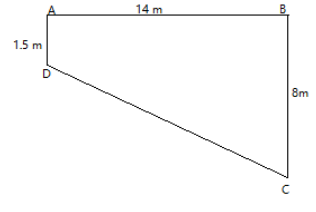
The cross-section \[ABCD\] of a swimming pool is a trapezium. It's width \[AB = 14{\text{m}}\] depth at the shallow end is 1.5 m and at the deep end is 8 m. Find the area of the cross-section.
Answer
 Verified
654.9k+ views
Hint: Construct the line \[DE\] perpendicular to the line \[BC\]. Find the area of the triangle \[DCE\] using the formula \[\dfrac{1}{2} \times base \times height\]. Find the area of the rectangle \[DABE\] using the formula \[Base \times height\]. Add the two to find the answer.
Complete step-by-step answer:
We will first construct the line \[DE\] perpendicular to the line \[BC\]. \[E\] is the intersection point of \[BC\]and $DE$, such that $BC \bot DE$
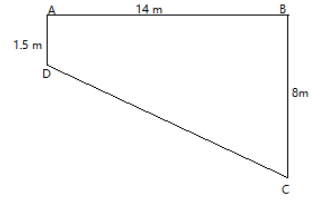
We know that the area of the triangle is \[\dfrac{1}{2} \times base \times height\]. In the triangle \[DCE\], the area can be calculated by substituting \[DE\] for base and \[CE\].
\[\dfrac{1}{2} \times CE \times DE\]
From the figure it is evident that, \[DE = AB = 14{\text{m}}\] and, \[CE + EB = {\text{ }}8{\text{m}}\]. Also, \[AD = EB = 1.5{\text{m}}\]
Therefore \[CE = 8 - 1.5 = 6.5{\text{m}}\].
Substituting the value 6.5 for \[CE\] and 14 for \[DE\] in the equation \[\dfrac{1}{2} \times CE \times DE\].
Thus, area of the triangle \[DCE\] = \[\dfrac{1}{2} \times 6.5 \times 14 = 45.5{{\text{m}}^3}\]
Also, the area of the rectangle is given by the formula \[Base \times height\].
Substituting the value of base with \[AB\] and \[AD\] for height in the formula \[Base \times height\] to find the area of the rectangle \[ABED\].
Area of \[ABED\]=\[AB \times AD\].
Substituting the value 14 for \[AB\] and 1.5 for \[AD\], we get
Area of \[ABED\]= \[14 \times 1.5 = 21\]
The area of the cross-section \[ABCD\] is equal to the sum of the section \[ABED\] and section \[DCE\].
Area of \[ABCD\]= Area of \[ABED\]+ Area of \[DCE\].
Area of \[ABCD\]= $45.5 + 21 = 66.5{{\text{m}}^3}$
Thus the area of the cross section \[ABCD\] is \[66.5{{\text{m}}^3}\].
Note: The formula of the area of the trapezium can also be used alternatively. The area of the trapezium is given by \[\dfrac{1}{2} \times \left( {sum{\text{ }}of{\text{ }}the{\text{ }}parallel{\text{ }}sides} \right) \times {\text{ }}height{\text{ }}between{\text{ }}the{\text{ }}parallel{\text{ }}sides\].
Complete step-by-step answer:
We will first construct the line \[DE\] perpendicular to the line \[BC\]. \[E\] is the intersection point of \[BC\]and $DE$, such that $BC \bot DE$
We know that the area of the triangle is \[\dfrac{1}{2} \times base \times height\]. In the triangle \[DCE\], the area can be calculated by substituting \[DE\] for base and \[CE\].
\[\dfrac{1}{2} \times CE \times DE\]
From the figure it is evident that, \[DE = AB = 14{\text{m}}\] and, \[CE + EB = {\text{ }}8{\text{m}}\]. Also, \[AD = EB = 1.5{\text{m}}\]
Therefore \[CE = 8 - 1.5 = 6.5{\text{m}}\].
Substituting the value 6.5 for \[CE\] and 14 for \[DE\] in the equation \[\dfrac{1}{2} \times CE \times DE\].
Thus, area of the triangle \[DCE\] = \[\dfrac{1}{2} \times 6.5 \times 14 = 45.5{{\text{m}}^3}\]
Also, the area of the rectangle is given by the formula \[Base \times height\].
Substituting the value of base with \[AB\] and \[AD\] for height in the formula \[Base \times height\] to find the area of the rectangle \[ABED\].
Area of \[ABED\]=\[AB \times AD\].
Substituting the value 14 for \[AB\] and 1.5 for \[AD\], we get
Area of \[ABED\]= \[14 \times 1.5 = 21\]
The area of the cross-section \[ABCD\] is equal to the sum of the section \[ABED\] and section \[DCE\].
Area of \[ABCD\]= Area of \[ABED\]+ Area of \[DCE\].
Area of \[ABCD\]= $45.5 + 21 = 66.5{{\text{m}}^3}$
Thus the area of the cross section \[ABCD\] is \[66.5{{\text{m}}^3}\].
Note: The formula of the area of the trapezium can also be used alternatively. The area of the trapezium is given by \[\dfrac{1}{2} \times \left( {sum{\text{ }}of{\text{ }}the{\text{ }}parallel{\text{ }}sides} \right) \times {\text{ }}height{\text{ }}between{\text{ }}the{\text{ }}parallel{\text{ }}sides\].
Recently Updated Pages
Which will be the least stable resonating structure class 11 chemistry CBSE

Explain the structure of megasporangium class 12 biology CBSE
Differentiate between voluntary action and reflex class 10 biology CBSE
How many 5 digit telephone numbers can be construc-class-11-maths-CBSE
How do you find the angle of the resultant vector class 11 physics CBSE
Why is chloroform kept in dark coloured bottles class 12 chemistry CBSE
Trending doubts
The common name of Rheo leaf is A Oyster plant B Boat class 9 biology CBSE
Difference Between Plant Cell and Animal Cell
Fill the blanks with the suitable prepositions 1 The class 9 english CBSE
What is the full form of pH?
Any five important events between the years 1930 to class 9 social science CBSE
On an outline map of India show its neighbouring c class 9 social science CBSE