




The coxal of the pelvic girdle is formed by the fusion of
A. Ilium, ischium, and pubis
B. Scapula and clavicle
C. Ilium and scapula
D. Ilium, scapula, and ischium
E. Clavicle and pubis
Answer
 Verified
621.9k+ views
Hint: Commonly referred to as hip bones, the coxal bones are the two key bones in the pelvis. The three smaller bones that fuse together make up each coxal bone: ilium, ischium, and pubic bone.
Complete answer:
The pelvic girdle, also known as the os coxae, Latin meaning "hip bone," comprises the fused bones colloquially referred to as the ilium, ischium, and pubis. These three parts (Ilium, ischium, and pubis) are split up at birth by hyaline cartilage. The ilium is the largest of the three bones that over time join together to form the pelvis' outermost layers. In most vertebrates, it is present, excluding bony fish and most snakes. Of the three regions which comprise the hip bone, the ischium is the strongest. The body, the superior ramus, and the inferior ramus are divisible into three parts. The ischium forms a large swelling, known as the "sit bone". The most anterior section of the hip bone is the pubis. The long, solid, medial and flat portion of the pubic bone which unites with the other pubic bone is constructed by the body. The ilium, pubis, and ischium together build a cup-shaped socket pointed to as the acetabulum.
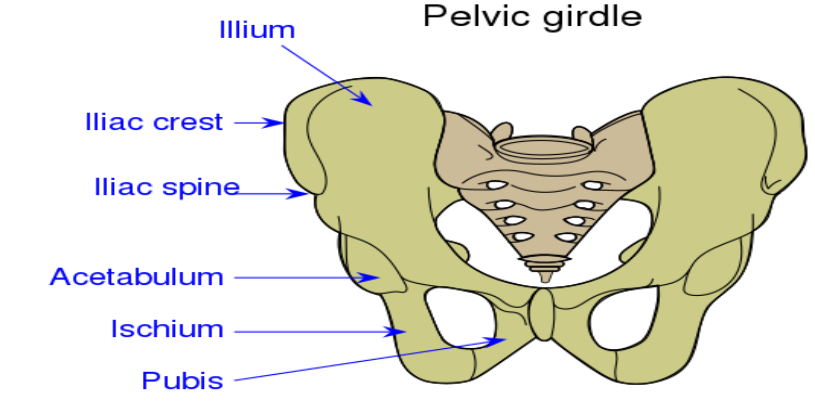
So, the correct answer is option (A)
Additional Information:
In the human psyche, the solid and rigid pelvis is adapted to perform a set of uses. The core functions are a change of weight, especially during movement, from the upper axial skeleton to the lower appendicular skeleton components, which provides attachment in mobility for a range of muscles and ligaments utilized and it contains and prevents the pelvic and abdominopelvic viscera.
Note: It is necessary to differentiate the pelvis muscles into three sections. Some muscles attach and provide postural support to the trunk. Other muscles are attached to the hip and thigh and end up making movement possible. Finally, in order to support the pelvic floor as well as urogenital and gastrointestinal functions, the muscles of the pelvic floor are involved. Hip bone fractures are called pelvic fractures, however, are never to be confused with hip fractures. In order to identify an increased risk of obstetric complications, pelvimetry is the evaluation of the female in relation to the birth of a child.
Complete answer:
The pelvic girdle, also known as the os coxae, Latin meaning "hip bone," comprises the fused bones colloquially referred to as the ilium, ischium, and pubis. These three parts (Ilium, ischium, and pubis) are split up at birth by hyaline cartilage. The ilium is the largest of the three bones that over time join together to form the pelvis' outermost layers. In most vertebrates, it is present, excluding bony fish and most snakes. Of the three regions which comprise the hip bone, the ischium is the strongest. The body, the superior ramus, and the inferior ramus are divisible into three parts. The ischium forms a large swelling, known as the "sit bone". The most anterior section of the hip bone is the pubis. The long, solid, medial and flat portion of the pubic bone which unites with the other pubic bone is constructed by the body. The ilium, pubis, and ischium together build a cup-shaped socket pointed to as the acetabulum.
So, the correct answer is option (A)
Additional Information:
In the human psyche, the solid and rigid pelvis is adapted to perform a set of uses. The core functions are a change of weight, especially during movement, from the upper axial skeleton to the lower appendicular skeleton components, which provides attachment in mobility for a range of muscles and ligaments utilized and it contains and prevents the pelvic and abdominopelvic viscera.
Note: It is necessary to differentiate the pelvis muscles into three sections. Some muscles attach and provide postural support to the trunk. Other muscles are attached to the hip and thigh and end up making movement possible. Finally, in order to support the pelvic floor as well as urogenital and gastrointestinal functions, the muscles of the pelvic floor are involved. Hip bone fractures are called pelvic fractures, however, are never to be confused with hip fractures. In order to identify an increased risk of obstetric complications, pelvimetry is the evaluation of the female in relation to the birth of a child.
Recently Updated Pages
The given figure shows two endocrine glands marked class 11 biology NEET_UG

Match columnI with columnII and select the correct class 11 biology NEET
Match column I with column II and select the correct class 11 biology NEET_UG
Which floral family has left 9 right + 1 arrangement class 11 biology NEET_UG
Which is not a variety of sheep A Lohi B Beetal C Nellore class 11 biology NEET_UG
Match column I with column II and select the correct class 11 biology NEET_UG
Trending doubts
One Metric ton is equal to kg A 10000 B 1000 C 100 class 11 physics CBSE
Draw a diagram of a plant cell and label at least eight class 11 biology CBSE
Difference Between Prokaryotic Cells and Eukaryotic Cells
Draw a well labelled diagram of reflex arc and explain class 11 biology CBSE
Two of the body parts which do not appear in MRI are class 11 biology CBSE
1 ton equals to A 100 kg B 1000 kg C 10 kg D 10000 class 11 physics CBSE