




The correct statement(s) about the oxoacids, \[HCl{O_4}\]and \[HClO\], is(are):
This question has multiple correct options
A. The central atom in both \[HCl{O_4}\] and \[HClO\] is \[s{p^3}\] hybridized
B. The conjugate base of \[HCl{O_4}\] is weaker base than\[\;{H_2}O\]
C. \[HCl{O_4}\] is formed in the reaction between\[C{l_2}\] and \[\;{H_2}O\]
D. \[HCl{O_4}\] is more stable than \[HClO\] because of the resonance stabilization of its anion.
Answer
 Verified
598.2k+ views
Hint: We know that oxoacids are the acids that have oxygen atoms in it. They are different from hydrochloric acid. Oxoacid may contain sulphur, carbon and nitrogen elements from p-block.
Complete answer:
Option (A) The central atom in both \[HCl{O_4}\]and \[HClO\] is \[s{p^3}\] hybridized. The central \[Cl\] atom in \[HCl{O_4}\] has \[4\] bonding domains and zero lone pairs of electrons. The oxygen atom in \[HClO\] has two bonding domains and two lone pairs of electrons.
Option (B) The conjugate base of \[HCl{O_4}\] is weaker than water. This is because \[HCl{O_4}\] is stronger acid than water. A stronger acid has weaker conjugate base and vice versa.
Option (D)\[HCl{O_4}\] is more acidic than \[HClO\] because of the resonance stabilization of its anion. Greater is the extent of delocalisation, greater is the stabilisation of negative charge and higher is the acidity. In \[HCl{O_4}\], negative charge is delocalised over four oxygen atoms.
Hence, the above statements (A), (B) and (D) are correct.
Now, let’s talk about the statement (C).
(C) \[HCl{O_4}\] is formed in the reaction between \[C{l_2}\] and \[{H_2}O\]. This is not the correct statement. Instead, the following methods are used.
\[NaCl{O_4} + HCl \to NaCl + HCl{O_4}\]
Hence, the answer is (A)(B) and (D).
Note:
Here the halogen can be any halogen from the halogen group of p-block.
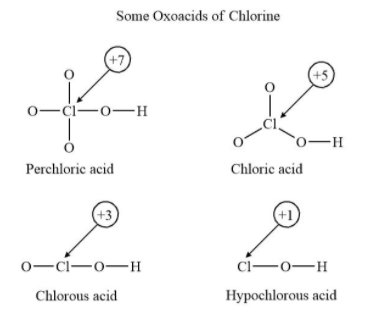
Here as shown in the figure the chlorine will have a different oxidation state. The change in oxidation state will be as per the bonding of the atoms with chlorine and hybridisation will be dependent on that.
Complete answer:
Option (A) The central atom in both \[HCl{O_4}\]and \[HClO\] is \[s{p^3}\] hybridized. The central \[Cl\] atom in \[HCl{O_4}\] has \[4\] bonding domains and zero lone pairs of electrons. The oxygen atom in \[HClO\] has two bonding domains and two lone pairs of electrons.
Option (B) The conjugate base of \[HCl{O_4}\] is weaker than water. This is because \[HCl{O_4}\] is stronger acid than water. A stronger acid has weaker conjugate base and vice versa.
Option (D)\[HCl{O_4}\] is more acidic than \[HClO\] because of the resonance stabilization of its anion. Greater is the extent of delocalisation, greater is the stabilisation of negative charge and higher is the acidity. In \[HCl{O_4}\], negative charge is delocalised over four oxygen atoms.
Hence, the above statements (A), (B) and (D) are correct.
Now, let’s talk about the statement (C).
(C) \[HCl{O_4}\] is formed in the reaction between \[C{l_2}\] and \[{H_2}O\]. This is not the correct statement. Instead, the following methods are used.
\[NaCl{O_4} + HCl \to NaCl + HCl{O_4}\]
Hence, the answer is (A)(B) and (D).
Note:
Here the halogen can be any halogen from the halogen group of p-block.
Here as shown in the figure the chlorine will have a different oxidation state. The change in oxidation state will be as per the bonding of the atoms with chlorine and hybridisation will be dependent on that.
Recently Updated Pages
Master Class 11 English: Engaging Questions & Answers for Success

Master Class 11 Maths: Engaging Questions & Answers for Success
Class 11 Question and Answer - Your Ultimate Solutions Guide
Master Class 11 Biology: Engaging Questions & Answers for Success
Master Class 11 Physics: Engaging Questions & Answers for Success
Master Class 11 Accountancy: Engaging Questions & Answers for Success
Trending doubts
Differentiate between an exothermic and an endothermic class 11 chemistry CBSE
One Metric ton is equal to kg A 10000 B 1000 C 100 class 11 physics CBSE
Difference Between Prokaryotic Cells and Eukaryotic Cells
There are 720 permutations of the digits 1 2 3 4 5 class 11 maths CBSE
Draw a diagram of a plant cell and label at least eight class 11 biology CBSE
1 Quintal is equal to a 110 kg b 10 kg c 100kg d 1000 class 11 physics CBSE