




The correct IUPAC name of the following structure is:
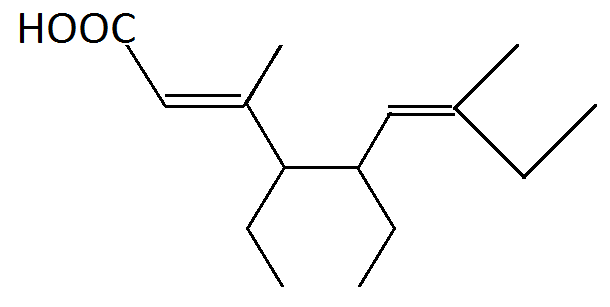
A.${\text{(2E,6Z) - 4,5 - diethyl - 3,7 - dimethylnona - 2,6 - dienal}}$
B.${\text{(2E,6Z) - 4,5 - diethyl - 3,7 - dimethylnona - 2,6 - dienoic acid}}$
C.${\text{(2E,6E) - 4,5 - diethyl - 3,7 - dimethylnona - 2,6 - dienoic acid}}$
Answer
 Verified
577.5k+ views
Hint: IUPAC (International union of pure and applied chemistry) provides the names to organic compounds and the structures related to chemical sciences. It has some guidelines and rules to define the names for particular chemical structures.
Complete step by step answer:
In organic chemistry the naming of compounds is done on the basis of IUPAC nomenclature. IUPAC is also known as the International Union of Pure and Applied Chemistry. The naming of compounds ensures the uniqueness of compounds. Mostly it is useful for industrial purposes because IUPAC nomenclature does not create any confusion and also it is easy to explain to others what we are talking about. And from the name of compound we can easily depict the image of complex in our mind hence the naming concept for compounds is very useful.
Some basic steps are followed to derive the name of organic compounds, these steps are as follows:
Recognize the functional group present in the compound if any.
Find the longest carbon chain containing the main functional group.
Do numbering to the carbon atoms of the longest carbon chain starting from the nearest carbon atom of the functional group.
Check out the substituents or branched groups, do their naming separately with the same method as discussed in the above four steps.
Now it’s time to combine to combine all these things in one name.
These were some steps related to simple IUPAC naming, but if due to presence of double bonds and restricted rotation we can see geometrical isomerism here, in organic chemistry geometrical isomerism names such as cis and trans are not applicable everywhere so the a system names as E-Z system is introduced for naming of these type of compounds. The rules followed by it are known as CIP rules. In this naming system the priority of groups matters.
So we will start by numbering;

Now we will be doing naming of substituents.

And we can see that at both the double bonds the high priority groups are opposite to each other therefore the naming will include ${\text{2E,6E}}$ suffix and the prefix will be enoic acid.
The name of the given structure is as follows:
${\text{(2E,6E) - 4,5 - diethyl - 3,7 - dimethylnona - 2,6 - dienoic acid}}$
Hence option (C) is correct.
Note: IUPAC is an international organization, basically it is a non – government organization which resolves the issues related to chemical science all over the world. The main motive of IUPAC is to encourage chemical science.
Complete step by step answer:
In organic chemistry the naming of compounds is done on the basis of IUPAC nomenclature. IUPAC is also known as the International Union of Pure and Applied Chemistry. The naming of compounds ensures the uniqueness of compounds. Mostly it is useful for industrial purposes because IUPAC nomenclature does not create any confusion and also it is easy to explain to others what we are talking about. And from the name of compound we can easily depict the image of complex in our mind hence the naming concept for compounds is very useful.
Some basic steps are followed to derive the name of organic compounds, these steps are as follows:
Recognize the functional group present in the compound if any.
Find the longest carbon chain containing the main functional group.
Do numbering to the carbon atoms of the longest carbon chain starting from the nearest carbon atom of the functional group.
Check out the substituents or branched groups, do their naming separately with the same method as discussed in the above four steps.
Now it’s time to combine to combine all these things in one name.
These were some steps related to simple IUPAC naming, but if due to presence of double bonds and restricted rotation we can see geometrical isomerism here, in organic chemistry geometrical isomerism names such as cis and trans are not applicable everywhere so the a system names as E-Z system is introduced for naming of these type of compounds. The rules followed by it are known as CIP rules. In this naming system the priority of groups matters.
So we will start by numbering;
Now we will be doing naming of substituents.
And we can see that at both the double bonds the high priority groups are opposite to each other therefore the naming will include ${\text{2E,6E}}$ suffix and the prefix will be enoic acid.
The name of the given structure is as follows:
${\text{(2E,6E) - 4,5 - diethyl - 3,7 - dimethylnona - 2,6 - dienoic acid}}$
Hence option (C) is correct.
Note: IUPAC is an international organization, basically it is a non – government organization which resolves the issues related to chemical science all over the world. The main motive of IUPAC is to encourage chemical science.
Recently Updated Pages
Master Class 11 Computer Science: Engaging Questions & Answers for Success

Master Class 11 Business Studies: Engaging Questions & Answers for Success
Master Class 11 Economics: Engaging Questions & Answers for Success
Master Class 11 English: Engaging Questions & Answers for Success
Master Class 11 Maths: Engaging Questions & Answers for Success
Master Class 11 Biology: Engaging Questions & Answers for Success
Trending doubts
One Metric ton is equal to kg A 10000 B 1000 C 100 class 11 physics CBSE
There are 720 permutations of the digits 1 2 3 4 5 class 11 maths CBSE
Discuss the various forms of bacteria class 11 biology CBSE
Draw a diagram of a plant cell and label at least eight class 11 biology CBSE
State the laws of reflection of light
10 examples of friction in our daily life