




The correct decreasing order of reactivity for a given alkyl(R) group in both ${S_N}1$ and ${S_N}2$ reaction mechanisms is:
A. $R - I > R - Br > R - Cl > R - F$
B. $R - I > R - Cl > R - Br > R - F$
C. $R - F > R - Cl > R - Br > R - I$
D. $R - F > RI > R - Cl > R - Br$
E. $R - Br > R - I > R - F > R - Cl$
Answer
 Verified
597.6k+ views
Hint: Basically, with increase in the size of the halogen atom, the bond length also increases or we can say that the bond strength decreases. Thus, it is very clear that the bond strength decreases. So, by knowing the trends we can easily solve this question.
Complete step by step answer:
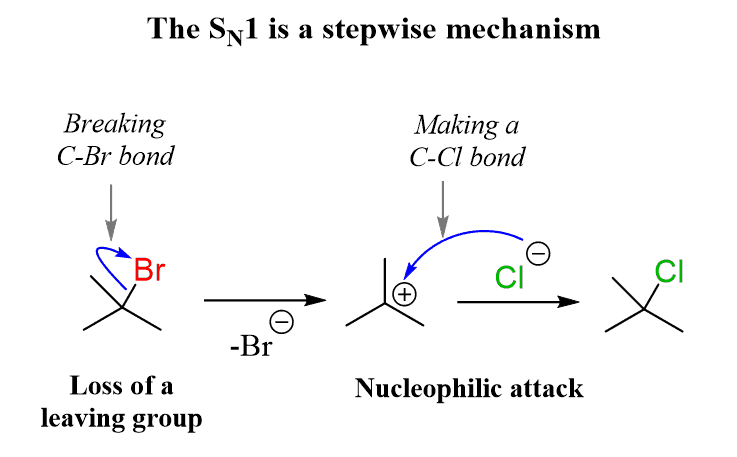
Basically, there are two types of for haloalkanes i.e. ${S_N}1$ and ${S_N}2$ reactions. First of all, we will discuss the ${S_N}1$ reaction. It is a substitution nucleophilic unimolecular reaction and is generally a two-step reaction. So, in the first step the carbon-halogen bond breaks heterolytically with the halogen retaining the previously shared pair of electrons and in the second step, the nucleophile reacts rapidly with the carbocation that was formed in the previous step. This reaction follows the first order kinetics. The reaction is as shown:
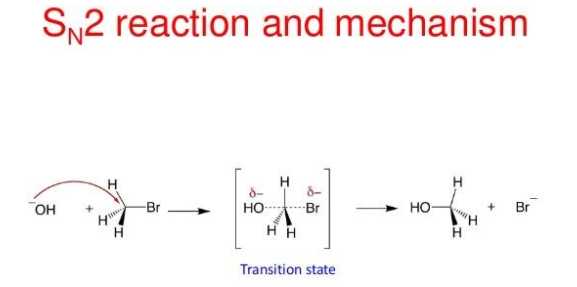
Now, ${S_N}2$ reaction follows the second order kinetics and the rate of reaction depends upon both halo alkane and the participating nucleophile. So, this reaction is known as substitution nucleophilic bimolecular reaction. It is a one- step reaction and in this reaction the nucleophile attacks the positively charged carbon and the halogen leaves the group. The reaction is as shown:
Now, as the size of the halogen atom increases, the bond length also increases or we can say that the bond strength decreases. Thus, the rate of reaction in ${S_N}1$ and $S_N^{}2$ reaction increases. So, the order of size of halogen atom is:
$I > Br > Cl > F$
Therefore, the order of reactivity is :
$R - I > R - Br > R - Cl > R - F$
Hence, option A is correct.
Note: The nucleophilic substitution reaction depends on a number of factors. Some important factors include effect of the solvent, effect of nucleophile, effect of leaving group and the effect of the structure of the substrate.
Complete step by step answer:
Basically, there are two types of for haloalkanes i.e. ${S_N}1$ and ${S_N}2$ reactions. First of all, we will discuss the ${S_N}1$ reaction. It is a substitution nucleophilic unimolecular reaction and is generally a two-step reaction. So, in the first step the carbon-halogen bond breaks heterolytically with the halogen retaining the previously shared pair of electrons and in the second step, the nucleophile reacts rapidly with the carbocation that was formed in the previous step. This reaction follows the first order kinetics. The reaction is as shown:
Now, ${S_N}2$ reaction follows the second order kinetics and the rate of reaction depends upon both halo alkane and the participating nucleophile. So, this reaction is known as substitution nucleophilic bimolecular reaction. It is a one- step reaction and in this reaction the nucleophile attacks the positively charged carbon and the halogen leaves the group. The reaction is as shown:
Now, as the size of the halogen atom increases, the bond length also increases or we can say that the bond strength decreases. Thus, the rate of reaction in ${S_N}1$ and $S_N^{}2$ reaction increases. So, the order of size of halogen atom is:
$I > Br > Cl > F$
Therefore, the order of reactivity is :
$R - I > R - Br > R - Cl > R - F$
Hence, option A is correct.
Note: The nucleophilic substitution reaction depends on a number of factors. Some important factors include effect of the solvent, effect of nucleophile, effect of leaving group and the effect of the structure of the substrate.
Recently Updated Pages
Master Class 12 Social Science: Engaging Questions & Answers for Success

Master Class 12 Physics: Engaging Questions & Answers for Success
Master Class 12 Maths: Engaging Questions & Answers for Success
Master Class 12 Economics: Engaging Questions & Answers for Success
Master Class 12 Chemistry: Engaging Questions & Answers for Success
Master Class 12 Business Studies: Engaging Questions & Answers for Success
Trending doubts
Which are the Top 10 Largest Countries of the World?
Draw a labelled sketch of the human eye class 12 physics CBSE
What are the major means of transport Explain each class 12 social science CBSE
Differentiate between homogeneous and heterogeneous class 12 chemistry CBSE
Sulphuric acid is known as the king of acids State class 12 chemistry CBSE
How many 176Omega resistors in parallel are required class 12 physics CBSE