




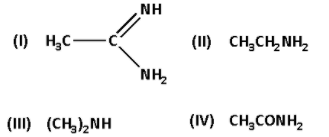
The correct basicity order of the following compound is:
A) I > III > II > IV
B) III > I > II > IV
C) II > I > III > IV
D) I > II > III > IV
Answer
 Verified
626.4k+ views
Hint:More the number of the lone pair of electrons are available higher is the basicity. The basicity is directly proportional to the number of electron donating groups and is inversely proportional to the number of electron withdrawing groups.
Complete step-by-step answer:
In compound (I), there is a lone pair of electron on both the groups ${\text{N}}{{\text{H}}_{\text{2}}}$ and ${\text{NH}}$. The lone pair of electrons on ${\text{N}}{{\text{H}}_{\text{2}}}$ group is in conjugation and is not available. But the lone pair of electrons on ${\text{NH}}$ group is not in conjugation and is available. Also, the two carbon atoms are electron donating. Thus, there are two electron donating groups.
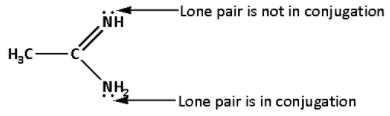
Thus, in compound (I), there is one lone pair available, two electron donating groups and also conjugation is available.
In compound (II), there is a lone pair on the ${\text{N}}{{\text{H}}_{\text{2}}}$ group. The lone pair of electrons on ${\text{N}}{{\text{H}}_{\text{2}}}$ group is not in conjugation and is available. Also, the two carbon atoms are electron donating. Thus, there are two electron donating groups from one side of the functional group.

Thus, in compound (II), there is one lone pair available, two electron donating groups from one side of the functional group but there is no conjugation.Thus, compound (I) is more basic than compound (II).
In compound (III), there is a lone pair on the ${\text{NH}}$ group. The lone pair of electrons on the ${\text{NH}}$ group is not in conjugation and is available. Also, the two carbon atoms are electron donating. Thus, there are two electron donating groups from both sides of the functional group.
Thus, in compound (III), there is one lone pair available, two electron donating groups from both sides of the functional group.

Thus, compound (III) is more basic than compound (II).
In compound (IV), there is a lone pair of electrons on the ${\text{N}}{{\text{H}}_{\text{2}}}$ group. The lone pair of electrons on ${\text{N}}{{\text{H}}_{\text{2}}}$ group is in conjugation and is not available. The group $\left( {{\text{C}} = {\text{O}}} \right)$ is an electron withdrawing group.
Thus, in compound (IV), there is no lone pair available and also, there is an electron withdrawing group which decreases the basicity.
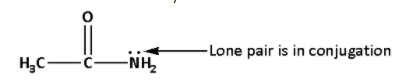
Thus, compound (IV) is least basic. Thus, the correct basicity order is as follows:
I > III > II > IV
Thus, the correct answer is (A) I > III > II > IV.
Note: We should remember that
i) As the number of the electron donating groups increases the basicity of the compound increases.
ii) As the number of electron withdrawing groups increases the basicity of the compound decreases.
Complete step-by-step answer:
In compound (I), there is a lone pair of electron on both the groups ${\text{N}}{{\text{H}}_{\text{2}}}$ and ${\text{NH}}$. The lone pair of electrons on ${\text{N}}{{\text{H}}_{\text{2}}}$ group is in conjugation and is not available. But the lone pair of electrons on ${\text{NH}}$ group is not in conjugation and is available. Also, the two carbon atoms are electron donating. Thus, there are two electron donating groups.
Thus, in compound (I), there is one lone pair available, two electron donating groups and also conjugation is available.
In compound (II), there is a lone pair on the ${\text{N}}{{\text{H}}_{\text{2}}}$ group. The lone pair of electrons on ${\text{N}}{{\text{H}}_{\text{2}}}$ group is not in conjugation and is available. Also, the two carbon atoms are electron donating. Thus, there are two electron donating groups from one side of the functional group.
Thus, in compound (II), there is one lone pair available, two electron donating groups from one side of the functional group but there is no conjugation.Thus, compound (I) is more basic than compound (II).
In compound (III), there is a lone pair on the ${\text{NH}}$ group. The lone pair of electrons on the ${\text{NH}}$ group is not in conjugation and is available. Also, the two carbon atoms are electron donating. Thus, there are two electron donating groups from both sides of the functional group.
Thus, in compound (III), there is one lone pair available, two electron donating groups from both sides of the functional group.
Thus, compound (III) is more basic than compound (II).
In compound (IV), there is a lone pair of electrons on the ${\text{N}}{{\text{H}}_{\text{2}}}$ group. The lone pair of electrons on ${\text{N}}{{\text{H}}_{\text{2}}}$ group is in conjugation and is not available. The group $\left( {{\text{C}} = {\text{O}}} \right)$ is an electron withdrawing group.
Thus, in compound (IV), there is no lone pair available and also, there is an electron withdrawing group which decreases the basicity.
Thus, compound (IV) is least basic. Thus, the correct basicity order is as follows:
I > III > II > IV
Thus, the correct answer is (A) I > III > II > IV.
Note: We should remember that
i) As the number of the electron donating groups increases the basicity of the compound increases.
ii) As the number of electron withdrawing groups increases the basicity of the compound decreases.
Recently Updated Pages
Master Class 11 Social Science: Engaging Questions & Answers for Success

Master Class 11 English: Engaging Questions & Answers for Success
Master Class 11 Accountancy: Engaging Questions & Answers for Success
Master Class 11 Physics: Engaging Questions & Answers for Success
Master Class 11 Computer Science: Engaging Questions & Answers for Success
Master Class 11 Business Studies: Engaging Questions & Answers for Success
Trending doubts
One Metric ton is equal to kg A 10000 B 1000 C 100 class 11 physics CBSE
Find the value of the expression given below sin 30circ class 11 maths CBSE
Draw a diagram of nephron and explain its structur class 11 biology CBSE
10 examples of friction in our daily life
Proton was discovered by A Thomson B Rutherford C Chadwick class 11 chemistry CBSE
The teeth used for biting and cutting food are called class 11 biology CBSE