




The coordinates of the orthocentre of the triangle formed by \[\left( 0,0 \right);\left( 8,0 \right);\left( 4,6 \right)\] is
A. $\left( 4,0 \right)$
B. $\left( 6,3 \right)$
C. $\left( 6,0 \right)$
D. None of these
Answer
 Verified
513.9k+ views
Hint: We first find the equation of two sides on which we draw the perpendicular lines from the opposite vertex. We find the equation of the perpendicular lines which gives us the orthocentre of the triangle as the intersecting point.
Complete step-by-step solution:
The orthocentre of a triangle is the intersecting point of all three altitudes of the triangle.
We draw the triangle formed by \[A=\left( 0,0 \right);B=\left( 8,0 \right);C=\left( 4,6 \right)\]. Let the orthocentre be O.
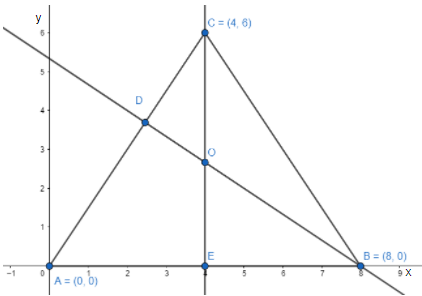
We find the equation of the lines AB and AC.
The general equation of a line going through points \[\left( a,b \right);\left( c,d \right)\] is $\dfrac{y-b}{b-d}=\dfrac{x-a}{a-c}$.
So, equation AB will be $\dfrac{y-0}{0-0}=\dfrac{x-0}{0-8}$. The simplified form is $y=0$.
So, equation AC will be $\dfrac{y-0}{0-6}=\dfrac{x-0}{0-4}$. The simplified form is $3x-2y=0$.
Now we draw the perpendicular lines from C and B on the lines AB and AC respectively.
The general equation of a line perpendicular to $ax+by=c$ is $bx-ay=k$.
Therefore, CE, the perpendicular line of the line $y=0$ will be $x=k$ which is going through the point \[C=\left( 4,6 \right)\].
Putting the values, we get $x=4$. The line CE is $x=4$.
Therefore, BD, the perpendicular line of the line $3x-2y=0$ will be $2x+3y=K$ which is going through the point \[B=\left( 8,0 \right)\].
Putting the values, we get $2\times 8+3\times 0=K\Rightarrow K=16$. The line BD is $2x+3y=16$.
Now we find the intersection point of BD and CE.
So, putting $x=4$ in $2x+3y=16$, we get
\[\begin{align}
& 2\times 4+3y=16 \\
& \Rightarrow y=\dfrac{16-8}{3}=\dfrac{8}{3} \\
\end{align}\]
The point O is \[O=\left( 0,\dfrac{8}{3} \right)\]. The correct option is D.
Note: We assume the lines AB and AC as the point \[A=\left( 0,0 \right)\] makes finding the equation easier. We can use any other line and its perpendicular line; the orthocentre remains fixed. If we draw the third perpendicular line from point A we will get the intersecting point on O.
Complete step-by-step solution:
The orthocentre of a triangle is the intersecting point of all three altitudes of the triangle.
We draw the triangle formed by \[A=\left( 0,0 \right);B=\left( 8,0 \right);C=\left( 4,6 \right)\]. Let the orthocentre be O.
We find the equation of the lines AB and AC.
The general equation of a line going through points \[\left( a,b \right);\left( c,d \right)\] is $\dfrac{y-b}{b-d}=\dfrac{x-a}{a-c}$.
So, equation AB will be $\dfrac{y-0}{0-0}=\dfrac{x-0}{0-8}$. The simplified form is $y=0$.
So, equation AC will be $\dfrac{y-0}{0-6}=\dfrac{x-0}{0-4}$. The simplified form is $3x-2y=0$.
Now we draw the perpendicular lines from C and B on the lines AB and AC respectively.
The general equation of a line perpendicular to $ax+by=c$ is $bx-ay=k$.
Therefore, CE, the perpendicular line of the line $y=0$ will be $x=k$ which is going through the point \[C=\left( 4,6 \right)\].
Putting the values, we get $x=4$. The line CE is $x=4$.
Therefore, BD, the perpendicular line of the line $3x-2y=0$ will be $2x+3y=K$ which is going through the point \[B=\left( 8,0 \right)\].
Putting the values, we get $2\times 8+3\times 0=K\Rightarrow K=16$. The line BD is $2x+3y=16$.
Now we find the intersection point of BD and CE.
So, putting $x=4$ in $2x+3y=16$, we get
\[\begin{align}
& 2\times 4+3y=16 \\
& \Rightarrow y=\dfrac{16-8}{3}=\dfrac{8}{3} \\
\end{align}\]
The point O is \[O=\left( 0,\dfrac{8}{3} \right)\]. The correct option is D.
Note: We assume the lines AB and AC as the point \[A=\left( 0,0 \right)\] makes finding the equation easier. We can use any other line and its perpendicular line; the orthocentre remains fixed. If we draw the third perpendicular line from point A we will get the intersecting point on O.
Recently Updated Pages
Master Class 10 Social Science: Engaging Questions & Answers for Success

Master Class 10 Science: Engaging Questions & Answers for Success
Master Class 10 Maths: Engaging Questions & Answers for Success
Master Class 10 General Knowledge: Engaging Questions & Answers for Success
Master Class 10 Computer Science: Engaging Questions & Answers for Success
Class 10 Question and Answer - Your Ultimate Solutions Guide
Trending doubts
What is the full form of PNG A Petrol Natural Gas B class 10 chemistry CBSE
Explain the Treaty of Vienna of 1815 class 10 social science CBSE
In cricket, how many legal balls are there in a standard over?
Why is there a time difference of about 5 hours between class 10 social science CBSE
Who Won 36 Oscar Awards? Record Holder Revealed
What is the median of the first 10 natural numbers class 10 maths CBSE