




The coordinates of the centre of mass of a uniform flag shaped lamina (thin flat plate) of mass 4kg. (The coordinates of the same are shown in figure) are:
1) $(1.25m,1.50m)$
2) $(1m,1.75m)$
3) $(0.75m,0.75m)$
4) $(0.75m,1.75m)$
Answer
 Verified
569.1k+ views
Hint:It is an imaginary point at which the whole mass of a body is supposed to be concentrated called the centre of mass and the concept of the centre of mass is that of the product of the masses by their distance from a reference point.
Complete step by step solution:
Given that the mass of uniform flag lamina is = $4Kg$
Now, we know that the lamina means (thin flat plate),
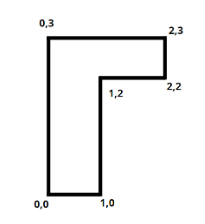
According to the diagram, Lamina can be considered into two rectangular parts and the two parts A and B having masses of $2Kg$ for A and $2Kg$ for B.
Mass of part A is given by
$\begin{gathered}
{m_A} = \sigma \times {A_A} \\
= \sigma \times 2 \times 1 \\
\end{gathered} $
$ = 2\sigma $................( 1)
Similarly, Mass of part B is given by
$\begin{gathered}
{m_B} = \sigma \times {A_B} \\
= \sigma \times 1 \times 2 \\
\end{gathered} $
$ = 2\sigma $.....................( 2)
Coordinate of the center of masses of the parts are given by
$\begin{gathered}
{X_{A(c.o.m)}} = \frac{{{x_1} + {x_2}}}{2} \\
{Y_{A(c.o.m)}} = \frac{{{y_1} + {y_2}}}{2} \\
\end{gathered} $ and
For part A is given by,
${X_{A(c.o.m)}} = \dfrac{{0 + 2}}{2} = 1$ …………...(3)
${Y_{A(c.o.m}} = \dfrac{{2 + 3}}{2} = \dfrac{5}{2}$..................(4)
For part B is given by
${X_{B(c.o.m)}} = \dfrac{{0 + 1}}{2} = \dfrac{1}{2}$ ……………..(5)
${Y_{B(c.o.m)}} = \dfrac{{2 + 0}}{2} = 1$.........................(6)
Now combining part A and part B,
According to the formula of center of mass
${X_{c.o.m}} = \dfrac{{{m_A}{X_A} + {m_B}{X_B}}}{{{m_A} + {m_B}}}$ (Equation 7)
Putting the value of equation (1), (3) and (5) in equation (7)
We get,
$\begin{gathered}
= \frac{{2\sigma (1) + 2\sigma (\frac{1}{2})}}{{2\sigma + 2\sigma }} \\
= \frac{{3\sigma }}{{4\sigma }} \\
= \frac{3}{4} \\
\end{gathered} $
Similarly,
${Y_{c.o.m}} = \dfrac{{{m_A}{Y_A} + {m_B}{Y_B}}}{{{m_A} + {m_B}}}$
$\begin{gathered}
= \dfrac{{2\sigma (\dfrac{5}{2}) + 2\sigma (1)}}{{2\sigma + 2\sigma }} \\
= \dfrac{{7\sigma }}{{4\sigma }} \\
= \frac{7}{4} \\
\end{gathered} $
The required coordinate of this system is given by $(\dfrac{3}{4},\dfrac{7}{4})$ and in decimals $(0.75,1.75)$
Hence, Option 4 is the correct answer.
Note:Remember, the location of mass depends on the distribution of masses and their individual location in the system and for regular geometrical shaped bodies having a uniform distribution of mass located at their centre.
Complete step by step solution:
Given that the mass of uniform flag lamina is = $4Kg$
Now, we know that the lamina means (thin flat plate),
According to the diagram, Lamina can be considered into two rectangular parts and the two parts A and B having masses of $2Kg$ for A and $2Kg$ for B.
Mass of part A is given by
$\begin{gathered}
{m_A} = \sigma \times {A_A} \\
= \sigma \times 2 \times 1 \\
\end{gathered} $
$ = 2\sigma $................( 1)
Similarly, Mass of part B is given by
$\begin{gathered}
{m_B} = \sigma \times {A_B} \\
= \sigma \times 1 \times 2 \\
\end{gathered} $
$ = 2\sigma $.....................( 2)
Coordinate of the center of masses of the parts are given by
$\begin{gathered}
{X_{A(c.o.m)}} = \frac{{{x_1} + {x_2}}}{2} \\
{Y_{A(c.o.m)}} = \frac{{{y_1} + {y_2}}}{2} \\
\end{gathered} $ and
For part A is given by,
${X_{A(c.o.m)}} = \dfrac{{0 + 2}}{2} = 1$ …………...(3)
${Y_{A(c.o.m}} = \dfrac{{2 + 3}}{2} = \dfrac{5}{2}$..................(4)
For part B is given by
${X_{B(c.o.m)}} = \dfrac{{0 + 1}}{2} = \dfrac{1}{2}$ ……………..(5)
${Y_{B(c.o.m)}} = \dfrac{{2 + 0}}{2} = 1$.........................(6)
Now combining part A and part B,
According to the formula of center of mass
${X_{c.o.m}} = \dfrac{{{m_A}{X_A} + {m_B}{X_B}}}{{{m_A} + {m_B}}}$ (Equation 7)
Putting the value of equation (1), (3) and (5) in equation (7)
We get,
$\begin{gathered}
= \frac{{2\sigma (1) + 2\sigma (\frac{1}{2})}}{{2\sigma + 2\sigma }} \\
= \frac{{3\sigma }}{{4\sigma }} \\
= \frac{3}{4} \\
\end{gathered} $
Similarly,
${Y_{c.o.m}} = \dfrac{{{m_A}{Y_A} + {m_B}{Y_B}}}{{{m_A} + {m_B}}}$
$\begin{gathered}
= \dfrac{{2\sigma (\dfrac{5}{2}) + 2\sigma (1)}}{{2\sigma + 2\sigma }} \\
= \dfrac{{7\sigma }}{{4\sigma }} \\
= \frac{7}{4} \\
\end{gathered} $
The required coordinate of this system is given by $(\dfrac{3}{4},\dfrac{7}{4})$ and in decimals $(0.75,1.75)$
Hence, Option 4 is the correct answer.
Note:Remember, the location of mass depends on the distribution of masses and their individual location in the system and for regular geometrical shaped bodies having a uniform distribution of mass located at their centre.
Recently Updated Pages
Master Class 11 Computer Science: Engaging Questions & Answers for Success

Master Class 11 Business Studies: Engaging Questions & Answers for Success
Master Class 11 Economics: Engaging Questions & Answers for Success
Master Class 11 English: Engaging Questions & Answers for Success
Master Class 11 Maths: Engaging Questions & Answers for Success
Master Class 11 Biology: Engaging Questions & Answers for Success
Trending doubts
One Metric ton is equal to kg A 10000 B 1000 C 100 class 11 physics CBSE
There are 720 permutations of the digits 1 2 3 4 5 class 11 maths CBSE
Discuss the various forms of bacteria class 11 biology CBSE
Draw a diagram of a plant cell and label at least eight class 11 biology CBSE
State the laws of reflection of light
Explain zero factorial class 11 maths CBSE