




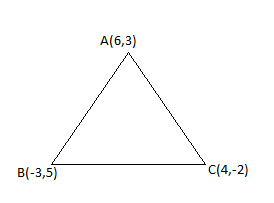
The coordinates of A, B, C are \[\left( {6,3} \right),\left( { - 3,5} \right),\left( {4, - 2} \right)\]respectively and P is any point \[\left( {x,y} \right)\]. Show that the ratio of area of ∆PBC to that of ∆ABC is \[\dfrac{{\left| {x + y - 2} \right|}}{7}\].
Answer
 Verified
586.2k+ views
Hint: Here we are given coordinates of vertices of ∆ABC along with coordinates of point P. Since we are not given the height of the triangle we will use the formula given below to find the area of both the triangles.
Formula used:
Area of the triangle with coordinates \[\left( {{x_1},{y_1}} \right),\left( {{x_2},{y_2}} \right),\left( {{x_3},{y_3}} \right)\] is given by,
\[ \Rightarrow \dfrac{1}{2}\left| {{x_1}\left( {{y_2} - {y_3}} \right) + {x_2}\left( {{y_3} - {y_1}} \right) + {x_3}\left( {{y_1} - {y_2}} \right)} \right|\]
Complete step-by-step answer:
For ∆ABC, coordinates are A \[\left( {{x_1},{y_1}} \right)\]=\[\left( {6,3} \right)\] , B \[\left( {{x_2},{y_2}} \right)\]=\[\left( { - 3,5} \right)\] , C \[\left( {{x_3},{y_3}} \right)\]=\[\left( {4, - 2} \right)\].
Area of ∆ABC \[ \Rightarrow \dfrac{1}{2}\left| {{x_1}\left( {{y_2} - {y_3}} \right) + {x_2}\left( {{y_3} - {y_1}} \right) + {x_3}\left( {{y_1} - {y_2}} \right)} \right|\]
Substituting the values
\[
\Rightarrow \dfrac{1}{2}\left| {6\left( {5 - \left( { - 2} \right)} \right) + ( - 3)\left( { - 2 - 3} \right) + 4\left( {3 - 5} \right)} \right| \\
\Rightarrow \dfrac{1}{2}\left| {6 \times 7 + ( - 3)( - 5) + 4 \times ( - 2)} \right| \\
\Rightarrow \dfrac{1}{2}\left| {42 + 15 - 8} \right| \\
\Rightarrow \dfrac{1}{2}\left| {49} \right| \\
\]
\[ \Rightarrow \dfrac{{49}}{2}\]
For ∆PBC, coordinates are \[P\left( {x,y} \right) = \left( {{x_1},{y_1}} \right)\], \[B\left( {{x_2},{y_2}} \right) = \left( { - 3,5} \right),C\left( {{x_3},{y_3}} \right) = \left( {4, - 2} \right)\]
Area of ∆PBC \[ \Rightarrow \dfrac{1}{2}\left| {{x_1}\left( {{y_2} - {y_3}} \right) + {x_2}\left( {{y_3} - {y_1}} \right) + {x_3}\left( {{y_1} - {y_2}} \right)} \right|\]
Substituting the values
\[
\Rightarrow \dfrac{1}{2}\left| {x\left( {5 - \left( { - 2} \right)} \right) + ( - 3)\left( { - 2 - y} \right) + 4\left( {y - 5} \right)} \right| \\
\Rightarrow \dfrac{1}{2}\left| {7x + 6 + 3y + 4y - 20} \right| \\
\Rightarrow \dfrac{1}{2}\left| {7x + 7y - 14} \right| \\
\]
Taking 7 common
\[ \Rightarrow \dfrac{7}{2}\left| {x + y - 2} \right|\]
Now we have to take ratio of area of ∆PBC to ∆ABC
\[
\Rightarrow \dfrac{{Area\left( {\vartriangle PBC} \right)}}{{Area\left( {\vartriangle ABC} \right)}} \\
\Rightarrow \dfrac{{\dfrac{7}{2}\left| {x + y - 2} \right|}}{{\dfrac{{49}}{2}}} \\
\Rightarrow \dfrac{{\left| {x + y - 2} \right|}}{7} \\
\]
This is the ratio so obtained.
Hence proved.
Note: Don’t use any other formula to find the area here because we are given the coordinates only. Also find the values of modulus. Take the correct ratio of areas of triangles. Carefully add and subtract the signs.
Formula used:
Area of the triangle with coordinates \[\left( {{x_1},{y_1}} \right),\left( {{x_2},{y_2}} \right),\left( {{x_3},{y_3}} \right)\] is given by,
\[ \Rightarrow \dfrac{1}{2}\left| {{x_1}\left( {{y_2} - {y_3}} \right) + {x_2}\left( {{y_3} - {y_1}} \right) + {x_3}\left( {{y_1} - {y_2}} \right)} \right|\]
Complete step-by-step answer:
For ∆ABC, coordinates are A \[\left( {{x_1},{y_1}} \right)\]=\[\left( {6,3} \right)\] , B \[\left( {{x_2},{y_2}} \right)\]=\[\left( { - 3,5} \right)\] , C \[\left( {{x_3},{y_3}} \right)\]=\[\left( {4, - 2} \right)\].
Area of ∆ABC \[ \Rightarrow \dfrac{1}{2}\left| {{x_1}\left( {{y_2} - {y_3}} \right) + {x_2}\left( {{y_3} - {y_1}} \right) + {x_3}\left( {{y_1} - {y_2}} \right)} \right|\]
Substituting the values
\[
\Rightarrow \dfrac{1}{2}\left| {6\left( {5 - \left( { - 2} \right)} \right) + ( - 3)\left( { - 2 - 3} \right) + 4\left( {3 - 5} \right)} \right| \\
\Rightarrow \dfrac{1}{2}\left| {6 \times 7 + ( - 3)( - 5) + 4 \times ( - 2)} \right| \\
\Rightarrow \dfrac{1}{2}\left| {42 + 15 - 8} \right| \\
\Rightarrow \dfrac{1}{2}\left| {49} \right| \\
\]
\[ \Rightarrow \dfrac{{49}}{2}\]
For ∆PBC, coordinates are \[P\left( {x,y} \right) = \left( {{x_1},{y_1}} \right)\], \[B\left( {{x_2},{y_2}} \right) = \left( { - 3,5} \right),C\left( {{x_3},{y_3}} \right) = \left( {4, - 2} \right)\]
Area of ∆PBC \[ \Rightarrow \dfrac{1}{2}\left| {{x_1}\left( {{y_2} - {y_3}} \right) + {x_2}\left( {{y_3} - {y_1}} \right) + {x_3}\left( {{y_1} - {y_2}} \right)} \right|\]
Substituting the values
\[
\Rightarrow \dfrac{1}{2}\left| {x\left( {5 - \left( { - 2} \right)} \right) + ( - 3)\left( { - 2 - y} \right) + 4\left( {y - 5} \right)} \right| \\
\Rightarrow \dfrac{1}{2}\left| {7x + 6 + 3y + 4y - 20} \right| \\
\Rightarrow \dfrac{1}{2}\left| {7x + 7y - 14} \right| \\
\]
Taking 7 common
\[ \Rightarrow \dfrac{7}{2}\left| {x + y - 2} \right|\]
Now we have to take ratio of area of ∆PBC to ∆ABC
\[
\Rightarrow \dfrac{{Area\left( {\vartriangle PBC} \right)}}{{Area\left( {\vartriangle ABC} \right)}} \\
\Rightarrow \dfrac{{\dfrac{7}{2}\left| {x + y - 2} \right|}}{{\dfrac{{49}}{2}}} \\
\Rightarrow \dfrac{{\left| {x + y - 2} \right|}}{7} \\
\]
This is the ratio so obtained.
Hence proved.
Note: Don’t use any other formula to find the area here because we are given the coordinates only. Also find the values of modulus. Take the correct ratio of areas of triangles. Carefully add and subtract the signs.
Recently Updated Pages
Master Class 11 English: Engaging Questions & Answers for Success

Master Class 11 Maths: Engaging Questions & Answers for Success
Master Class 11 Biology: Engaging Questions & Answers for Success
Master Class 11 Social Science: Engaging Questions & Answers for Success
Master Class 11 Physics: Engaging Questions & Answers for Success
Master Class 11 Accountancy: Engaging Questions & Answers for Success
Trending doubts
One Metric ton is equal to kg A 10000 B 1000 C 100 class 11 physics CBSE
There are 720 permutations of the digits 1 2 3 4 5 class 11 maths CBSE
Discuss the various forms of bacteria class 11 biology CBSE
Draw a diagram of a plant cell and label at least eight class 11 biology CBSE
State the laws of reflection of light
Explain zero factorial class 11 maths CBSE