




The coordinates for a rhombus are given as $(2a,0),(0,2b),( - 2a,0),and(0, - 2b)$ . How does one prove that the midpoints of the sides of a rhombus determine a rectangle using coordinate geometry?
Answer
 Verified
579.9k+ views
Hint: The Midpoint Formula works precisely the same way as If you would like to search out the purpose that's exactly halfway between two given points, just average the x-values and therefore the y-values.
Complete step-by-step solution:
Let the coordinates of a rhombus as
$A(2a,0),B(0,2b),C( - 2a,0)$ and $D(0, - 2b)$ .
Let the midpoint of $AB$be $P$ .
Therefore , coordinates are given as ,
$P = \left( {\dfrac{{0 + 2a}}{2},\dfrac{{0 + 2b}}{2}} \right) = (a,b)$
Let the midpoint of $BC$be $Q$ .
Therefore , coordinates are given as ,
$Q = \left( {\dfrac{{ - 2a + 0}}{2},\dfrac{{0 + 2b}}{2}} \right) = ( - a,b)$
Let the midpoint of $CD$be $R$ .
Therefore , coordinates are given as ,
$R = \left( {\dfrac{{0 - 2a}}{2},\dfrac{{ - 2b + 0}}{2}} \right) = ( - a, - b)$
Let the midpoint of $DA$be $S$ .
Therefore , coordinates are given as ,
$S = \left( {\dfrac{{2a + 0}}{2},\dfrac{{0 - 2b}}{2}} \right) = (a, - b)$
It can be seen that $P$ lies in quadrant $I$, $Q$ in Quadrant $II$ , $R$ in $III$ and $S$ in $IV$, Further $P$ and $Q$ are the reflections of each other in y-axis, $Q$ and $R$ are the reflections of each other in x-axis, $R$ and $S$ are reflection of each other in y -axis and $S$ and $P$ are reflection of each other in x -axis.
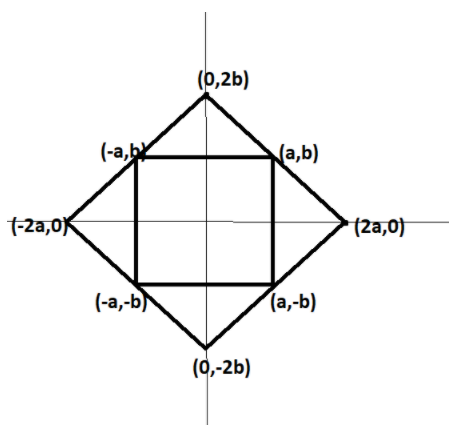
Hence, the mid points of the rhombus form the rectangle.
Note: Sometimes you would like to seek out the purpose that's exactly midway between two other points. For example, you may find a line that bisects (divides into two equal halves) a given line segment. This middle point is named the "midpoint". The concept doesn't come up often, but the Formula is sort of simple and obvious, so you must easily be able to recall it for later.
Complete step-by-step solution:
Let the coordinates of a rhombus as
$A(2a,0),B(0,2b),C( - 2a,0)$ and $D(0, - 2b)$ .
Let the midpoint of $AB$be $P$ .
Therefore , coordinates are given as ,
$P = \left( {\dfrac{{0 + 2a}}{2},\dfrac{{0 + 2b}}{2}} \right) = (a,b)$
Let the midpoint of $BC$be $Q$ .
Therefore , coordinates are given as ,
$Q = \left( {\dfrac{{ - 2a + 0}}{2},\dfrac{{0 + 2b}}{2}} \right) = ( - a,b)$
Let the midpoint of $CD$be $R$ .
Therefore , coordinates are given as ,
$R = \left( {\dfrac{{0 - 2a}}{2},\dfrac{{ - 2b + 0}}{2}} \right) = ( - a, - b)$
Let the midpoint of $DA$be $S$ .
Therefore , coordinates are given as ,
$S = \left( {\dfrac{{2a + 0}}{2},\dfrac{{0 - 2b}}{2}} \right) = (a, - b)$
It can be seen that $P$ lies in quadrant $I$, $Q$ in Quadrant $II$ , $R$ in $III$ and $S$ in $IV$, Further $P$ and $Q$ are the reflections of each other in y-axis, $Q$ and $R$ are the reflections of each other in x-axis, $R$ and $S$ are reflection of each other in y -axis and $S$ and $P$ are reflection of each other in x -axis.
Hence, the mid points of the rhombus form the rectangle.
Note: Sometimes you would like to seek out the purpose that's exactly midway between two other points. For example, you may find a line that bisects (divides into two equal halves) a given line segment. This middle point is named the "midpoint". The concept doesn't come up often, but the Formula is sort of simple and obvious, so you must easily be able to recall it for later.
Recently Updated Pages
Master Class 12 Economics: Engaging Questions & Answers for Success

Master Class 12 English: Engaging Questions & Answers for Success
Master Class 12 Social Science: Engaging Questions & Answers for Success
Master Class 12 Maths: Engaging Questions & Answers for Success
Master Class 12 Physics: Engaging Questions & Answers for Success
Master Class 11 Social Science: Engaging Questions & Answers for Success
Trending doubts
One Metric ton is equal to kg A 10000 B 1000 C 100 class 11 physics CBSE
Difference Between Prokaryotic Cells and Eukaryotic Cells
Two of the body parts which do not appear in MRI are class 11 biology CBSE
1 ton equals to A 100 kg B 1000 kg C 10 kg D 10000 class 11 physics CBSE
Draw a diagram of nephron and explain its structur class 11 biology CBSE
10 examples of friction in our daily life