




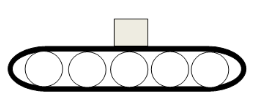
The conveyor belt is designed to transport packages of various weights. Each \[10{\text{kg}}\]package has a coefficient of kinetic friction \[{\text{0}}{\text{.15}}\]. If the speed of the conveyor belt is \[{\text{5m}}{{\text{s}}^{ - 1}}\] and then it suddenly stops, determine the distance the package will slide before coming to rest:
\[(g = 9.8{\text{m}}{{\text{s}}^{{\text{ - 2}}}})\]
A. \[8.5{\text{m}}\]
B. \[8{\text{m}}\]
C. \[10{\text{m}}\]
D. \[6{\text{m}}\]
Answer
 Verified
593.7k+ views
Hint:We are asked to find the distance travelled by the package after the belt is stopped suddenly. There is frictional force, recall the concept and formula of frictional force. Also recall the equations of motion. All these concepts will help you to get the desired result.
Complete step by step answer:
Given, weight of a package \[m = 10{\text{kg}}\]. Coefficient of kinetic friction between the package and the belt, \[{\mu _k} = {\text{5m}}{{\text{s}}^{ - 1}}\]. Speed of the conveyor belt, \[u = {\text{5m}}{{\text{s}}^{ - 1}}\]. Acceleration due to gravity, \[g = 9.8{\text{m}}{{\text{s}}^{{\text{ - 2}}}}\]
Let \[d\] be the distance the package will slide before coming to rest when the belt suddenly stops. We can observe that there is no other force acting on the package other than frictional force when the belt stops. Therefore the acceleration will be only due to the frictional force.
Acceleration can be expressed as force divided by mass of the object. Here the force is frictional force and mass is mass of the package, so acceleration of the package will be
\[a = \dfrac{f}{m}\] (i)
where \[f\] is the frictional force.
Frictional force can be written as,
\[f = {\mu _k}mg\] (ii)
where \[{\mu _k}\] is coefficient of kinetic friction, \[m\] is mass of the object and \[g\] is acceleration due to gravity.
Here, putting the values of \[m\], \[{\mu _k}\], \[g\] in equation (ii), friction force will be,
\[f = {\text{0}}{\text{.15}} \times 10 \times 9.8 \\
\Rightarrow f = 14.7{\text{N}} \]
Putting the value of \[f\] and \[m\] in equation (i), we get
\[a = \dfrac{{14.7}}{{10}} \\
\Rightarrow a = 1.47{\text{m}}{{\text{s}}^{{\text{ - 2}}}} \]
As it is a retarded motion so acceleration will be negative that is \[a = - 1.47{\text{m}}{{\text{s}}^{{\text{ - 2}}}}\]
From third equation of motion, we have
\[{v^2} - {u^2} = 2as\] (iii)
where \[u\] is the initial velocity,\[v\] is the final velocity, \[a\] is the acceleration of the body and \[s\] is the distance travelled.
Here the final velocity is zero as the package stops therefore in this case equation of motion will be
\[{0^2} - {u^2} = 2ad \\
\Rightarrow 2ad + {u^2} = 0 \]
Putting the values of \[u\] and \[a\], we get
\[2 \times ( - 1.47) \times d + {5^2} = 0\]
\[\Rightarrow d = \dfrac{{25}}{{2 \times 1.47}} \\
\Rightarrow d = 8.5{\text{m}} \]
Therefore, distance travelled by the package before it comes to rest is \[8.5{\text{m}}\].
Hence, the correct answer is option A.
Note: Always remember that frictional force acts opposite to the direction of force or we can say it opposes the motion of an object. There are four kinds of frictional forces; static friction, kinetic friction, rolling friction and sliding friction. The friction that keeps an object at rest is static friction. Kinetic friction acts between surfaces when both or any one surface is in motion. Rolling friction is the force that resists the motion when a body rolls. Sliding friction is the friction that acts when two bodies slide over each other.
Complete step by step answer:
Given, weight of a package \[m = 10{\text{kg}}\]. Coefficient of kinetic friction between the package and the belt, \[{\mu _k} = {\text{5m}}{{\text{s}}^{ - 1}}\]. Speed of the conveyor belt, \[u = {\text{5m}}{{\text{s}}^{ - 1}}\]. Acceleration due to gravity, \[g = 9.8{\text{m}}{{\text{s}}^{{\text{ - 2}}}}\]
Let \[d\] be the distance the package will slide before coming to rest when the belt suddenly stops. We can observe that there is no other force acting on the package other than frictional force when the belt stops. Therefore the acceleration will be only due to the frictional force.
Acceleration can be expressed as force divided by mass of the object. Here the force is frictional force and mass is mass of the package, so acceleration of the package will be
\[a = \dfrac{f}{m}\] (i)
where \[f\] is the frictional force.
Frictional force can be written as,
\[f = {\mu _k}mg\] (ii)
where \[{\mu _k}\] is coefficient of kinetic friction, \[m\] is mass of the object and \[g\] is acceleration due to gravity.
Here, putting the values of \[m\], \[{\mu _k}\], \[g\] in equation (ii), friction force will be,
\[f = {\text{0}}{\text{.15}} \times 10 \times 9.8 \\
\Rightarrow f = 14.7{\text{N}} \]
Putting the value of \[f\] and \[m\] in equation (i), we get
\[a = \dfrac{{14.7}}{{10}} \\
\Rightarrow a = 1.47{\text{m}}{{\text{s}}^{{\text{ - 2}}}} \]
As it is a retarded motion so acceleration will be negative that is \[a = - 1.47{\text{m}}{{\text{s}}^{{\text{ - 2}}}}\]
From third equation of motion, we have
\[{v^2} - {u^2} = 2as\] (iii)
where \[u\] is the initial velocity,\[v\] is the final velocity, \[a\] is the acceleration of the body and \[s\] is the distance travelled.
Here the final velocity is zero as the package stops therefore in this case equation of motion will be
\[{0^2} - {u^2} = 2ad \\
\Rightarrow 2ad + {u^2} = 0 \]
Putting the values of \[u\] and \[a\], we get
\[2 \times ( - 1.47) \times d + {5^2} = 0\]
\[\Rightarrow d = \dfrac{{25}}{{2 \times 1.47}} \\
\Rightarrow d = 8.5{\text{m}} \]
Therefore, distance travelled by the package before it comes to rest is \[8.5{\text{m}}\].
Hence, the correct answer is option A.
Note: Always remember that frictional force acts opposite to the direction of force or we can say it opposes the motion of an object. There are four kinds of frictional forces; static friction, kinetic friction, rolling friction and sliding friction. The friction that keeps an object at rest is static friction. Kinetic friction acts between surfaces when both or any one surface is in motion. Rolling friction is the force that resists the motion when a body rolls. Sliding friction is the friction that acts when two bodies slide over each other.
Recently Updated Pages
Master Class 11 Social Science: Engaging Questions & Answers for Success

Master Class 11 English: Engaging Questions & Answers for Success
Master Class 11 Maths: Engaging Questions & Answers for Success
Master Class 11 Chemistry: Engaging Questions & Answers for Success
Master Class 11 Biology: Engaging Questions & Answers for Success
Master Class 11 Physics: Engaging Questions & Answers for Success
Trending doubts
Differentiate between an exothermic and an endothermic class 11 chemistry CBSE
One Metric ton is equal to kg A 10000 B 1000 C 100 class 11 physics CBSE
Difference Between Prokaryotic Cells and Eukaryotic Cells
There are 720 permutations of the digits 1 2 3 4 5 class 11 maths CBSE
Draw a diagram of a plant cell and label at least eight class 11 biology CBSE
1 Quintal is equal to a 110 kg b 10 kg c 100kg d 1000 class 11 physics CBSE