




The compound $buta - 1,2 - dien$ consists of:
A.only $sp - $ hybridized carbon atom
B.only $s{p^2}$ hybridized carbon atom
C.both $sp$ and $s{p^2}$ hybridized carbon atom
D.$sp$ , $s{p^2}$ and $s{p^3}$ hybridized carbon atom
Answer
 Verified
604.8k+ views
Hint:Hybridization can be defined as the mixing of two atomic orbitals with the same energy levels to give a new degenerated type of orbitals. There are different types of hybridization namely: $sp,s{p^2},s{p^3},s{p^3}d$and $s{p^3}{d^2}$ .
Complete step by step answer:
-Hybridization can be defined as the mixing of two atomic orbitals with the same energy levels to give a new degenerated type of orbitals. There are different types of hybridization namely: $sp,s{p^2},s{p^3},s{p^3}d$ and $s{p^3}{d^2}$ .
-We will discuss about each hybridization as follows:
-$sp$ hybridization: In this type of hybridization, one $s$ orbital and one $p$ orbital are mixed together to form a completely new orbital called $sp$ orbital.
It forms linear molecules.
Example of $sp$ hybridization: $Be{F_2},BeC{l_2}$ .
-$s{p^2}$ hybridization: In this type of hybridization, one $s$ orbital and two $p$ orbital are mixed together to form a completely new orbital called $s{p^2}$ orbital.
It forms a trigonal symmetry.
Example of $s{p^2}$ hybridization:$B{F_3},B{H_3}$ .
-$s{p^3}$ hybridization: In this type of hybridization, one $s$ orbital and three $p$ orbital are mixed together to form a completely new orbital called $s{p^3}$ orbital.
It forms a tetrahedron.
Example of $s{p^2}$ hybridization: ethane,methane.
-$s{p^3}d$ hybridization: In this type of hybridization, one $s$ orbital , three $p$ orbital and one $d$ orbital are mixed together to form a completely new orbital called $s{p^3}d $orbital.
It forms a trigonal bipyramidal.
Example of $s{p^2}$hybridization: $PC{l_5}$
-$s{p^3}d$ hybridization: In this type of hybridization, one $s$ orbital , three $p$ orbital and two $d$ orbital are mixed together to form a completely new orbital called $s{p^3}{d^2} $orbital.
It forms an octahedron.
Now, we will discuss about the compound $buta - 1,2 - dien$ :
It is an organic compound and it is the isomer of $1,3 - butadiene$ .
The structure of $buta - 1,2 - dien$ is given below:
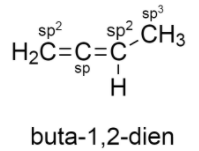
It consists of two double bonds and two sigma bonds.
-$C{H_2}$ is attached to three atoms: two of hydrogen, one to carbon atom. Thus it is $s{p^2}$ hybridized.
-The carbon adjacent to the $C{H_2}$ group also has two double bonds which means it is $sp$ hybridized.
-The carbon that is attached to $C{H_3}$ is $s{p^2}$ hybridized because it is bonded to two carbon atoms and one hydrogen atom.
The carbon atom of $C{H_3}$ is $s{p^3}$ hybridized.
So the correct is option D) $sp$ , $s{p^2}$ and $s{p^3}$ hybridized carbon atoms.
Note:
The basic criteria to check for hybridisation of carbon atoms is to look at the number of bonds it has like if a carbon atom has triple bond it is sp hybridised , if it has double bond it is $s{p^2}$ hybridised and if a carbon atom has only single bonds it is $s{p^3}$ hybridised .
Complete step by step answer:
-Hybridization can be defined as the mixing of two atomic orbitals with the same energy levels to give a new degenerated type of orbitals. There are different types of hybridization namely: $sp,s{p^2},s{p^3},s{p^3}d$ and $s{p^3}{d^2}$ .
-We will discuss about each hybridization as follows:
-$sp$ hybridization: In this type of hybridization, one $s$ orbital and one $p$ orbital are mixed together to form a completely new orbital called $sp$ orbital.
It forms linear molecules.
Example of $sp$ hybridization: $Be{F_2},BeC{l_2}$ .
-$s{p^2}$ hybridization: In this type of hybridization, one $s$ orbital and two $p$ orbital are mixed together to form a completely new orbital called $s{p^2}$ orbital.
It forms a trigonal symmetry.
Example of $s{p^2}$ hybridization:$B{F_3},B{H_3}$ .
-$s{p^3}$ hybridization: In this type of hybridization, one $s$ orbital and three $p$ orbital are mixed together to form a completely new orbital called $s{p^3}$ orbital.
It forms a tetrahedron.
Example of $s{p^2}$ hybridization: ethane,methane.
-$s{p^3}d$ hybridization: In this type of hybridization, one $s$ orbital , three $p$ orbital and one $d$ orbital are mixed together to form a completely new orbital called $s{p^3}d $orbital.
It forms a trigonal bipyramidal.
Example of $s{p^2}$hybridization: $PC{l_5}$
-$s{p^3}d$ hybridization: In this type of hybridization, one $s$ orbital , three $p$ orbital and two $d$ orbital are mixed together to form a completely new orbital called $s{p^3}{d^2} $orbital.
It forms an octahedron.
Now, we will discuss about the compound $buta - 1,2 - dien$ :
It is an organic compound and it is the isomer of $1,3 - butadiene$ .
The structure of $buta - 1,2 - dien$ is given below:
It consists of two double bonds and two sigma bonds.
-$C{H_2}$ is attached to three atoms: two of hydrogen, one to carbon atom. Thus it is $s{p^2}$ hybridized.
-The carbon adjacent to the $C{H_2}$ group also has two double bonds which means it is $sp$ hybridized.
-The carbon that is attached to $C{H_3}$ is $s{p^2}$ hybridized because it is bonded to two carbon atoms and one hydrogen atom.
The carbon atom of $C{H_3}$ is $s{p^3}$ hybridized.
So the correct is option D) $sp$ , $s{p^2}$ and $s{p^3}$ hybridized carbon atoms.
Note:
The basic criteria to check for hybridisation of carbon atoms is to look at the number of bonds it has like if a carbon atom has triple bond it is sp hybridised , if it has double bond it is $s{p^2}$ hybridised and if a carbon atom has only single bonds it is $s{p^3}$ hybridised .
Recently Updated Pages
Master Class 11 Social Science: Engaging Questions & Answers for Success

Master Class 11 English: Engaging Questions & Answers for Success
Master Class 11 Maths: Engaging Questions & Answers for Success
Master Class 11 Chemistry: Engaging Questions & Answers for Success
Master Class 11 Biology: Engaging Questions & Answers for Success
Master Class 11 Physics: Engaging Questions & Answers for Success
Trending doubts
One Metric ton is equal to kg A 10000 B 1000 C 100 class 11 physics CBSE
Difference Between Prokaryotic Cells and Eukaryotic Cells
How many of the following diseases can be studied with class 11 biology CBSE
Two of the body parts which do not appear in MRI are class 11 biology CBSE
Which of the following enzymes is used for carboxylation class 11 biology CBSE
Explain zero factorial class 11 maths CBSE