




The complex numbers ${{z}_{1}},{{z}_{2}},{{z}_{3}}$ are the vertices A, B, C of a parallelogram ABCD, then the fourth vertex D is?
(a) $\dfrac{1}{2}\left( {{z}_{1}}+{{z}_{2}} \right)$
(b) $\dfrac{1}{2}\left( {{z}_{1}}+{{z}_{2}}+{{z}_{3}}+{{z}_{4}} \right)$
(c) $\dfrac{1}{2}\left( {{z}_{1}}+{{z}_{2}}+{{z}_{3}} \right)$
(d) ${{z}_{1}}+{{z}_{3}}-{{z}_{2}}$
Answer
 Verified
528.6k+ views
Hint: Assume the fourth vertex of the parallelogram as ${{z}_{4}}$. Draw a rough diagram of the parallelogram ABCD. Join the diagonals AC and BD and use the fact that the diagonals of a parallelogram bisect each other. Consider this as point O and find the value of this point in terms of complex numbers of the opposite vertices, first with the vertices A and C and second with the vertices B and D. Equate the two relations and find the value of ${{z}_{4}}$ in terms of ${{z}_{1}},{{z}_{2}},{{z}_{3}}$.
Complete step by step solution:
Here we have been provided with a parallelogram ABCD with ${{z}_{1}},{{z}_{2}},{{z}_{3}}$ as the vertices A, B, C respectively. We are asked to determine the fourth vertex D.
Now, let us assume that the fourth vertex of the parallelogram is represented by the complex number ${{z}_{4}}$. Let us draw a diagram of the given situation.
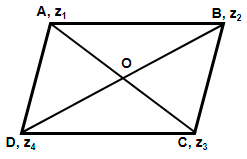
In the above diagram we have joined the diagonals AC and BD of the parallelogram that are intersecting at O. Now, we know that the diagonals of a parallelogram bisect each other. So the value of point O can be given in terms of the complex numbers that represent the opposite vertices.
(1) Considering the vertices A and C we have,
$\Rightarrow O=\dfrac{{{z}_{1}}+{{z}_{3}}}{2}.........\left( i \right)$
(1) Considering the vertices B and D we have,
$\Rightarrow O=\dfrac{{{z}_{2}}+{{z}_{4}}}{2}.........\left( ii \right)$
From equations (i) and (ii) we get,
$\begin{align}
& \Rightarrow \dfrac{{{z}_{1}}+{{z}_{3}}}{2}=\dfrac{{{z}_{2}}+{{z}_{4}}}{2} \\
& \Rightarrow {{z}_{1}}+{{z}_{3}}={{z}_{2}}+{{z}_{4}} \\
& \therefore {{z}_{4}}={{z}_{1}}+{{z}_{3}}-{{z}_{2}} \\
\end{align}$
So, the correct answer is “Option d”.
Note: You can also consider the coordinates of these complex numbers and then use the mid – point formula to get the answer. However it will only increase the steps of the solution. A complex number is denoted as $z=x+iy$ where we can assume x and y as the coordinates on the argand plane. Remember the properties of special quadrilaterals and triangles because they are used in complex numbers.
Complete step by step solution:
Here we have been provided with a parallelogram ABCD with ${{z}_{1}},{{z}_{2}},{{z}_{3}}$ as the vertices A, B, C respectively. We are asked to determine the fourth vertex D.
Now, let us assume that the fourth vertex of the parallelogram is represented by the complex number ${{z}_{4}}$. Let us draw a diagram of the given situation.
In the above diagram we have joined the diagonals AC and BD of the parallelogram that are intersecting at O. Now, we know that the diagonals of a parallelogram bisect each other. So the value of point O can be given in terms of the complex numbers that represent the opposite vertices.
(1) Considering the vertices A and C we have,
$\Rightarrow O=\dfrac{{{z}_{1}}+{{z}_{3}}}{2}.........\left( i \right)$
(1) Considering the vertices B and D we have,
$\Rightarrow O=\dfrac{{{z}_{2}}+{{z}_{4}}}{2}.........\left( ii \right)$
From equations (i) and (ii) we get,
$\begin{align}
& \Rightarrow \dfrac{{{z}_{1}}+{{z}_{3}}}{2}=\dfrac{{{z}_{2}}+{{z}_{4}}}{2} \\
& \Rightarrow {{z}_{1}}+{{z}_{3}}={{z}_{2}}+{{z}_{4}} \\
& \therefore {{z}_{4}}={{z}_{1}}+{{z}_{3}}-{{z}_{2}} \\
\end{align}$
So, the correct answer is “Option d”.
Note: You can also consider the coordinates of these complex numbers and then use the mid – point formula to get the answer. However it will only increase the steps of the solution. A complex number is denoted as $z=x+iy$ where we can assume x and y as the coordinates on the argand plane. Remember the properties of special quadrilaterals and triangles because they are used in complex numbers.
Recently Updated Pages
Master Class 10 Computer Science: Engaging Questions & Answers for Success

Master Class 10 General Knowledge: Engaging Questions & Answers for Success
Master Class 10 English: Engaging Questions & Answers for Success
Master Class 10 Social Science: Engaging Questions & Answers for Success
Master Class 10 Maths: Engaging Questions & Answers for Success
Master Class 10 Science: Engaging Questions & Answers for Success
Trending doubts
What is the median of the first 10 natural numbers class 10 maths CBSE
Which women's tennis player has 24 Grand Slam singles titles?
Who is the Brand Ambassador of Incredible India?
Why is there a time difference of about 5 hours between class 10 social science CBSE
Write a letter to the principal requesting him to grant class 10 english CBSE
A moving boat is observed from the top of a 150 m high class 10 maths CBSE