




The complete reabsorption of glucose takes place in
A) Collecting tubule
B) Distal tubule
C) Proximal convoluted tubule
D) None of the above
Answer
 Verified
531.3k+ views
Hint: The nephron is the kidney's microscopic structure and functional unit. A renal corpuscle and a renal tubule are the two elements that make up the kidney. A tuft of capillaries known as a glomerulus and an encircling Bowman's capsule make up the renal corpuscle. The renal tubule is a tube that runs from the capsule to the kidney.
Complete answer:
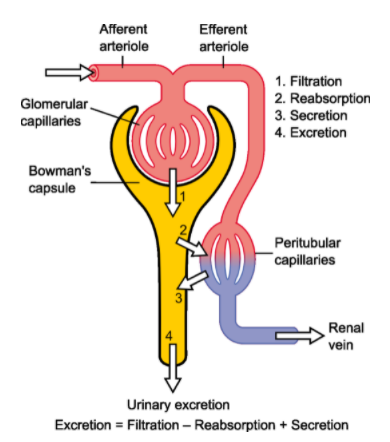
The primary role of the nephron is to remove all waste products from the blood, including solid wastes and excess water, to turn blood into the urine, and to reabsorb, secrete, and excrete a variety of substances.
A tuft of capillaries known as a glomerulus and an encircling Bowman's capsule make up the renal corpuscle. The renal tubule is a tube that runs from the capsule to the kidney.
The glomerulus is the nephron site where fluid and solutes are drained out of the blood to form glomerular filtrate.
- Water and ion reabsorption occurs in the proximal and distal tubules, the circle of Henle, and the collecting ducts.
- The proximal convoluted tubule reabsorbs all of the glucose in the blood through ion cotransport.
- The loop of Henle (also known as the nephron loop) is a U-shaped tube with descending and ascending limbs that vary in permeability.
- The collecting duct and distal convoluted tubule are usually water-impermeable, but this is altered during homeostasis due to hormone stimulation.
- The complete reabsorption of glucose takes place in the proximal part of the tubule.
Thus the correct answer is option ‘C’.
Note: A nephron is the kidney's basic structural and functional unit. Its primary role is to control water and soluble substances in the body by filtering the blood, reabsorbing what is required, and excreting the remainder as urine.
Complete answer:
The primary role of the nephron is to remove all waste products from the blood, including solid wastes and excess water, to turn blood into the urine, and to reabsorb, secrete, and excrete a variety of substances.
A tuft of capillaries known as a glomerulus and an encircling Bowman's capsule make up the renal corpuscle. The renal tubule is a tube that runs from the capsule to the kidney.
The glomerulus is the nephron site where fluid and solutes are drained out of the blood to form glomerular filtrate.
- Water and ion reabsorption occurs in the proximal and distal tubules, the circle of Henle, and the collecting ducts.
- The proximal convoluted tubule reabsorbs all of the glucose in the blood through ion cotransport.
- The loop of Henle (also known as the nephron loop) is a U-shaped tube with descending and ascending limbs that vary in permeability.
- The collecting duct and distal convoluted tubule are usually water-impermeable, but this is altered during homeostasis due to hormone stimulation.
- The complete reabsorption of glucose takes place in the proximal part of the tubule.
Thus the correct answer is option ‘C’.
Note: A nephron is the kidney's basic structural and functional unit. Its primary role is to control water and soluble substances in the body by filtering the blood, reabsorbing what is required, and excreting the remainder as urine.
Recently Updated Pages
Master Class 11 Social Science: Engaging Questions & Answers for Success

Master Class 11 English: Engaging Questions & Answers for Success
Master Class 11 Maths: Engaging Questions & Answers for Success
Master Class 11 Chemistry: Engaging Questions & Answers for Success
Master Class 11 Biology: Engaging Questions & Answers for Success
Master Class 11 Physics: Engaging Questions & Answers for Success
Trending doubts
Differentiate between an exothermic and an endothermic class 11 chemistry CBSE
One Metric ton is equal to kg A 10000 B 1000 C 100 class 11 physics CBSE
Difference Between Prokaryotic Cells and Eukaryotic Cells
There are 720 permutations of the digits 1 2 3 4 5 class 11 maths CBSE
Two of the body parts which do not appear in MRI are class 11 biology CBSE
Which gas is abundant in air class 11 chemistry CBSE