




The common tangents to ${x^2} + {y^2} - 10y = 0$ and ${x^2} + {y^2} + 6y = 0$ form a triangle . Then the correct option is
a.Triangle is isosceles but not equilateral
b.Triangle is equilateral
c.Area of the triangle is ${\left( {15} \right)^{\dfrac{3}{2}}}$ sq. units
d.Area of the triangle is 15 sq. units
Answer
 Verified
628.2k+ views
Hint: We know that the general equation of a circle is ${x^2} + {y^2} + 2gx + 2fy + c = 0$ whose centre and radius is given by $\left( { - g, - f} \right){\text{ and }}\sqrt {{g^2} + {f^2} - c} $.using this we can find the centre and radius of the two circles and by finding the distance between the two centres using the formula$\sqrt {{{\left( {{x_1} - {x_2}} \right)}^2} + {{\left( {{y_1} - {y_2}} \right)}^2}} $ we get that it is equal to the sum of the radii of the circles .Hence the circles touch each other externally and by using the property that the length of tangents from an external point to a circle are equal. we can show that the triangle formed is a isosceles triangle
Complete step-by-step answer:
We are given equations of two circles ${x^2} + {y^2} - 10y = 0$and ${x^2} + {y^2} + 6y = 0$
We know that the general equation of a circle is ${x^2} + {y^2} + 2gx + 2fy + c = 0$
Its centre and radius is given by $\left( { - g, - f} \right){\text{ and }}\sqrt {{g^2} + {f^2} - c} $
Let's consider the circle ${x^2} + {y^2} - 10y = 0$
Here $2g = 0{\text{ and }}2f = - 10$
Hence $g = 0{\text{ and }}f = - 5$
Therefore its centre is $\left( { - g, - f} \right) = \left( {0,5} \right)$
And radius is $\sqrt {{0^2} + {{\left( { - 5} \right)}^2} - 0} = \sqrt {25} = 5units$
Let's consider the circle ${x^2} + {y^2} + 6y = 0$
Here $2g = 0{\text{ and }}2f = 6$
Hence $g = 0{\text{ and }}f = 3$
Therefore its centre is $\left( { - g, - f} \right) = \left( {0, - 3} \right)$
And radius is $\sqrt {{0^2} + {{\left( 3 \right)}^2} - 0} = \sqrt 9 = 3units$
Let's find the distance between the centres
$
\Rightarrow \sqrt {{{\left( {{x_1} - {x_2}} \right)}^2} + {{\left( {{y_1} - {y_2}} \right)}^2}} \\
\Rightarrow \sqrt {{{\left( {0 - 0} \right)}^2} + {{\left( {5 - ( - 3)} \right)}^2}} \\
\Rightarrow \sqrt {{{\left( 8 \right)}^2}} = 8units \\
$
Sum of radii = 5 + 3 =8 units
Therefore the distance between the centres is equal to the sum of their radii
Hence the circles touch each other externally
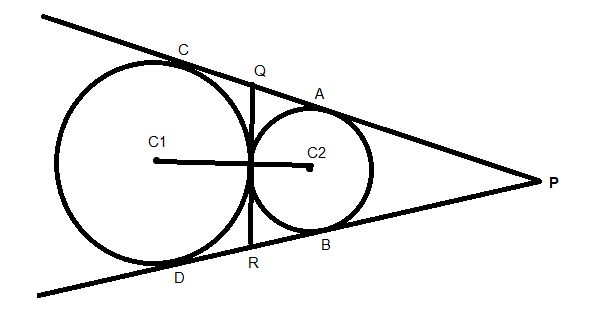
Now the tangents touch the circle ${x^2} + {y^2} - 10y = 0$at C and D and touch the circle ${x^2} + {y^2} + 6y = 0$ at A and B
Let PQR be the triangle formed
By the property ,
The length of tangents from an external point to a circle are equal.
$ \Rightarrow PA = PB$……..(1)
$ \Rightarrow PC = PD$ …….(2)
From this
We get that $AC = BD$ ……..(3)
And $AQ = BR$ ……..(4)
Adding (1) and (4) we get
$
\Rightarrow PA + AQ = PB + BR \\
\Rightarrow PQ = PR \\
$
Therefore we get that the two sides of the triangle PQR are equal .
Hence it is an isosceles triangle
The correct option is a.
Note: The tangent always touches the circle at a single point.
It is perpendicular to the radius of the circle at the point of tangency
It never intersects the circle at two points.
Complete step-by-step answer:
We are given equations of two circles ${x^2} + {y^2} - 10y = 0$and ${x^2} + {y^2} + 6y = 0$
We know that the general equation of a circle is ${x^2} + {y^2} + 2gx + 2fy + c = 0$
Its centre and radius is given by $\left( { - g, - f} \right){\text{ and }}\sqrt {{g^2} + {f^2} - c} $
Let's consider the circle ${x^2} + {y^2} - 10y = 0$
Here $2g = 0{\text{ and }}2f = - 10$
Hence $g = 0{\text{ and }}f = - 5$
Therefore its centre is $\left( { - g, - f} \right) = \left( {0,5} \right)$
And radius is $\sqrt {{0^2} + {{\left( { - 5} \right)}^2} - 0} = \sqrt {25} = 5units$
Let's consider the circle ${x^2} + {y^2} + 6y = 0$
Here $2g = 0{\text{ and }}2f = 6$
Hence $g = 0{\text{ and }}f = 3$
Therefore its centre is $\left( { - g, - f} \right) = \left( {0, - 3} \right)$
And radius is $\sqrt {{0^2} + {{\left( 3 \right)}^2} - 0} = \sqrt 9 = 3units$
Let's find the distance between the centres
$
\Rightarrow \sqrt {{{\left( {{x_1} - {x_2}} \right)}^2} + {{\left( {{y_1} - {y_2}} \right)}^2}} \\
\Rightarrow \sqrt {{{\left( {0 - 0} \right)}^2} + {{\left( {5 - ( - 3)} \right)}^2}} \\
\Rightarrow \sqrt {{{\left( 8 \right)}^2}} = 8units \\
$
Sum of radii = 5 + 3 =8 units
Therefore the distance between the centres is equal to the sum of their radii
Hence the circles touch each other externally
Now the tangents touch the circle ${x^2} + {y^2} - 10y = 0$at C and D and touch the circle ${x^2} + {y^2} + 6y = 0$ at A and B
Let PQR be the triangle formed
By the property ,
The length of tangents from an external point to a circle are equal.
$ \Rightarrow PA = PB$……..(1)
$ \Rightarrow PC = PD$ …….(2)
From this
We get that $AC = BD$ ……..(3)
And $AQ = BR$ ……..(4)
Adding (1) and (4) we get
$
\Rightarrow PA + AQ = PB + BR \\
\Rightarrow PQ = PR \\
$
Therefore we get that the two sides of the triangle PQR are equal .
Hence it is an isosceles triangle
The correct option is a.
Note: The tangent always touches the circle at a single point.
It is perpendicular to the radius of the circle at the point of tangency
It never intersects the circle at two points.
Recently Updated Pages
Master Class 11 English: Engaging Questions & Answers for Success

Master Class 11 Social Science: Engaging Questions & Answers for Success
Master Class 11 Maths: Engaging Questions & Answers for Success
Master Class 11 Biology: Engaging Questions & Answers for Success
Master Class 11 Physics: Engaging Questions & Answers for Success
Master Class 11 Chemistry: Engaging Questions & Answers for Success
Trending doubts
One Metric ton is equal to kg A 10000 B 1000 C 100 class 11 physics CBSE
What is cell theory Who formulated it class 11 biology CBSE
Phyllotaxy is the arrangement of ALeaflets BLeaves class 11 biology CBSE
Difference Between Prokaryotic Cells and Eukaryotic Cells
The symbiotic association of fungi and algae is called class 11 biology CBSE
Cell theory was formulated by A Schleiden and Schwann class 11 biology CBSE