




The colourless plastids are called as……………….and their main function is …………….
(a) Chloroplasts, photosynthesis
(b) Leucoplasts, respiration
(c) Chromoplasts, protection from sunlight
(d) Leucoplasts, storage of food
Answer
 Verified
599.1k+ views
Hint: Plastids are membrane-bound organelles present in eukaryotes which helps in storage and synthesis of various organic compounds. It is mainly found in plant cells and protists and divided into three types on basis of its colour and functions.
Complete Answer:
The colourless plastids are called the leucoplast and their main function is the storage of food. Leucoplast is oval, spherical and rod in shape. It is found in fruits, seeds, tubers, and rhizomes of a plant and mainly stores food in the form of carbohydrates, lipids and proteins.
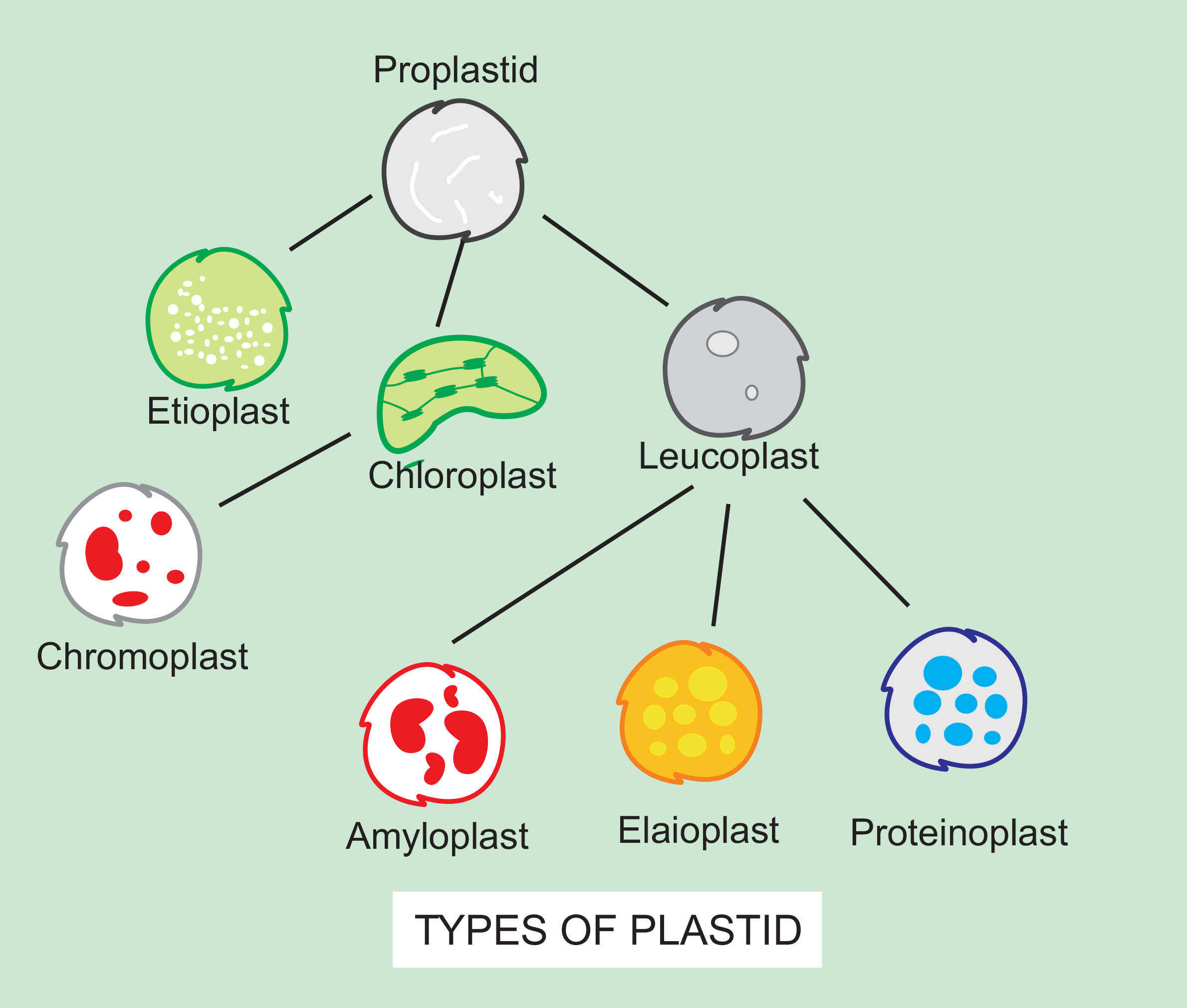
Based on storage, it is divided into amyloplasts, elaioplasts and aleuroplasts. Amyloplasts store starch in the form of simple or compound starch grains, elaioplasts store fats and aleuroplasts store protein in amorphous and crystalloids form.
Additional information: Chromoplasts are coloured plastids with the presence of red, yellow and orange pigments like xanthophyll and phycoerythrin. These pigments are fat-soluble carotenoids which form either from leucoplasts or chloroplasts. It also provides colour to many flowers and fruits.
Chloroplasts are green coloured plastids which help in photosynthesis. It only consists of chlorophyll pigments. Chloroplast helps in the synthesis of organic food from inorganic substances with the help of sunlight. Chloroplast number and size varies from species to species. In case of numbers, it ranges from one chloroplast one cell to hundred of chloroplasts in one cell.
So, the correct answer is ‘(d) Leucoplast, storage of food.’
Note: Plastids are considered as a semi-autonomous organelle due to the presence of its DNA and double membrane-bound organelles. This DNA is mainly found in chloroplast which helps in replication, transcription, synthesis of enzyme and production of proteins. The chloroplast is symbiotic in origin as mitochondria.
Complete Answer:
The colourless plastids are called the leucoplast and their main function is the storage of food. Leucoplast is oval, spherical and rod in shape. It is found in fruits, seeds, tubers, and rhizomes of a plant and mainly stores food in the form of carbohydrates, lipids and proteins.
Based on storage, it is divided into amyloplasts, elaioplasts and aleuroplasts. Amyloplasts store starch in the form of simple or compound starch grains, elaioplasts store fats and aleuroplasts store protein in amorphous and crystalloids form.
Additional information: Chromoplasts are coloured plastids with the presence of red, yellow and orange pigments like xanthophyll and phycoerythrin. These pigments are fat-soluble carotenoids which form either from leucoplasts or chloroplasts. It also provides colour to many flowers and fruits.
Chloroplasts are green coloured plastids which help in photosynthesis. It only consists of chlorophyll pigments. Chloroplast helps in the synthesis of organic food from inorganic substances with the help of sunlight. Chloroplast number and size varies from species to species. In case of numbers, it ranges from one chloroplast one cell to hundred of chloroplasts in one cell.
So, the correct answer is ‘(d) Leucoplast, storage of food.’
Note: Plastids are considered as a semi-autonomous organelle due to the presence of its DNA and double membrane-bound organelles. This DNA is mainly found in chloroplast which helps in replication, transcription, synthesis of enzyme and production of proteins. The chloroplast is symbiotic in origin as mitochondria.
Recently Updated Pages
Master Class 11 English: Engaging Questions & Answers for Success

Master Class 11 Social Science: Engaging Questions & Answers for Success
Master Class 11 Maths: Engaging Questions & Answers for Success
Master Class 11 Biology: Engaging Questions & Answers for Success
Master Class 11 Physics: Engaging Questions & Answers for Success
Master Class 11 Chemistry: Engaging Questions & Answers for Success
Trending doubts
One Metric ton is equal to kg A 10000 B 1000 C 100 class 11 physics CBSE
Difference Between Prokaryotic Cells and Eukaryotic Cells
Find the value of the expression given below sin 30circ class 11 maths CBSE
Difference between physical and chemical change class 11 chemistry CBSE
Two of the body parts which do not appear in MRI are class 11 biology CBSE
Draw a diagram of a plant cell and label at least eight class 11 biology CBSE