



The colour of the final product ‘D’ is:

A.Deep blue
B.Deep orange
C.White
D.Pink
Answer
 Verified
581.1k+ views
Hint: To solve this question, we must proceed with one reaction at a time and proceed with taking into consideration each chemical species and its properties that are being used. The given compound in the question is benzene which undergoes Sandmeyer’s reaction to form diazonium salt.
Complete step by step answer:
Before we move forward with the solution of the given question, let us first understand some important basic concepts.
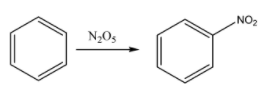
Benzene is an aromatic compound and the reaction of benzene with dinitrogen pentoxide or \[{N_2}{O_5}\] to form a \[N{O_2}\] based compound of benzene. The name of this compound is nitrobenzene. Dinitrogen pentoxide causes the nitration of benzene. The chemical reaction for the same can be given as:
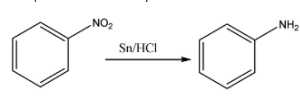
Now, this nitrobenzene is made to react with tin in the presence of hydrochloric acid or HCl. This will result in the substitution of the oxygen atom from the \[N{O_2}\] substituent and result in the formation of an amino functional group. When amine is attached directly to the benzene ring, then that compound is commonly known as aniline. The chemical reaction for the same can be given as:
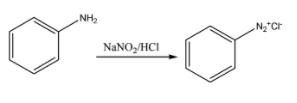
Now, Aniline is made to react with sodium nitrate and HCL. This causes the formation of a compound named benzene diazonium chloride. The chemical reaction for the same can be given as:
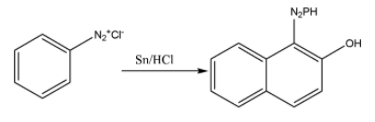
Now, finally, this benzene diazonium chloride is made to react with beta- naphthol. This beta – naphthol couples with the phenyl diazonium electrophile to produce an intense orange-red dye. The chemical reaction for the same can be given as:
Hence, Option B is the correct option
Note:
The orange – yellow dye thus formed is known as Solvent yellow 7. The compound formed is a yellowish orange coloured azo compound, and this entire reaction is base catalysed. Another common name for this compound is aniline yellow.
Complete step by step answer:
Before we move forward with the solution of the given question, let us first understand some important basic concepts.
Benzene is an aromatic compound and the reaction of benzene with dinitrogen pentoxide or \[{N_2}{O_5}\] to form a \[N{O_2}\] based compound of benzene. The name of this compound is nitrobenzene. Dinitrogen pentoxide causes the nitration of benzene. The chemical reaction for the same can be given as:
Now, this nitrobenzene is made to react with tin in the presence of hydrochloric acid or HCl. This will result in the substitution of the oxygen atom from the \[N{O_2}\] substituent and result in the formation of an amino functional group. When amine is attached directly to the benzene ring, then that compound is commonly known as aniline. The chemical reaction for the same can be given as:
Now, Aniline is made to react with sodium nitrate and HCL. This causes the formation of a compound named benzene diazonium chloride. The chemical reaction for the same can be given as:
Now, finally, this benzene diazonium chloride is made to react with beta- naphthol. This beta – naphthol couples with the phenyl diazonium electrophile to produce an intense orange-red dye. The chemical reaction for the same can be given as:
Hence, Option B is the correct option
Note:
The orange – yellow dye thus formed is known as Solvent yellow 7. The compound formed is a yellowish orange coloured azo compound, and this entire reaction is base catalysed. Another common name for this compound is aniline yellow.
Recently Updated Pages
Master Class 12 Economics: Engaging Questions & Answers for Success

Master Class 12 Physics: Engaging Questions & Answers for Success
Master Class 12 English: Engaging Questions & Answers for Success
Master Class 12 Social Science: Engaging Questions & Answers for Success
Master Class 12 Maths: Engaging Questions & Answers for Success
Master Class 12 Business Studies: Engaging Questions & Answers for Success
Trending doubts
What are the major means of transport Explain each class 12 social science CBSE
India is a sovereign socialist secular democratic republic class 12 social science CBSE
How many states of matter are there in total class 12 chemistry CBSE
What are the advantages of vegetative propagation class 12 biology CBSE
Suicide bags of cells are aEndoplasmic reticulum bLysosome class 12 biology CBSE
What is the Full Form of PVC, PET, HDPE, LDPE, PP and PS ?