




The colour code of a resistor is brown , black, and brown. The resistance of the resistor is \[\begin{align}
& \text{A}\text{. }10\Omega \\
& \text{B}\text{. }100m\Omega \\
& \text{C}\text{. }0.1k\Omega \\
& \text{D}\text{. }100+5\% \\
\end{align}\]
Answer
 Verified
663.9k+ views
Hint: The resistor controls the amount of current flow in a circuit. The resistor comes with a predefined value. To determine the value of resistance it is required to understand the colour codes. Generally, 4 band colour codes are used, but sometimes 5 band colour coded resistors were also used. In 4 band 1st 2 bands represent digits, 3rd band represents multiplier, and 4th band represents tolerance. In 5 band type, 1st 3 colour represents the digits 4th colour represents the multiplier and 5th colour represents the tolerance. In three-band colour code, the first two colours represent the digit and the 3rd colour represents the multiplier.
Complete answer:
The following table shows the values of resistance with the respective colour.
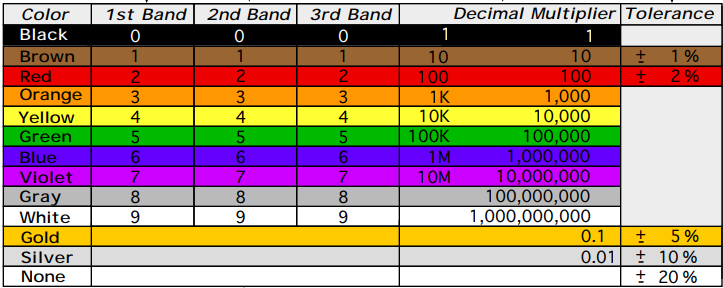
In the given colour combination of brown, black, brown the first two colours represent the digit. So the digit value of the resistance is \[10\] and the multiplier colour is brown so multiply brown’s respective multiplier with the digit value to get the resistance. The multiplier value of brown is $10$
So the resistance is $10\times 10=100\Omega =0.1k\Omega $
So, the correct answer is “Option C”.
Note:
In the colour code of resistance the tolerance means the error in calculating the resistance so we have to add and subtract the tolerance value to get the resistance. Usually, the resistance value of some resistor is too high and can’t be written on the resistor so instead, we use the colour code to calculate the resistance. Using this method we can calculate the resistance of a resistor within seconds without connecting it to a millimeter.
Complete answer:
The following table shows the values of resistance with the respective colour.
In the given colour combination of brown, black, brown the first two colours represent the digit. So the digit value of the resistance is \[10\] and the multiplier colour is brown so multiply brown’s respective multiplier with the digit value to get the resistance. The multiplier value of brown is $10$
So the resistance is $10\times 10=100\Omega =0.1k\Omega $
So, the correct answer is “Option C”.
Note:
In the colour code of resistance the tolerance means the error in calculating the resistance so we have to add and subtract the tolerance value to get the resistance. Usually, the resistance value of some resistor is too high and can’t be written on the resistor so instead, we use the colour code to calculate the resistance. Using this method we can calculate the resistance of a resistor within seconds without connecting it to a millimeter.
Recently Updated Pages
Master Class 12 Physics: Engaging Questions & Answers for Success

Master Class 12 Social Science: Engaging Questions & Answers for Success
Master Class 12 English: Engaging Questions & Answers for Success
Master Class 12 Maths: Engaging Questions & Answers for Success
Master Class 12 Business Studies: Engaging Questions & Answers for Success
Master Class 12 Chemistry: Engaging Questions & Answers for Success
Trending doubts
Draw a labelled sketch of the human eye class 12 physics CBSE
Which are the Top 10 Largest Countries of the World?
Draw ray diagrams each showing i myopic eye and ii class 12 physics CBSE
One megawatt is equal to how many units of electri class 12 physics CBSE
Which is the correct genotypic ratio of mendel dihybrid class 12 biology CBSE
Give 10 examples of unisexual and bisexual flowers