




The closed ring compounds formed by bidentate ligands on binding to metal or metal ions are called:
A. Monodentate
B. Chelates
C. Ambidentate
D. None of these
Answer
 Verified
585.9k+ views
Hint: Recollect coordination chemistry concepts. Recollect the types of ligands and what bidentate ligand is and how can it form closed ring compounds. Take an example and then draw the structure of that complex and then determine what the complex will be known as. Take a look at all the options in the question and then decide the correct answer.
Complete step by step answer:
In coordination compounds, a central metal is bound to ligands in its coordination sphere to form a complex. Ligands can be atoms, ions, or molecules that donate electrons to the metal. And also these complexes can be neutral or charged. Now, we will understand what will happen if the complex is charged or neutral. When a complex is charged it is stabilized by neighbouring counter-ions. We should understand that, in a complex ion there is a metal ion at its centre with a number of other molecules or ions surrounding it. These ligands are attached to central metal by coordinate bonds. Some examples of coordination compounds are $Ni{{(CN)}_{4}}$, ${{K}_{4}}[Fe{{(CN)}_{6}}]$, etc.
Let’s now take a look at the question. A bidentate ligand is a ligand that has two teeth or we can say that, there are two atoms of one ligand that coordinate directly to the central atom in a complex. An example of a bidentate ligand is ethylenediamine. A single molecule of ethylenediamine can form two coordinate bonds with a metal ion. For example, ${{[Ni{{(en)}_{2}}]}^{2+}}$
The structure of ethylenediamine and its bonding is shown below:
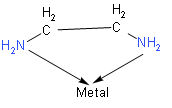
Just look at the structure formed by this ligand. If you look closely, you will find that it seems crab’s claws are folded and holding the metal and the ligand is the crab. Basically the complex has crab-like structure so thus, it is known as chelate. Chelate means Crab-like. Chelates are complexes that are formed when polydentate ligands form complexes with central metal atoms. Some such ligands forming chelates are DMG (dimethylglyoxime) which is bidentate, dien (diethylenetriamine) which is tridentate, EDTA (ethylenediaminetetraacetic acid) which is hexadentate, etc.
So, the correct answer is “Option B”.
Note: Chelates play important roles in oxygen transport and in photosynthesis like in haemoglobin and chlorophyll. And we should know that many biological catalysts (enzymes) are chelates. And also we can say that chelates are also economically important, both as products in themselves and as agents in the production of other chemicals. There is chelation therapy to remove toxic metals from the body.
Complete step by step answer:
In coordination compounds, a central metal is bound to ligands in its coordination sphere to form a complex. Ligands can be atoms, ions, or molecules that donate electrons to the metal. And also these complexes can be neutral or charged. Now, we will understand what will happen if the complex is charged or neutral. When a complex is charged it is stabilized by neighbouring counter-ions. We should understand that, in a complex ion there is a metal ion at its centre with a number of other molecules or ions surrounding it. These ligands are attached to central metal by coordinate bonds. Some examples of coordination compounds are $Ni{{(CN)}_{4}}$, ${{K}_{4}}[Fe{{(CN)}_{6}}]$, etc.
Let’s now take a look at the question. A bidentate ligand is a ligand that has two teeth or we can say that, there are two atoms of one ligand that coordinate directly to the central atom in a complex. An example of a bidentate ligand is ethylenediamine. A single molecule of ethylenediamine can form two coordinate bonds with a metal ion. For example, ${{[Ni{{(en)}_{2}}]}^{2+}}$
The structure of ethylenediamine and its bonding is shown below:
Just look at the structure formed by this ligand. If you look closely, you will find that it seems crab’s claws are folded and holding the metal and the ligand is the crab. Basically the complex has crab-like structure so thus, it is known as chelate. Chelate means Crab-like. Chelates are complexes that are formed when polydentate ligands form complexes with central metal atoms. Some such ligands forming chelates are DMG (dimethylglyoxime) which is bidentate, dien (diethylenetriamine) which is tridentate, EDTA (ethylenediaminetetraacetic acid) which is hexadentate, etc.
So, the correct answer is “Option B”.
Note: Chelates play important roles in oxygen transport and in photosynthesis like in haemoglobin and chlorophyll. And we should know that many biological catalysts (enzymes) are chelates. And also we can say that chelates are also economically important, both as products in themselves and as agents in the production of other chemicals. There is chelation therapy to remove toxic metals from the body.
Recently Updated Pages
Master Class 11 Computer Science: Engaging Questions & Answers for Success

Master Class 11 Business Studies: Engaging Questions & Answers for Success
Master Class 11 Economics: Engaging Questions & Answers for Success
Master Class 11 English: Engaging Questions & Answers for Success
Master Class 11 Maths: Engaging Questions & Answers for Success
Master Class 11 Biology: Engaging Questions & Answers for Success
Trending doubts
One Metric ton is equal to kg A 10000 B 1000 C 100 class 11 physics CBSE
There are 720 permutations of the digits 1 2 3 4 5 class 11 maths CBSE
Discuss the various forms of bacteria class 11 biology CBSE
Draw a diagram of a plant cell and label at least eight class 11 biology CBSE
State the laws of reflection of light
Explain zero factorial class 11 maths CBSE