




The class of phylum protozoa to which Noctiluca belongs is
A. Rhizopoda
B. Sporozoa
C. Mastigophora
D. Ciliata
Answer
 Verified
613.8k+ views
Hint: Protozoans are single-celled eukaryotes that feed on other microorganisms and organic matter. Protozoa is either parasitic or free-living in nature. They possess animal-like characteristics such as the absence of cell wall, motility, and predation.
Complete answer: Noctiluca is more commonly known as Noctiluca scintillans are a species of dinoflagellate that are free-living in nature and dwell in marine habitats. These are non-photosynthetic in nature and engulf microorganisms through phagocytosis. One of the favorite food sources of Noctiluca is considered to be the diatom Thalassiosira. They also feed on bacteria, planktons, other dinoflagellates, fish eggs, and diatoms. The Noctiluca scintillans have a flagellum that is a hair-like structure that facilitates locomotion and is also a distinct identity of the phylum protozoa Mastigophora. They are phyla of single-celled protozoans. Some Mastigophora species have the ability to extend their interior content outward in an arm-like temporary protrusion called the pseudopodia that encapsulate the food and direct it into the microorganism. Approximately, 1500 species of Mastigophora have been recorded. Based on this, the class of phylum protozoa to which Noctiluca belongs is Mastigophora.
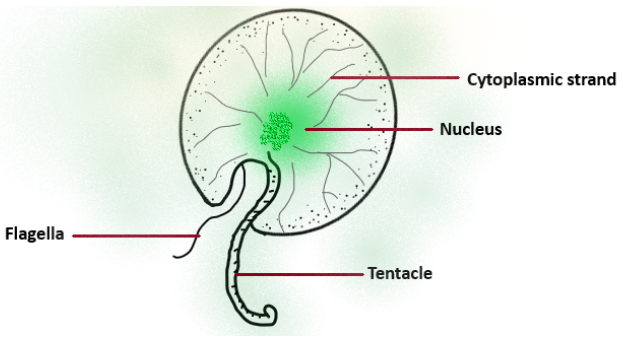
Therefore the correct answer is option C.
Note: Zoologist George August Goldfuss coined the term “Protozoa” in the year 1818. Originally, both single-celled organisms and some lower multicellular organisms were classified under protozoa. This included jellyfish, corals, polychaete worms, bryozoan, sponges, etc. to name a few.
Complete answer: Noctiluca is more commonly known as Noctiluca scintillans are a species of dinoflagellate that are free-living in nature and dwell in marine habitats. These are non-photosynthetic in nature and engulf microorganisms through phagocytosis. One of the favorite food sources of Noctiluca is considered to be the diatom Thalassiosira. They also feed on bacteria, planktons, other dinoflagellates, fish eggs, and diatoms. The Noctiluca scintillans have a flagellum that is a hair-like structure that facilitates locomotion and is also a distinct identity of the phylum protozoa Mastigophora. They are phyla of single-celled protozoans. Some Mastigophora species have the ability to extend their interior content outward in an arm-like temporary protrusion called the pseudopodia that encapsulate the food and direct it into the microorganism. Approximately, 1500 species of Mastigophora have been recorded. Based on this, the class of phylum protozoa to which Noctiluca belongs is Mastigophora.
Therefore the correct answer is option C.
Note: Zoologist George August Goldfuss coined the term “Protozoa” in the year 1818. Originally, both single-celled organisms and some lower multicellular organisms were classified under protozoa. This included jellyfish, corals, polychaete worms, bryozoan, sponges, etc. to name a few.
Recently Updated Pages
Master Class 11 English: Engaging Questions & Answers for Success

Master Class 11 Social Science: Engaging Questions & Answers for Success
Master Class 11 Maths: Engaging Questions & Answers for Success
Master Class 11 Biology: Engaging Questions & Answers for Success
Master Class 11 Physics: Engaging Questions & Answers for Success
Master Class 11 Chemistry: Engaging Questions & Answers for Success
Trending doubts
One Metric ton is equal to kg A 10000 B 1000 C 100 class 11 physics CBSE
Difference Between Prokaryotic Cells and Eukaryotic Cells
Two of the body parts which do not appear in MRI are class 11 biology CBSE
Find the value of the expression given below sin 30circ class 11 maths CBSE
Draw a diagram of a plant cell and label at least eight class 11 biology CBSE
10 examples of friction in our daily life